
Volkswagen Just Bought 62,889,522 Rivian Shares for $1 Billion — And the Form 4 Confirms It's a 10% Owner
Volkswagen's May 4, 2026 Form 4 disclosed a 62.9M share private placemnt acquisition of Rivian Class A stock for ~$1B. Here's why a strategic-partner buy that crosses the 10% threshold is the rarest bullish signal on EDGAR — and what the filing actually says.
Form 4 filings usually come in two flavors. An officer or director buys a few thousand shares, or someone exercises options on schedule. Then there’s the version Volkswagen filed on May 4, 2026: a 62,889,522-share acquisition of Rivian Automotive (NASDAQ: RIVN) Class A common stock — roughly $1 billion of equity, executed by a 10% Owner via a negotiated private placement. That is not an insider’s signaling buy. That is a strategic partner doubling down on the joint venture they already share.
The filing was logged on EDGAR by VOLKSWAGEN AG and Volkswagen US-Holding, Inc., both reporting as 10% Owner. StreetInsider, Investing.com, Stocktitan, and The Globe and Mail picked it up the same day. The news coverage gives you the dollar figure. The Form 4 gives you the ownership math — and the ownership math is what makes this filing different from every other EV-sector buy printed this quarter.
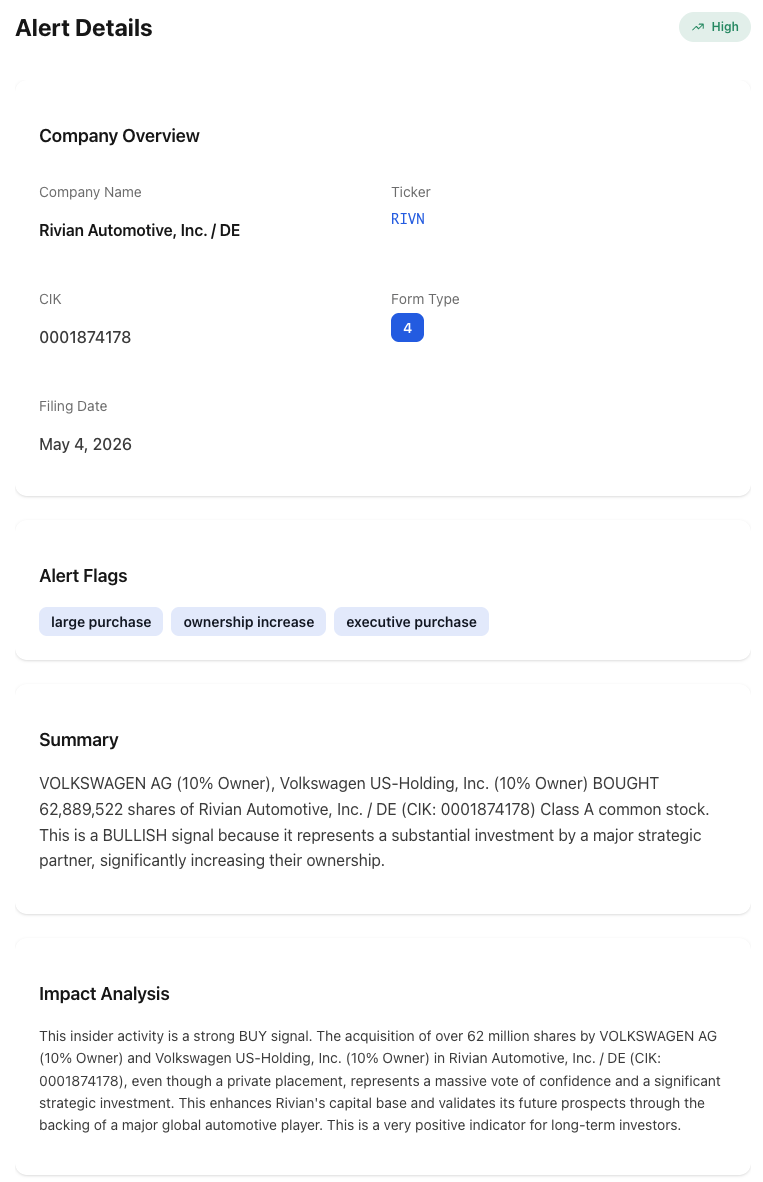
Three flags fired on a single Form 4: large purchase, ownership increase, and executive purchase. That stack is the structural fingerprint of a 10%-owner discretionary buy at scale — not the routine officer-level transaction that dominates the Form 4 feed. The Impact Analysis even calls out the strategic-partner angle directly: this isn’t a financial bet, it’s a JV partner reinforcing the relationship.
Why the 10% Owner Designation Is the Whole Story
Form 4 is filed by three classes of insider: officers, directors, and any beneficial owner of 10%+ of a registered class of equity securities. Volkswagen is filing as the third category. That single check-box on the form changes the interpretation of the trade in three ways:
- The buyer already had board-level visibility. A 10% owner sees information line-officers and 5% holders don’t. A purchase at this scale tells you the entity with the most disclosed insight into Rivian’s near-term trajectory chose to add to the position, not trim it.
- The reporting requirement is automatic and unflinching. Once you cross 10%, every subsequent transaction is publicly logged within two business days. Volkswagen cannot quietly accumulate or distribute from here — every move shows up.
- The “10% Owner” label trips a different alert path than ordinary insider buys. Most Form 4s come from officers under Rule 10b5-1 plans. A 10%-owner discretionary buy outside a plan is the rarer category — and historically the more informative one.
The Form 4 also names Volkswagen US-Holding, Inc. as a co-reporting 10% Owner. That dual filing is the structural fingerprint of a master-subsidiary holding chain: the U.S. holding entity is the registered owner of record, and the parent (Volkswagen AG) is the indirect beneficial owner. Both file because both have reporting obligations under Section 16. The filing economics are transparent — and the filing architecture is what tells you the position is structured for the long haul, not for a near-term flip.
What 62,889,522 Shares Actually Buys
Per StreetInsider’s coverage, Volkswagen paid approximately $1 billion for the block. That implies a per-share price of roughly $15.90 — meaningfully below where RIVN traded through much of 2025, and consistent with a strategic partner negotiating a primary share issuance at a price anchored to the recent depressed trading range. The math is its own signal:
- Block size. 62.89M shares is a primary-issuance block from Rivian to Volkswagen — a negotiated private placement, not a fill scraped together on the tape.
- Strategic partner economics. Volkswagen is already Rivian’s joint-venture partner on shared software and electrical architecture. Adding $1B of equity at a negotiated price strengthens the partner’s incentive alignment — and dilutes any board friction over JV terms going forward.
- The 10% threshold creates voting weight. Crossing 10% is not just a reporting threshold; it is a governance-relevant ownership level. At this size Volkswagen materially shapes the proxy outcome on any shareholder vote where the float is contested.
The Form 4 records the acquisition as a 10%-owner accumulation event — the structural signature of a primary equity issuance to a strategic partner, not a grant, not a plan-driven exercise, and not the routine end-of-month officer-level Form 4 noise. The Impact Analysis on the alert calls this out directly: “even though a private placement, represents a massive vote of confidence and a significant strategic investment.”
Why “10% Owner Buy” Is the Highest-Conviction Form 4 Pattern
Decades of academic research on insider trading converge on the same finding: insider purchases are far more informative than insider sales, and the most informative purchases come from large beneficial owners committing real capital. Volkswagen’s transaction sits at the intersection of all three drivers:
- It’s a buy, not a sell. Insiders sell for hundreds of reasons (diversification, taxes, personal liquidity). They buy for one — they think the stock is going up.
- It’s a 10%-owner buy, not an officer buy. A 10% owner moving size is the institutional analog of a CEO open-market purchase, but at a scale that requires real capital commitment.
- It’s a discretionary capital-allocation decision, not a plan-driven exercise. No 10b5-1 plan triggered this; no grant vested into it. A negotiated primary investment at this size is an active strategic allocation by the partner’s treasury function.
That is why a 62.9M-share Form 4 from a 10% owner deserves a different alert tier than a 5,000-share director buy on a small-cap. Both are technically Form 4 transactions. Only one of them changes the cap table.
What the Sentiment Arc Says About the Setup
A 10%-owner buy at this scale doesn’t drop into a vacuum — it lands on top of a multi-quarter sentiment trajectory that the AI-derived signal track has been building for months:
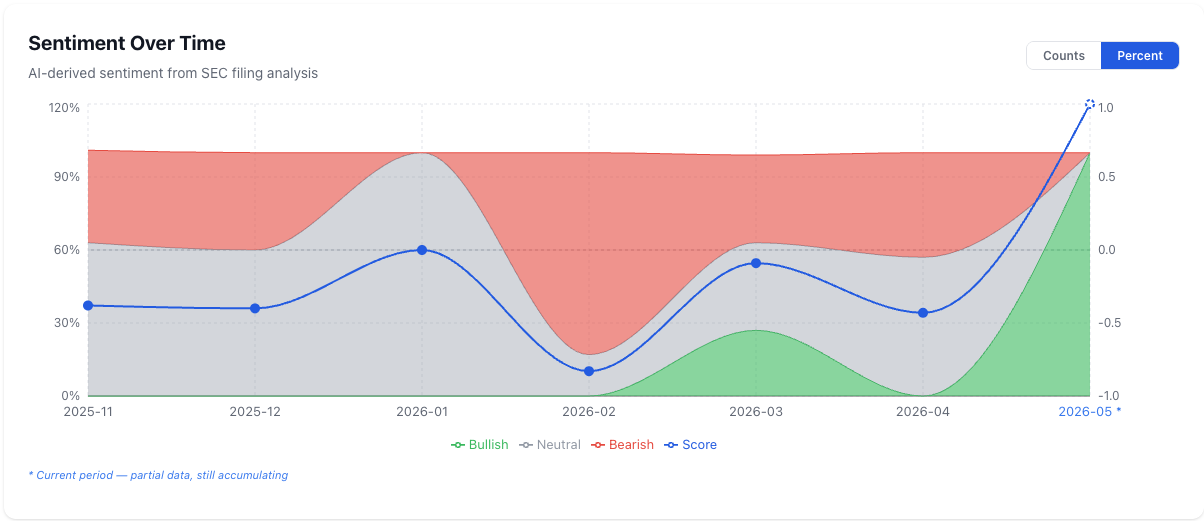
The shape of that line is the part news coverage misses entirely. From November 2025 through April 2026, AI-derived sentiment on Rivian’s filing flow ran neutral-to-bearish — consistent with the equity drawdown that pulled the stock toward the level Volkswagen ultimately bought at. The May 2026 spike is the inflection: a 10%-owner discretionary buy is exactly the kind of filing that flips the multi-quarter sentiment line from defensive to bullish in a single update.
That arc is the difference between a one-day headline and a setup. The Form 4 is the trigger; the sentiment chart is the context that tells you whether the trigger lines up with a trend reversal or just a one-off blip.
What the Strategic-Partner Angle Adds
Volkswagen and Rivian announced a joint venture in 2024 around a shared software architecture and the partnership has been a key anchor for Rivian’s enterprise value. A 10%-owner equity buy from inside that partnership recasts how the JV reads on the balance sheet:
- Equity capital reinforces the JV. A partner adding $1B of equity at the parent level is, in practice, a capital injection into the joint venture’s runway — even if no JV-specific transaction occurred.
- It hardens the strategic relationship against acquirer risk. With a 10% bloc held by Volkswagen, any third-party approach for Rivian has to negotiate around an existing strategic shareholder before reaching the rest of the cap table.
- It compresses the optionality discount on the JV. Markets price strategic partnerships at a discount when partners can walk; an explicit equity stake is the most direct refutation of walk-away risk.
The Form 4 by itself doesn’t say “the JV expanded.” But the implied message — partner adding capital under the same registration name that anchors the JV — is exactly the signal a deal-watcher would want to see in size.
Why This Form 4 Is Easy to Miss in a Manual EDGAR Read
Form 4 is the highest-volume insider-filing form on EDGAR. Every day, hundreds are filed. The vast majority are routine Rule 10b5-1 sales, option exercises, restricted-stock vesting events, and 401(k)-related transactions. A 10%-owner discretionary buy at this scale is genuinely rare — but it shows up in the same daily list as the 5,000-share director purchases and the option-exercise paperwork.
Three filters separate this filing from the noise:
- Reporter capacity = 10% Owner (not officer, not director).
- Transaction type = discretionary acquisition (not grant, not plan-driven option exercise).
- Aggregate dollar size > $100M (filters out routine even at 10%-owner scale).
Run those three filters across EDGAR for any given quarter and the resulting list is short. This Volkswagen / Rivian filing belongs at the top of it.
The most informative Form 4 in any given week is the one filed by a 10% owner who committed real capital for shares they didn’t have to buy. Everything else is paperwork.
What This Looks Like on a NexusAlert Watchlist
If RIVN were on a NexusAlert watchlist heading into May 4, 2026, the Form 4 would have lit up the same day with the full structural metadata parsed:
- Form type — Form 4
- Reporter capacity — 10% Owner (Volkswagen AG; Volkswagen US-Holding, Inc.)
- Transaction type — discretionary acquisition via private placement (not plan, not grant)
- Share count — 62,889,522
- Aggregate value — ~$1.0B
- Flags — large purchase + ownership increase + executive purchase, BULLISH classification
- Severity — High / Opportunity (green up arrow)
The classification logic is what separates the alert from the raw EDGAR feed. A 10%-owner discretionary acquisition at this size is automatically promoted to a top-of-feed signal — the same way a CEO open-market buy on a small-cap would be — because the Form 4 transaction type and reporter capacity together cross the threshold for high-conviction insider activity.
How to Track 10%-Owner Form 4s Without Reading EDGAR All Day
EDGAR publishes Form 4 filings continuously through the trading day. Most readers can’t realistically scan the feed. NexusAlert handles the filtering automatically:
- Parses every Form 4 for reporter capacity, transaction type, and aggregate dollar size
- Distinguishes 10%-owner discretionary acquisitions (open-market or private placement) from officer / director buys and from plan-driven sales
- Flags strategic-partner accumulation patterns (joint-venture partners adding equity at the parent level)
- Cross-links the Form 4 to any related 8-K disclosures or SC 13G/13D filings on the same ticker
- Surfaces the multi-quarter ownership trend in Investor Trends so subscribers see the arc, not just the spike
The Volkswagen / Rivian Form 4 fired as a High-severity Opportunity alert with all of those fields parsed before most secondary commentary appeared.
Catch the Next 10%-Owner $1B Buy the Day It Files
Create a free NexusAlert account to get AI-powered alerts on Form 4 insider-trading filings, 10%-owner accumulation patterns, and strategic-partner equity moves across every public company — with reporter capacity, transaction code, and aggregate value parsed for you in real time.
Sources
Prefer to own it outright? NexusAlert lifetime access is available for a one-time payment of $299 — no subscription, no recurring charges, all future Pro features included. Learn more →