
Michael Saylor's Strategy Just Booked an $8.3 Billion Bitcoin Loss. The Same Filing Shows It Started Selling.
Strategy's Q2 8-K reports an $8.32 billion bitcoin loss, nearly all unrealized, and a quieter detail: it sold 3,588 BTC for $216 million. Analysis by NexusAlert.
The number everyone saw, and the one they missed
Michael Saylor’s company just reported an $8.32 billion loss on its bitcoin for the second quarter of 2026, and $8.31 billion of that was unrealized. The 8-K, filed July 6, 2026, is the kind of headline that lights up fintwit: the loudest corporate bitcoin bull on Earth, nursing an eight-figure paper wound.
But the more useful line in the filing is not the $8 billion. It is buried a few paragraphs down. Strategy $MSTR sold 3,588 bitcoins for about $216 million between June 29 and July 5, and it used the proceeds to fund its preferred stock dividends.
That is the story the headline number hides.
What the filing actually says
Start with the loss, because the size of it is real even if the meaning is not what it looks like. For the three months ended June 30, 2026, Strategy recorded an $8.32 billion loss on digital assets. Of that, $8.31 billion was unrealized and roughly $0.9 million was realized.
Unrealized is the operative word. Under the fair-value accounting rules Strategy now follows, the company marks its bitcoin to market every quarter. When the price sits below what the company paid, the difference lands on the income statement as a loss, whether or not a single coin is sold. As of June 30, the carrying value of the stack was $49.67 billion against a total cost of about $63.94 billion, an average purchase price near $75,578 per coin. Bitcoin spent the quarter trading well under that, so the paper loss ballooned.
The filing also notes that because cost exceeded fair value, Strategy took a full valuation allowance against the related deferred tax assets. In plain terms: it cannot bank a tax benefit on a loss it has not actually taken.
So did Saylor blink? Not exactly, but read closer
Here is the question worth asking honestly: is an $8 billion loss a sign that the bitcoin treasury bet is unraveling?
On the accounting alone, no. A mark-to-market swing is not cash leaving the building, and these losses reverse on paper the moment bitcoin trades back above the cost basis. Strategy has ridden that roller coaster before. The $8.32 billion is volatility wearing the costume of a loss.
The detail that deserves more attention is the sale. Strategy sold 3,588 coins for $216 million, and the filing is explicit that the money went to preferred stock distributions and to replenish its dollar reserve, which stood at $2.55 billion as of July 5. It did this under a bitcoin monetization program that allows the sale of up to $1.25 billion of bitcoin to service those obligations. No shares were sold under the at-the-market program and no buybacks were made in that window.
That is a meaningful shift for a company whose entire brand was built on never selling. When the firm that told the world to hold forever starts trimming the stack to pay its dividend checks, the accounting loss is not the signal. The sale is.
An $8 billion mark-to-market loss is math. Selling bitcoin to cover the dividend is a decision. Only one of those tells you something about the company.
Why NexusAlert flagged it
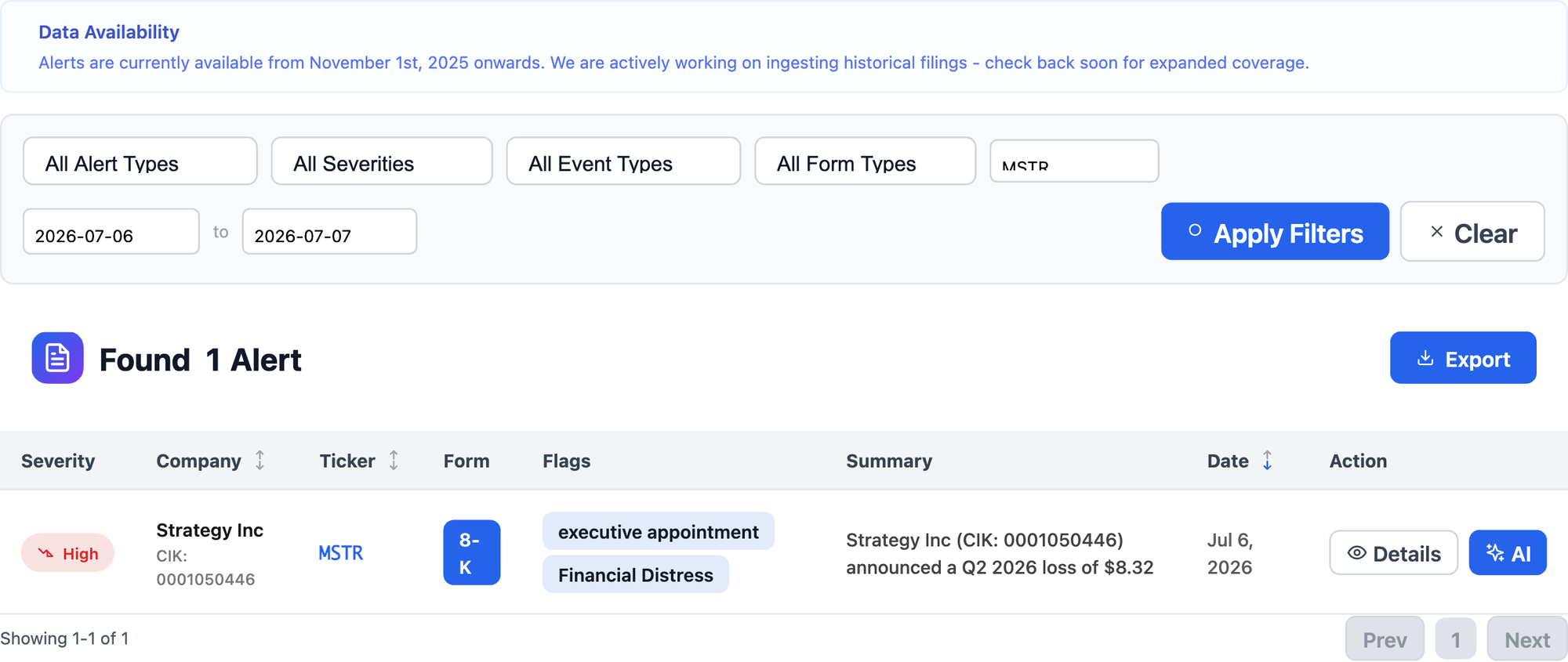
This is exactly the case where a headline and a filing say two different things. The wires ran with the $8.32 billion loss. NexusAlert flagged the 8-K as high severity the same day and pulled the details that matter: the split between unrealized and realized, the 3,588-coin sale and its purpose, the $2.55 billion cash reserve, and even the executive footnote that Andrew Kang was named principal accounting officer effective June 30, succeeding Jeanine Montgomery.
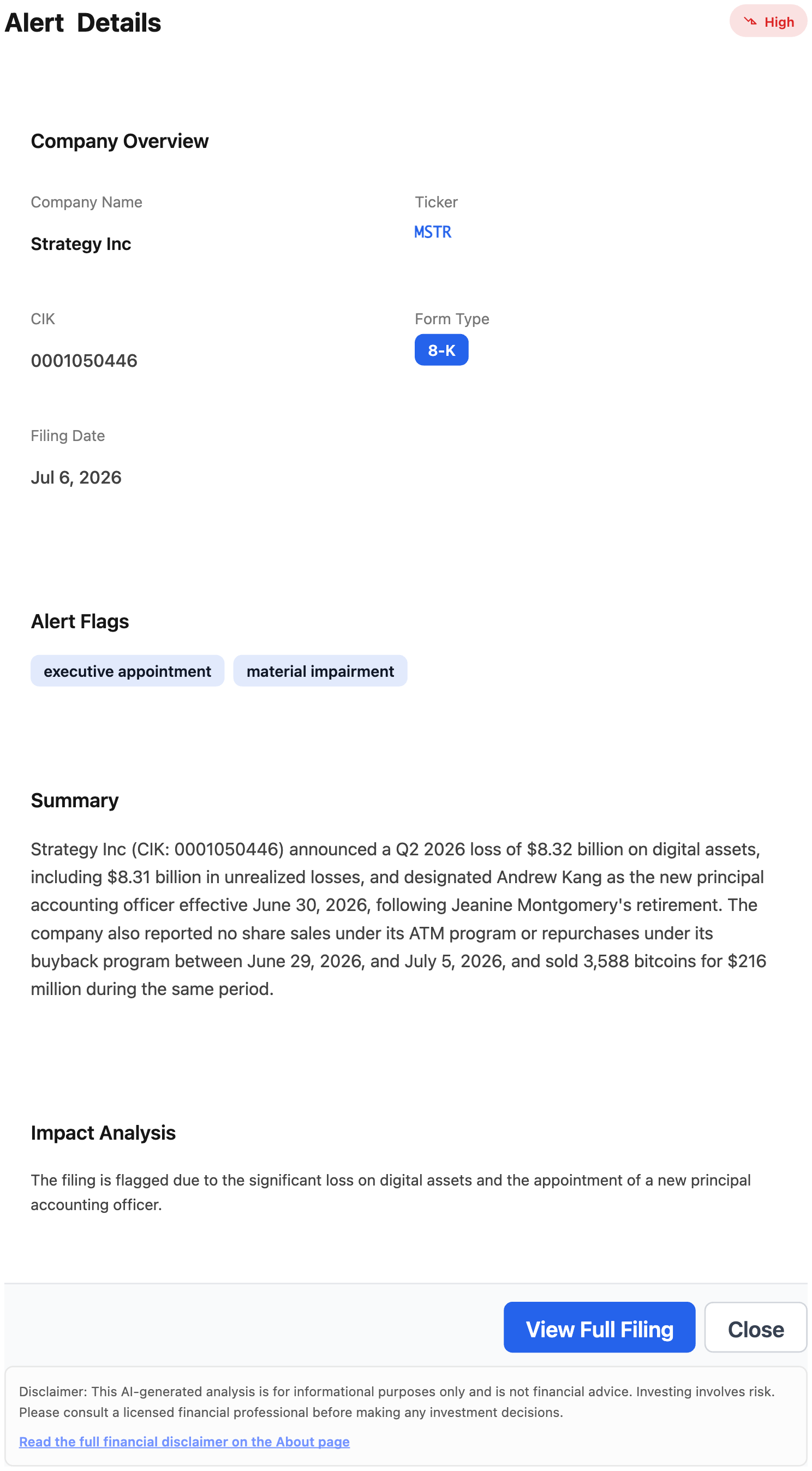
It shows up in the alert feed as a single high-severity row with the financial-distress flag, which is how a filing this dense gets triaged in seconds instead of read cover to cover.
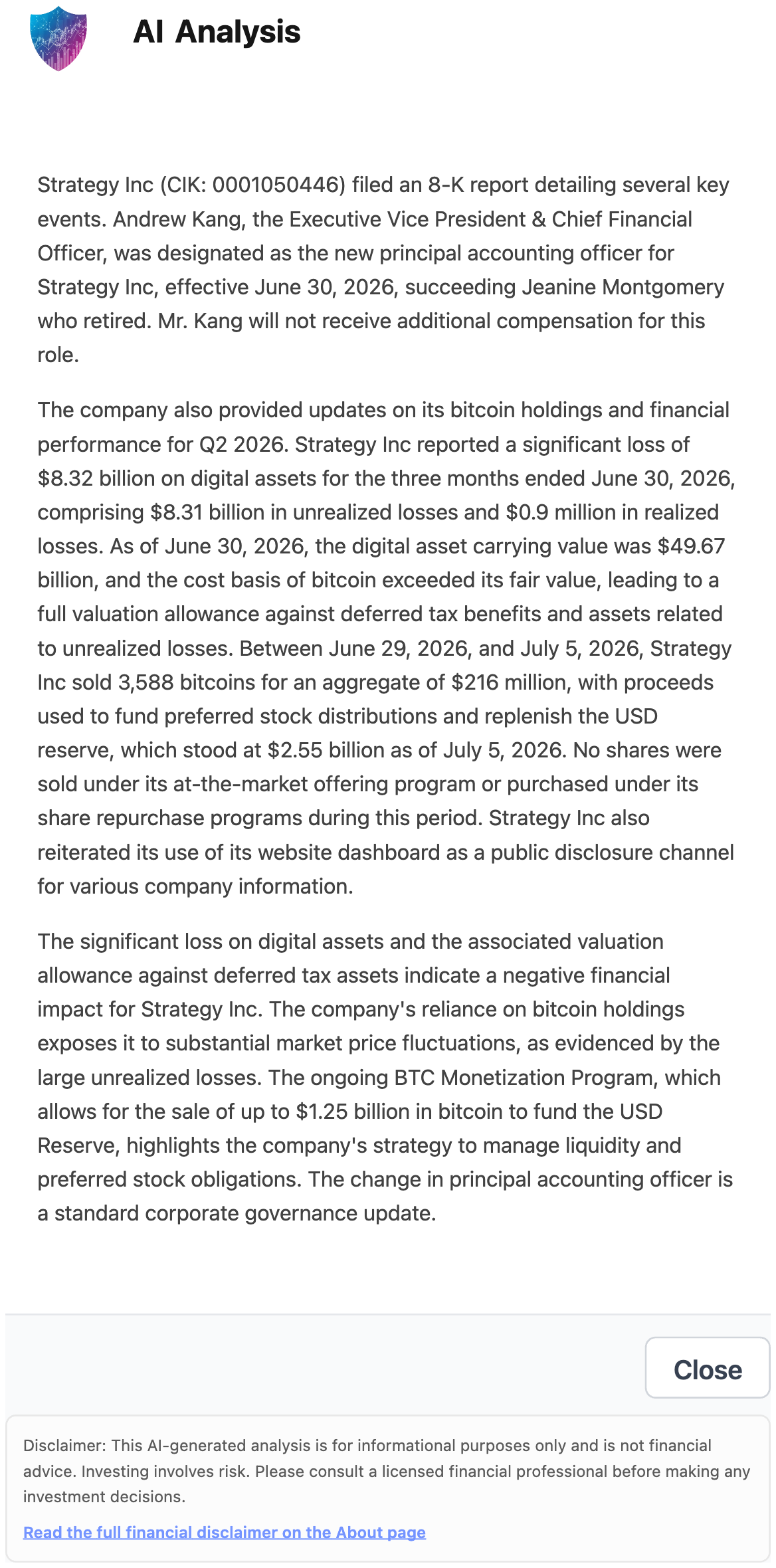
The AI analysis goes a step further, connecting the loss, the valuation allowance, the monetization program, and the dividend obligation into one read.
The lesson that outlasts this filing
The takeaway is not really about Strategy or bitcoin. It is that the biggest number in a filing is often the least informative one, and the number that actually changes your view is the one nobody put in the headline.
Read the whole filing, not the headline. A giant loss can be an accounting artifact. A small sale can be a strategy change. Telling them apart is the entire job.
Create a free NexusAlert account and get the same-day read on the filings that move your names, not just the number that trends.
Sources
- Strategy Inc 8-K, StockTitan
- Strategy stock falls after $8.32B bitcoin loss and BTC sales, Investing.com
- Strategy Shares Slip After Reporting $8.32 Billion Bitcoin Loss and Asset Sales, Yahoo Finance
- Strategy sells bitcoin at a loss to cover preferred stock dividends, Crypto Briefing
- Strategy Bitcoin Reserves Fall to 843,775 BTC After 3,588 BTC Sale for $216M, Coinpaper
Prefer to own it outright? NexusAlert lifetime access is available for a one-time payment of $299 — no subscription, no recurring charges, all future Pro features included. Learn more →