
Allstate Just Told the SEC It Lost $1.72 Billion. That's the Good News.
Allstate filed an 8-K on July 16 reporting $563 million of June catastrophe losses and $1.72 billion for Q2. Last year's Q2 was $1.99 billion. Context changes everything.
A $1.72 billion number landed on the SEC wire at 6am. Nobody wrote about it.
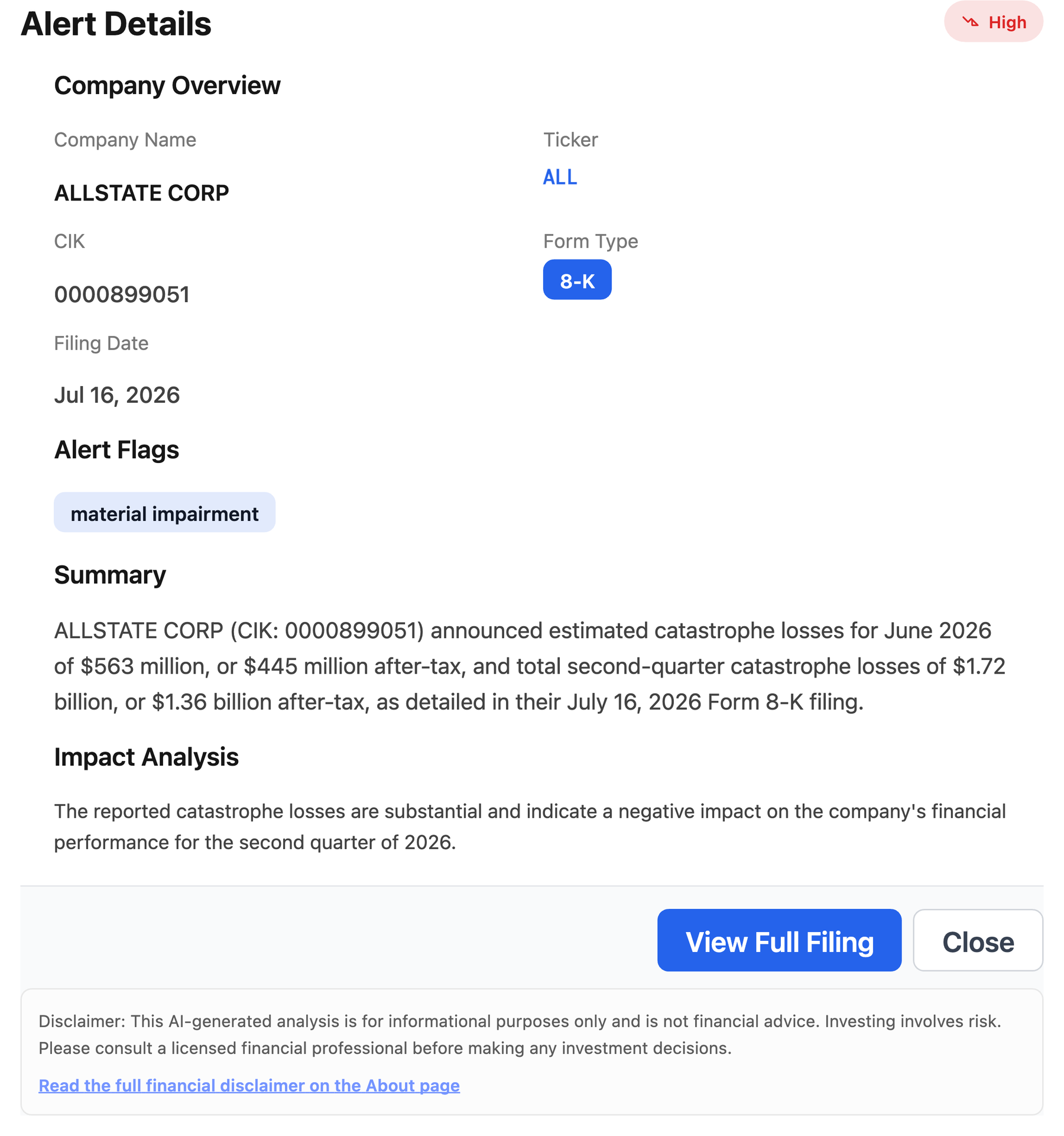
On July 16, 2026, The Allstate Corporation filed an 8-K reporting estimated catastrophe losses for June of $563 million, or $445 million after-tax, bringing total second-quarter catastrophe losses to $1.72 billion, or $1.36 billion after-tax.
There was no CNBC segment. No wire story. Just a press release attached as Exhibit 99 to a routine Item 7.01 filing, sitting on EDGAR before most people had opened their laptops.
NexusAlert tagged it High severity the same morning and pulled all four figures out of the filing.
So is $1.72 billion a disaster?
Here is where most coverage would stop, because the number is big and big numbers feel like news.
But a catastrophe loss figure means nothing without the thing to compare it to. So go get it. Allstate filed the same disclosure last year, in the same form, in the same month.
Q2 2025 catastrophe losses were $1.99 billion, or $1.57 billion after-tax. June 2025 alone was $619 million.
Line them up:
- June 2026: $563 million. June 2025: $619 million.
- Q2 2026: $1.72 billion. Q2 2025: $1.99 billion.
Catastrophe losses are down roughly 14% year over year. The scary headline number is an improvement.
That does not make $1.72 billion free. It is a real cost and it lands on a real quarter. But “Allstate lost $1.72 billion to storms” and “Allstate’s storm losses fell 14%” describe the same filing, and only one of them is the whole picture.
The part almost nobody knows
Here is the misconception worth busting: most investors assume catastrophe losses show up at earnings.
They don’t. Allstate discloses them every single month, in an 8-K, under Item 7.01. April’s number was $870 million. May was $289 million. June was $563 million. Each one filed weeks before the quarter closed, each one public, each one free.
By the time the figure reaches the earnings call, it isn’t news. It has been sitting on EDGAR for a month.
You can see the cadence in the filing mix itself. Regulation FD disclosures are Allstate’s second-most-common event filing over the trailing twelve months, ten of them, which is close to one a month.
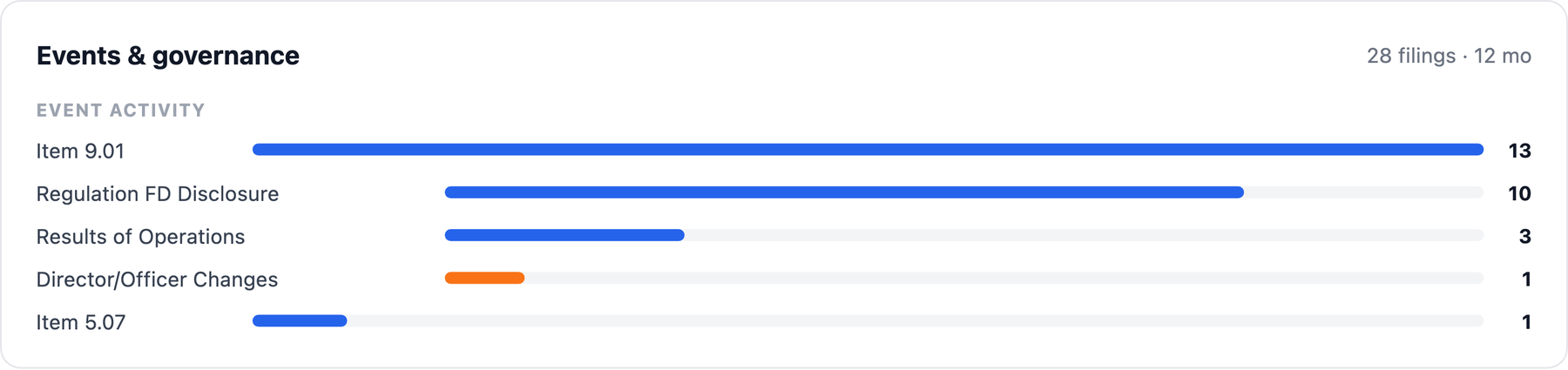
That is the actual signal in this story. Not the loss. The rhythm.
What to watch
The April figure did the damage this quarter, not June. $870 million in one month, against $563 million in June, tells you the quarter was front-loaded by spring wind and hail rather than steadily bleeding.
Allstate’s Q2 earnings release will restate all of this in a few weeks. Everything material in it about catastrophe losses is already public, in three separate 8-Ks, and has been for a month.
A big number is not a bad number until you have something to compare it to. The comparison was one filing away.
This is the part of the market that rewards reading rather than reacting. NexusAlert watches EDGAR so the Item 7.01 filing nobody covered still reaches you the morning it lands, summarized, with the figures pulled out. The Company Dossier keeps the twelve-month filing history next to it so the context takes seconds instead of an afternoon.
Create a free NexusAlert account
Sources
- Allstate Form 8-K filed July 16, 2026 (Exhibit 99, June 2026 Monthly Release)
- Allstate Form 8-K filed July 17, 2025 (Exhibit 99, June 2025 Monthly Release)
- Allstate May 2026 Monthly Release, filed June 18, 2026
- May 2026 Monthly Release, Allstate Newsroom
- April 2026 Monthly Release, Allstate Newsroom
- Allstate Corporation EDGAR filing index
- Alert and Dossier data: NexusAlert (app.nexus-alert.com), accessed July 16, 2026.
Prefer to own it outright? NexusAlert lifetime access is available for a one-time payment of $299 — no subscription, no recurring charges, all future Pro features included. Learn more →