
Rocket Lab Is Buying Iridium for $8 Billion. Only Half Is Cash.
Rocket Lab is acquiring Iridium for $54 a share, but only $27 of that is cash. Here is what the 8-K reveals about the other half. Analysis by NexusAlert.
A rocket company just agreed to buy the satellite phone company
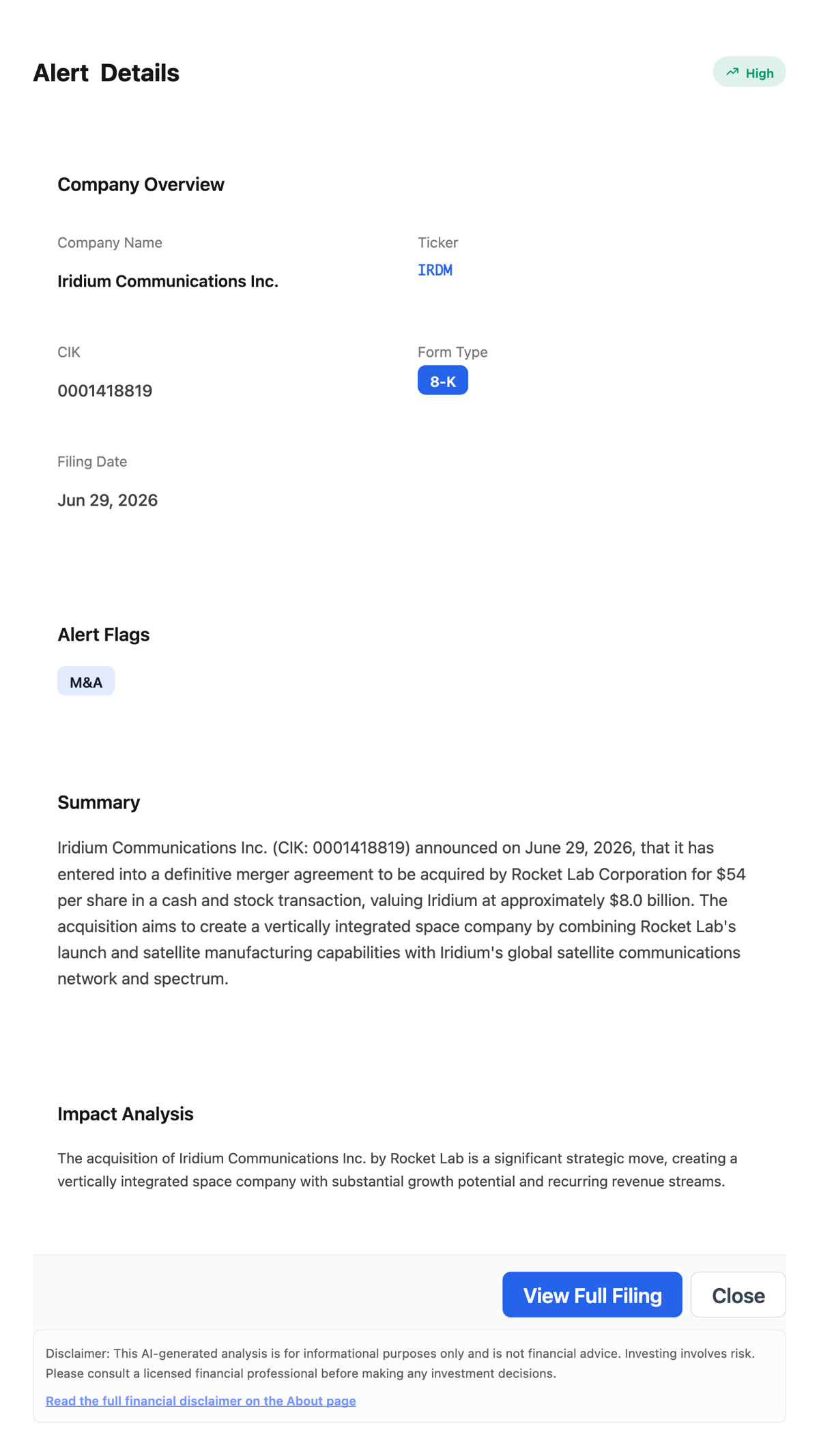
On June 29, 2026, Rocket Lab agreed to acquire Iridium Communications, the company behind the satellite phones that work where cell towers do not, in a deal that values Iridium at roughly $8.0 billion. Iridium shareholders are being offered $54 per share, and the 8-K hit IRDM the same morning the news broke on Bloomberg.
A launch-and-satellite-manufacturing company buying a global satellite network is the kind of headline that lights up fintwit. The space economy has a recognizable name on both sides, and “$8 billion space megadeal” is easy to share. So is the easy assumption that comes with it: that Iridium holders are about to be handed $8 billion in cash.
They are not. And the gap between the headline and the filing is the whole story.
What the 8-K actually says
The structure is $27.00 in cash plus Rocket Lab stock for each Iridium share, with the stock leg targeting another $27 of value to reach the headline $54. That is a cash-and-stock deal, not a cash buyout.
So roughly half of what an Iridium holder receives is not money. It is shares in Rocket Lab. That turns the question from “what is my payout” into “what is Rocket Lab worth, and what will it be worth when this closes.”
A cash-and-stock price is a sticker, not a guarantee. The cash half is fixed. The stock half rides on the buyer.
Why the other half is a bet, not a payout
The stock portion comes with a price collar, banded between $67.50 and $112.50 on Rocket Lab shares. A collar adjusts the exchange ratio inside that band so the stock leg holds its targeted value, but if Rocket Lab trades outside the band, the value an Iridium holder ultimately pockets can move with it. In plain terms, the floor and ceiling protect part of the value, not all of it.
Rocket Lab also lined up financing to cover the cash it owes: a $3.6 billion 364-day senior secured bridge term loan, alongside other debt and balance-sheet cash. That is a lot of leverage stacked against a deal that is not expected to close until mid-2027, pending Iridium shareholder approval plus antitrust and communications-regulatory clearances.
A year of regulatory review, a leveraged buyer, and half the consideration in a volatile space stock. None of that is a reason the deal fails. It is a reason the $54 number on the press release is the start of the analysis, not the end of it.
The bigger picture
Strategically, the logic is clean. Rocket Lab gets a working global satellite network and spectrum to pair with its launch and manufacturing. Iridium gets scale and a path into a vertically integrated space company. Both tickers will trade on it, which is why the cashtags here are $RKLB for the buyer and $IRDM for the target.
But the part that moves money is in the mechanics. A retail investor reading “$8 billion, $54 a share” and a retail investor reading “$27 cash plus a collared stock leg financed with a $3.6 billion bridge loan, closing in 2027” are making two very different decisions about the same deal.
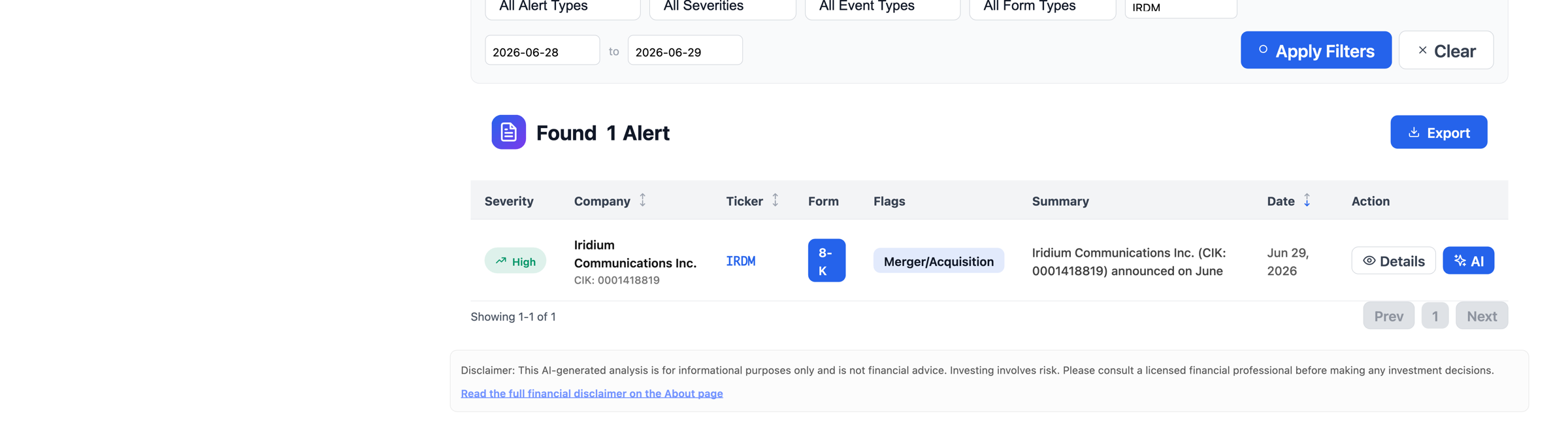
This is exactly the wedge NexusAlert is built for. The headline tells you a deal happened. The 8-K tells you what kind of deal it is. NexusAlert flagged the Iridium filing as a High-severity Merger and Acquisition event the morning it posted, decomposed the consideration, and summarized the structure so the cash-versus-stock split was visible without reading the full agreement.
The lesson
Read the structure, not the sticker. In a cash-and-stock deal, the price on the press release is a target, and half of it can ride on the buyer’s stock for a year before anyone gets paid. The investors who know that before the close are the ones reading the filing.
Create a free NexusAlert account and get the deal mechanics the morning they file, not the week they trend.
Sources
Prefer to own it outright? NexusAlert lifetime access is available for a one-time payment of $299 — no subscription, no recurring charges, all future Pro features included. Learn more →