
Kroger Is Buying Giant Eagle for $1.65 Billion. Only $1.25 Billion Is Cash.
Kroger is buying Giant Eagle for $1.65 billion, but only $1.25 billion is cash. The 8-K flags store divestitures and a 2027 close. Analysis by NexusAlert.
The grocery chain that millions of shoppers in Ohio and Pennsylvania know by name just changed hands. On July 1, 2026, Kroger (NYSE: KR) filed an 8-K disclosing an agreement to acquire Giant Eagle for approximately $1.65 billion, and the headline number is the first thing most readers will get wrong. The $1.65 billion is not a $1.65 billion check. It is $1.25 billion in cash plus roughly $400 million in assumed liabilities.
That distinction is the whole story, and it is sitting in the body of the filing rather than the headline. NexusAlert flagged the KR 8-K as a High-severity M&A alert the same day it hit SEC EDGAR, with the deal structure already parsed out of the filing text.
What NexusAlert Surfaced on Filing Day
The alert landed as a single High-severity row for KR, flagged M&A, with the AI summary pulling the exact consideration split, the close timeline, and the regulatory conditions straight out of the 8-K.
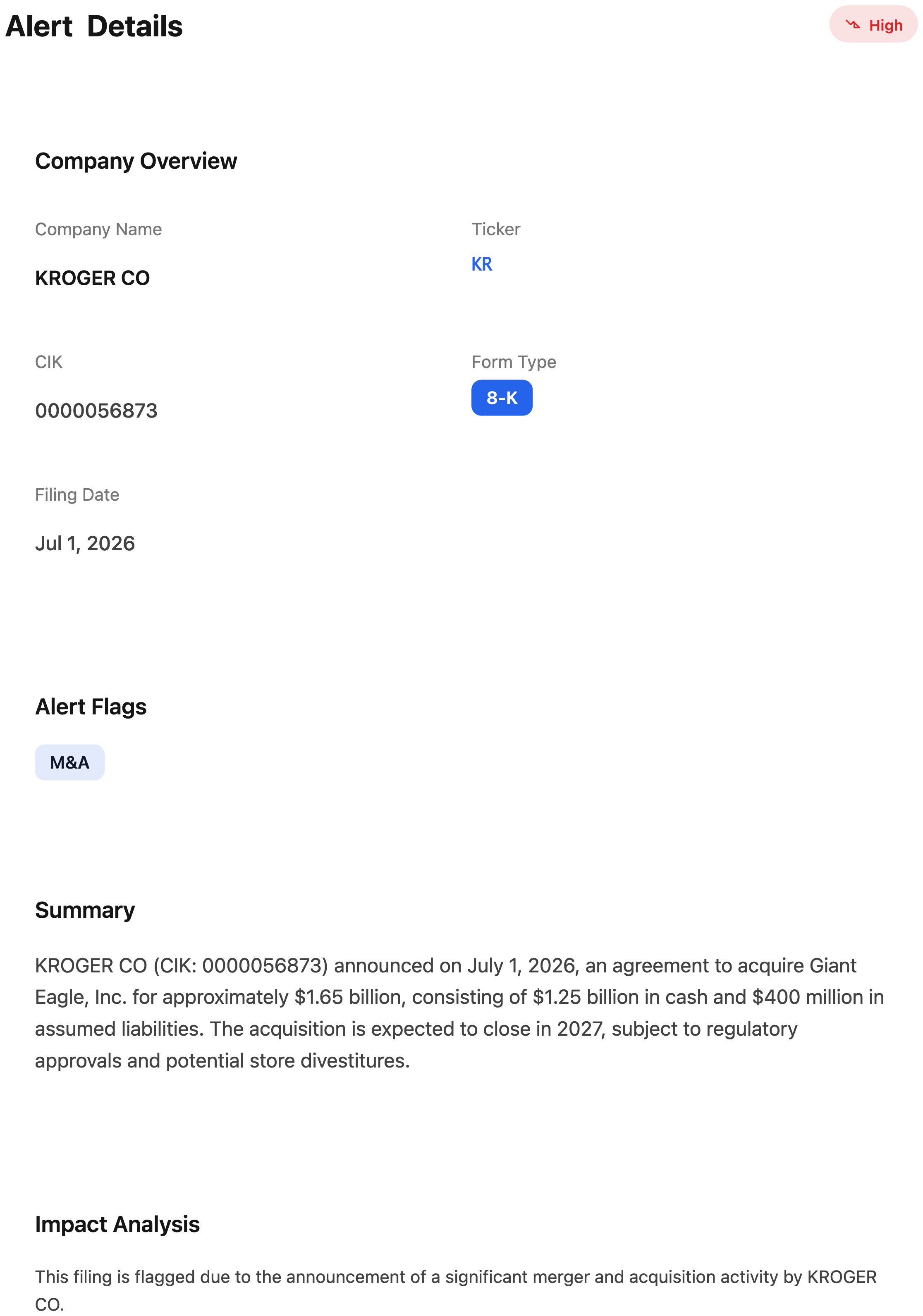
Company, ticker, CIK, form type, filing date, the M&A flag, and the AI summary in one branded card. The summary does the first-pass reading so an investor does not have to open the 8-K to know the deal is cash-plus-liabilities, not all cash, and that it will not close until 2027.
What the 8-K Actually Discloses
The filing lands under Item 8.01. The core terms are short and specific.
The consideration is $1.25 billion in cash and approximately $400 million in assumed liabilities, for a total deal value of about $1.65 billion. Giant Eagle is a family-owned food and pharmacy retailer headquartered in Pittsburgh that runs roughly 197 supermarkets and 11 standalone pharmacies across northern Ohio, western Pennsylvania, West Virginia, Maryland, and Indiana, generating about $9 billion in annual sales. The transaction is expected to close in 2027, subject to the expiration or termination of the Hart-Scott-Rodino antitrust waiting period and other customary conditions.
The detail that deal-day coverage tends to skip: Kroger and Giant Eagle already expect to divest a limited number of Giant Eagle stores to get the transaction through review. Neither side put a number on it, but the fact that store divestitures are named in the announcement itself, before any regulator has weighed in, tells you both sides know overlap is coming.
Why the Cash Split Changes the Read
A $1.65 billion sticker price and a $1.25 billion cash outlay are not the same commitment. Assuming $400 million of a target’s liabilities means Kroger takes on existing obligations rather than writing a larger check, which keeps more of Kroger’s balance sheet free while still getting the stores. For a company that just spent 2024 and 2025 recovering from a collapsed megadeal, the smaller cash figure is the point, not a footnote.
Why Kroger Is Buying Giant Eagle Now
This is the first major acquisition under Kroger CEO Greg Foran, and the first since the company’s roughly $25 billion merger with Albertsons fell apart in 2024. After a deal that size failed on antitrust grounds, a $1.65 billion regional tuck-in is a very different kind of move: small enough to clear review, large enough to add real density in the Midwest and Mid-Atlantic where Giant Eagle is already a household name.
There is a neat symmetry hiding in the timeline. Giant Eagle sold its GetGo convenience-store business, roughly 270 GetGo and WetGo locations, to Alimentation Couche-Tard for about $1.6 billion in 2025. A year later, the remaining supermarket-and-pharmacy business is going to Kroger for about $1.65 billion. The family-owned grocer effectively unbundled itself, monetizing the fuel-and-convenience arm first and the core grocery banner second.
The Regulatory Catch Is the Real Timeline
The 8-K says 2027, and the Hart-Scott-Rodino reference explains why. Grocery M&A has been the single hardest retail category to get past antitrust regulators in the current cycle, and Kroger learned that firsthand when the Albertsons deal died. Naming store divestitures up front is a signal that Kroger is trying to pre-negotiate the antitrust concession into the deal narrative from day one rather than fighting it later.
A headline that reads “$1.65 billion acquisition” hides three things the 8-K spells out: only $1.25 billion is cash, the close is more than a year away, and stores will be sold to get it done. Read the whole filing, not the headline.
How NexusAlert Read This Filing
Opening the alert into the SEC Filing Viewer puts the primary 8-K and the AI analysis side by side, so the deal economics, the Hart-Scott-Rodino conditions, and the divestiture risk are all readable without leaving the platform.
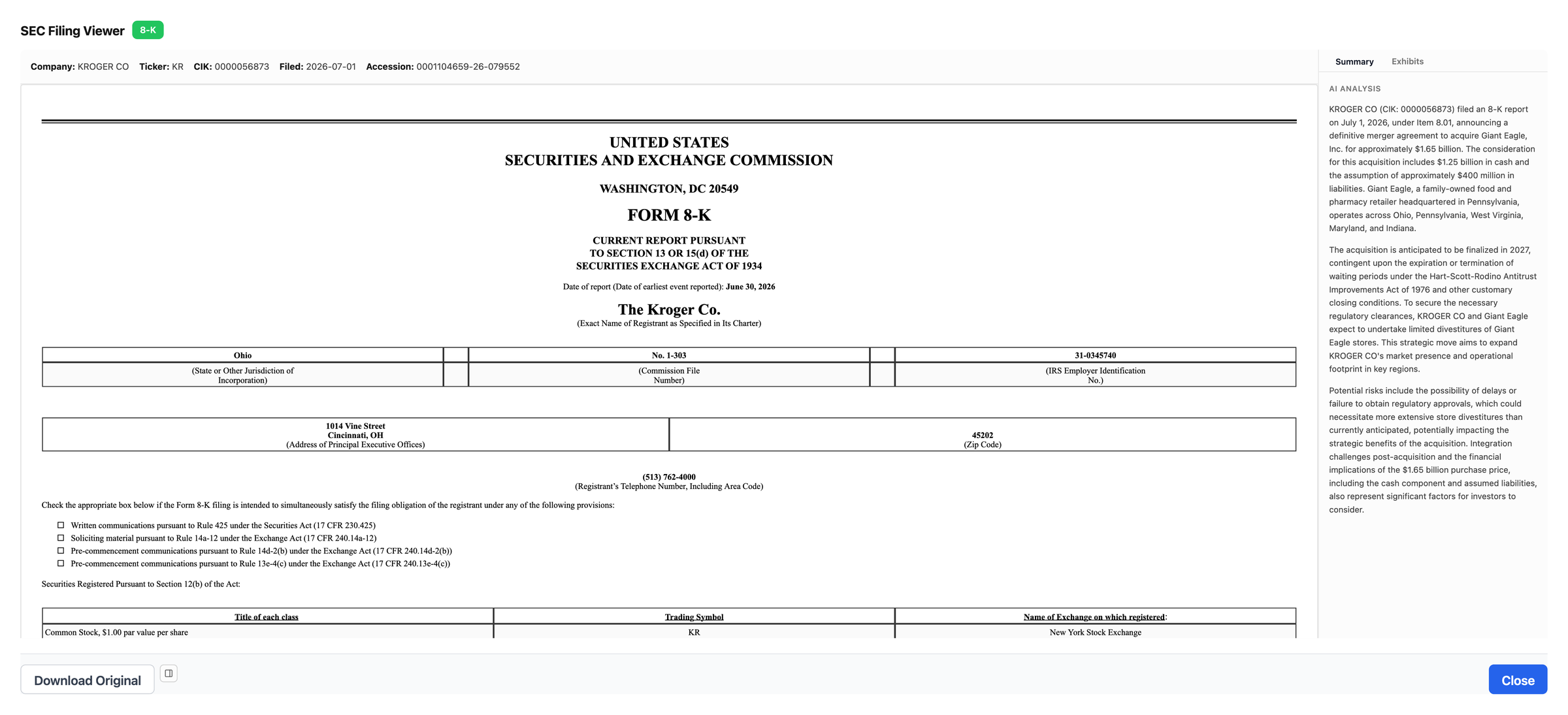
The AI analysis does not just restate the press release. It names the specific antitrust mechanism (the Hart-Scott-Rodino waiting period), the regulatory clearance path, and the integration and purchase-price risks tied to the cash-plus-liabilities structure. That is the read most deal coverage will not print on filing day, because it requires actually parsing the 8-K rather than the wire summary.
For a retail investor watching either Kroger or the grocery sector, the value is timing and precision: the exact consideration split, the real close timeline, and the divestiture flag, delivered the same day the filing posted, before the story fully develops in the financial press.
Start Tracking Same-Day M&A Filings
Create a free NexusAlert account to get same-day alerts on 8-K merger announcements, the exact deal structures buried inside them, and the regulatory conditions that set the real timeline.
Sources
- Kroger to buy grocer Giant Eagle in $1.65 billion deal as competition heats up, CNBC
- Kroger Announces Agreement to Acquire Giant Eagle, Kroger Investor Relations
- Kroger to acquire Giant Eagle for $1.65B, Supermarket News
- Giant Eagle will retain its name and Pittsburgh headquarters after $1.65 billion sale to Kroger, CBS Pittsburgh
- Kroger to buy Giant Eagle for $1.65 billion, Axios Pittsburgh
- Kroger Co. Form 8-K, July 1, 2026, SEC EDGAR
- NexusAlert daily news-correlation report, July 2, 2026, internal
Prefer to own it outright? NexusAlert lifetime access is available for a one-time payment of $299 — no subscription, no recurring charges, all future Pro features included. Learn more →