
10 Kratos Defense Insiders Filed Sales in 3 Weeks — While the Stock Dropped 30%
14 unique insiders, $144M in net selling, and a bearish AI sentiment score. The Form 4 filings told the whole story — if you were watching.
Defense stocks have been on a tear. Geopolitical tensions, rising government spending, and the drone warfare boom pushed Kratos Defense & Security Solutions ($KTOS) above $95 in mid-March. By April 10, the stock was trading near $68.
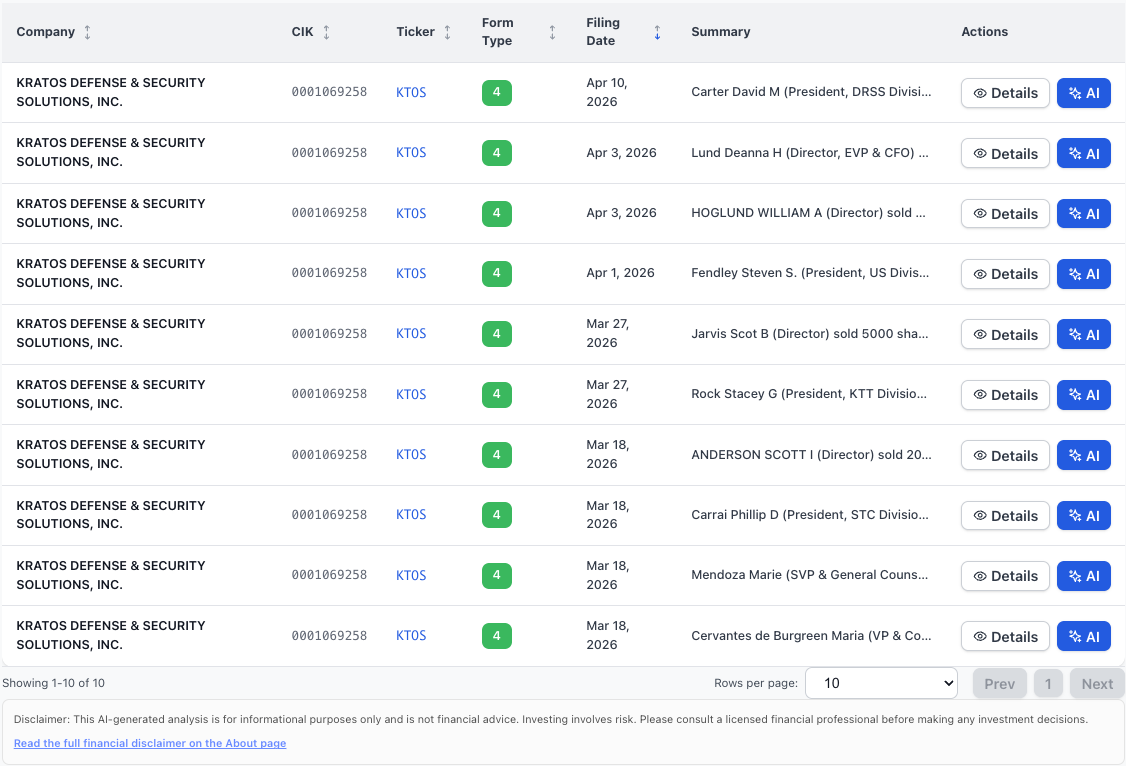
During that same window, 10 Form 4 insider sales were filed with the SEC. Not one insider. Ten filings across three weeks — from the CFO, division presidents, directors, a general counsel, and VPs.
The Selling Timeline
Here’s the sequence, all pulled from SEC Form 4 filings:
March 18: Four insiders filed on the same day. SVP & General Counsel Mendoza Marie sold shares. President Phillip Carrai (STC Division) sold shares. Director Scott Anderson sold shares. VP & Corporate Controller Maria Cervantes de Burgreen sold shares.
March 27: Director Scot Jarvis sold 5,000 shares. President Stacey Rock (KTT Division) sold shares the same day.
April 1: President Steven Fendley (US Division) sold shares under a pre-arranged 10b5-1 plan.
April 3: CFO Deanna Lund (Director, EVP & CFO) sold shares. Director William Hoglund also sold the same day.
April 10: Division President David Carter (DRSS Division) sold 4,000 shares at prices between $72.67 and $77.85 under a 10b5-1 plan adopted in June 2025.
That’s 10 Form 4 filings from senior leadership in a three-week window — presidents, directors, C-suite, general counsel, and VPs — all reducing their personal exposure during a steep price decline.
The Bigger Picture: $144 Million in Net Selling
The individual filings are just the surface. When we pulled up the Investor Trends page for $KTOS on NexusAlert, the numbers were striking:
- $144.3 million in net selling
- 1.8 million shares sold against 1.3 million bought
- 14 unique insiders participating
- $0 bought on the open market
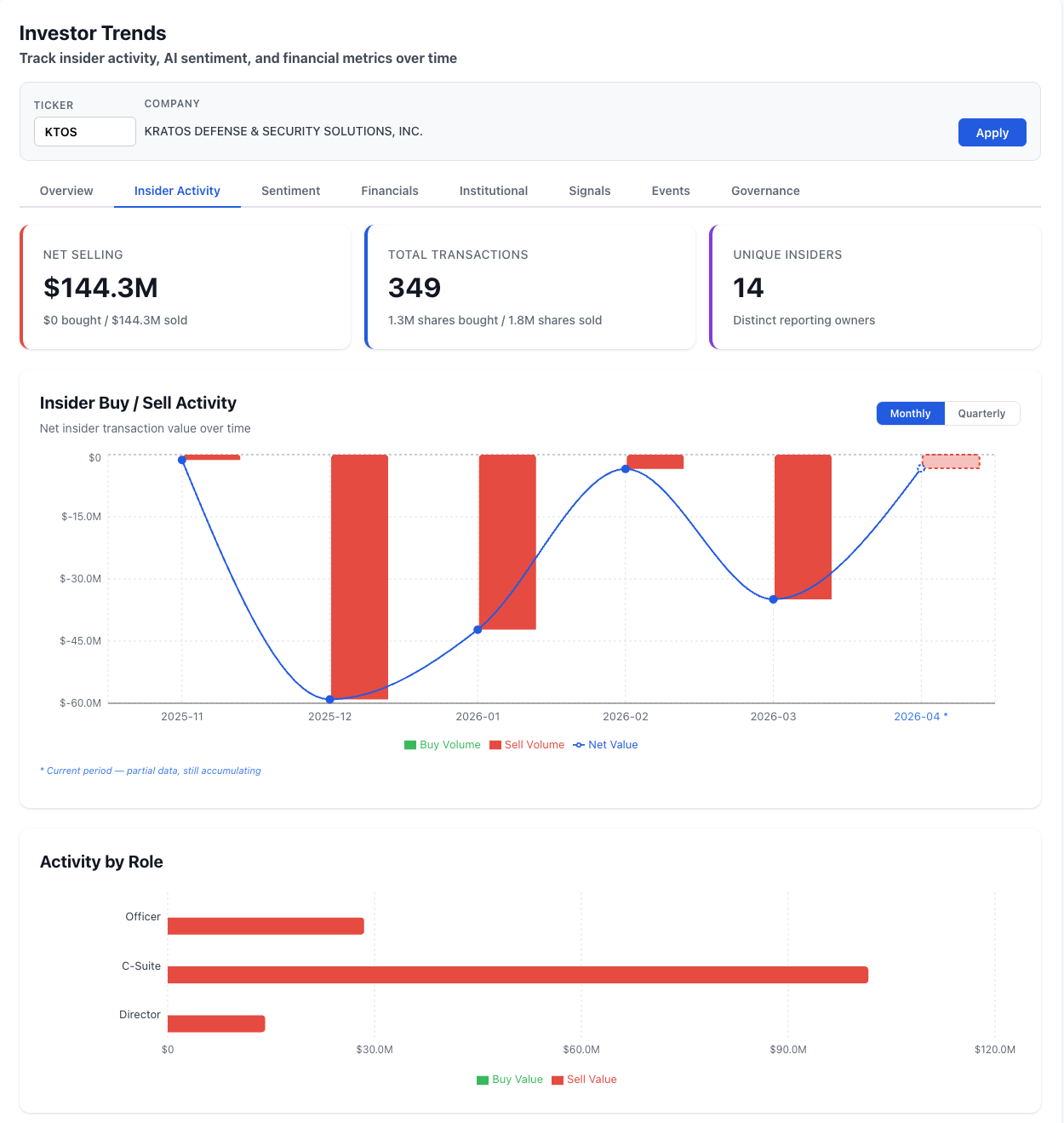
The Activity by Role chart tells its own story: C-Suite executives account for the largest share of selling by dollar value — north of $100 million — followed by Officers and Directors. And the monthly chart shows heavy red sell-volume bars across multiple months, with the net value line (blue) trending deeply negative.
Zero insider buying against $144 million in selling. That’s not noise. That’s a signal.
AI Sentiment: Bearish at -0.50
NexusAlert’s AI-derived sentiment analysis across 74 KTOS filings scored the stock at -0.50 — firmly bearish. Of the 74 filings analyzed, 42 were flagged bearish, just 5 were bullish, and 27 were neutral.
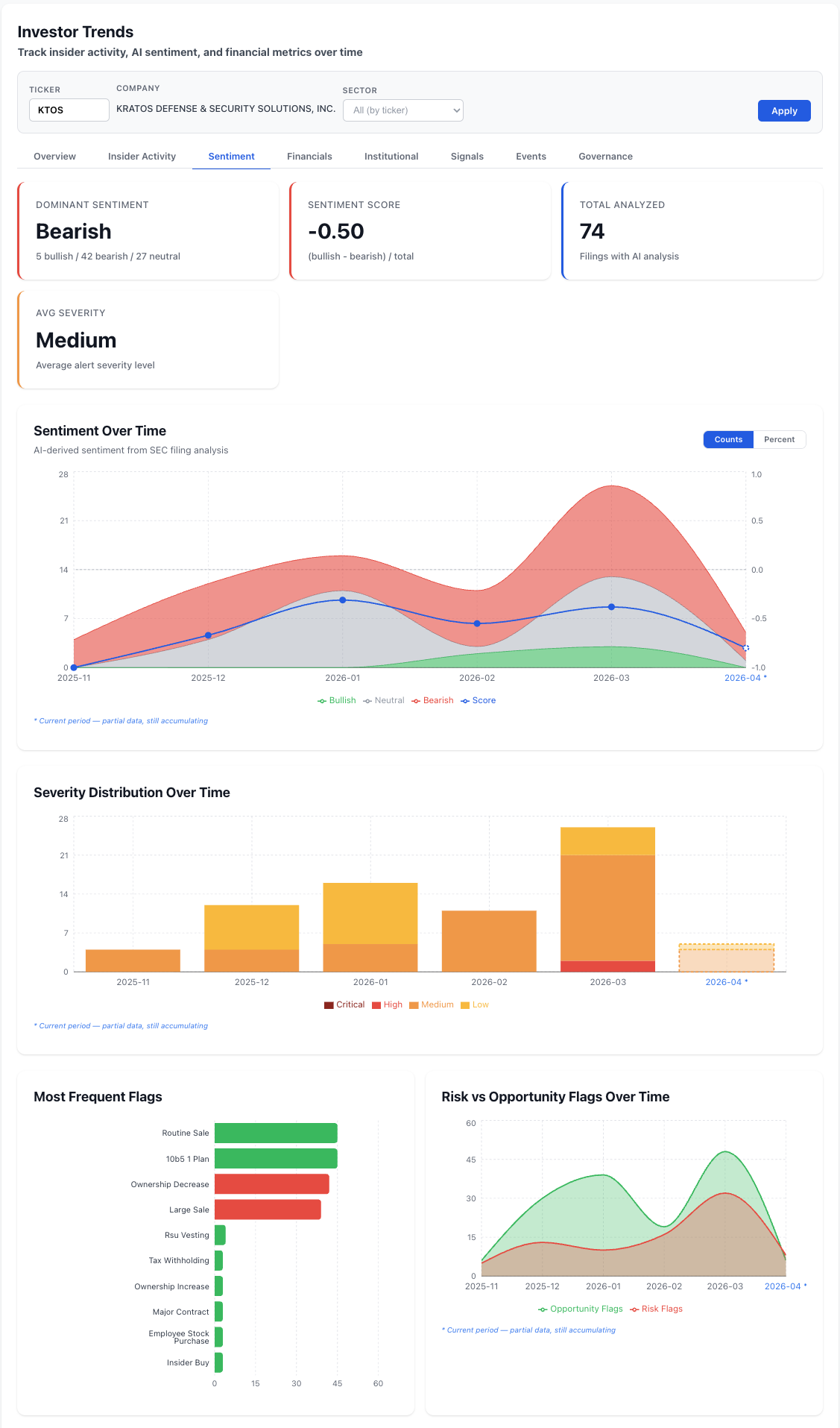
The Most Frequent Flags chart breaks down what the AI is detecting: Routine Sale, 10b5-1 Plan, Ownership Decrease, and Large Sale dominate. And the Risk vs Opportunity Flags chart shows risk flags spiking sharply in March 2026 — exactly when the cluster selling intensified.
Inside a Single Filing: The Carter Sale
To see how much detail is buried in a single Form 4, look at the April 10 filing from Division President David Carter. NexusAlert’s AI analysis breaks it down:
Carter sold 4,000 shares across multiple price tranches — 1,905 shares at a weighted average of $73.30, 1,295 at $74.15, 400 at $75.19, 300 at $76.97, and 100 at $77.85. The sales were made under a 10b5-1 plan adopted on June 13, 2025 — meaning Carter decided nearly a year ago that spring 2026 was the right time to sell.
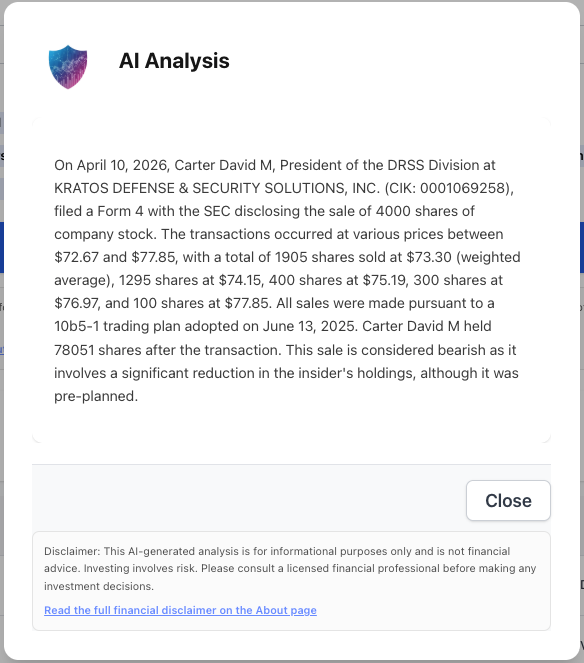
After the transaction, Carter held 78,051 shares. NexusAlert’s AI flagged this as a bearish signal because it represents “a significant reduction in the insider’s holdings, although it was pre-planned.”
The stock price chart in the filing detail view shows it all: $KTOS dropped from around $95 in mid-March to roughly $68 by April 10 — a ~30% decline during the exact period insiders were filing sales.
Why Cluster Selling Matters
A single insider selling stock doesn’t tell you much. Executives sell for all kinds of reasons — taxes, diversification, a house, tuition. Most of these sales were under pre-arranged 10b5-1 trading plans, which means the transactions were scheduled in advance.
But cluster selling — multiple insiders at the same company selling in the same narrow window — is a different signal entirely. Academic research has consistently found that coordinated insider selling is more predictive of future stock underperformance than individual sales.
One insider might sell for personal reasons. But when 14 unique insiders collectively sell $144 million worth of stock with zero buying to offset it, they’re all making the same implicit assessment: the stock price is high enough to take money off the table.
When 10 insiders at the same company file Form 4 sales in 3 weeks — and zero file purchases — that’s not 10 personal decisions. That’s a consensus.
What the 10b5-1 Plans Don’t Tell You
Financial media often waves off insider sales by noting they were executed under pre-arranged 10b5-1 plans. And yes, these plans are set up months in advance to avoid accusations of trading on material non-public information.
But here’s the part that gets glossed over: the executive chose when to create the plan and how many shares to include. Carter’s plan was adopted in June 2025. CFO Lund’s plan was adopted in May 2025. These executives decided nearly a year ago that spring 2026 would be the right time to sell — and multiple executives independently arrived at the same window.
The plan removes the timing decision from the trade execution. It doesn’t remove the timing decision from the plan creation. When multiple executives all created plans that converge on the same selling window, that convergence is itself informative.
How to Catch Cluster Selling Early
The challenge with insider selling patterns is that no single Form 4 filing makes headlines. A division president selling 4,000 shares doesn’t move the needle on its own. You need to see the cluster — and that requires tracking every Form 4 filing for a given company over a rolling window, analyzing the aggregate data, and reading the AI sentiment signals.
NexusAlert monitors all Form 4 filings in real time, surfaces the aggregate insider activity data through Investor Trends, and uses AI-powered sentiment analysis to flag bearish patterns like cluster selling — so you see the full picture forming, not just individual filings in isolation.
The $KTOS story was all there in the filings. Ten Form 4s. $144 million in net selling. Bearish sentiment at -0.50. A stock that dropped 30%. The only question is whether you saw it in time.
Create a free NexusAlert account to get AI-powered alerts on insider trading patterns, including cluster selling, across every public company.
Prefer to own it outright? NexusAlert lifetime access is available for a one-time payment of $299 — no subscription, no recurring charges, all future Pro features included. Learn more →