
JPMorgan Just Beat Earnings. The Stock Fell Anyway. Here's What the 8-K Says.
JPMorgan posted $16.5B in Q1 profit and beat EPS estimates by nearly 10%. JPM stock still fell 0.8% on the day. The answer is buried in the 8-K — and Jamie Dimon put it plainly.
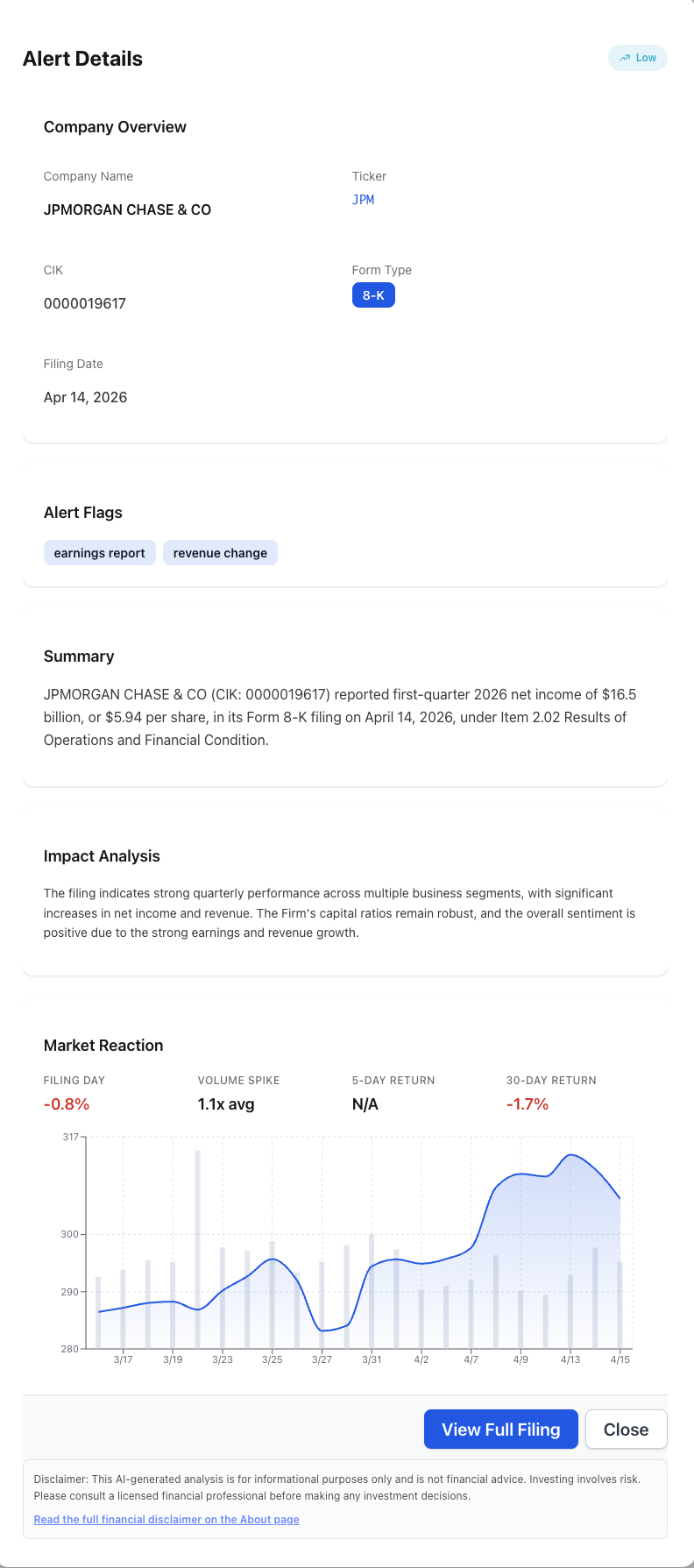
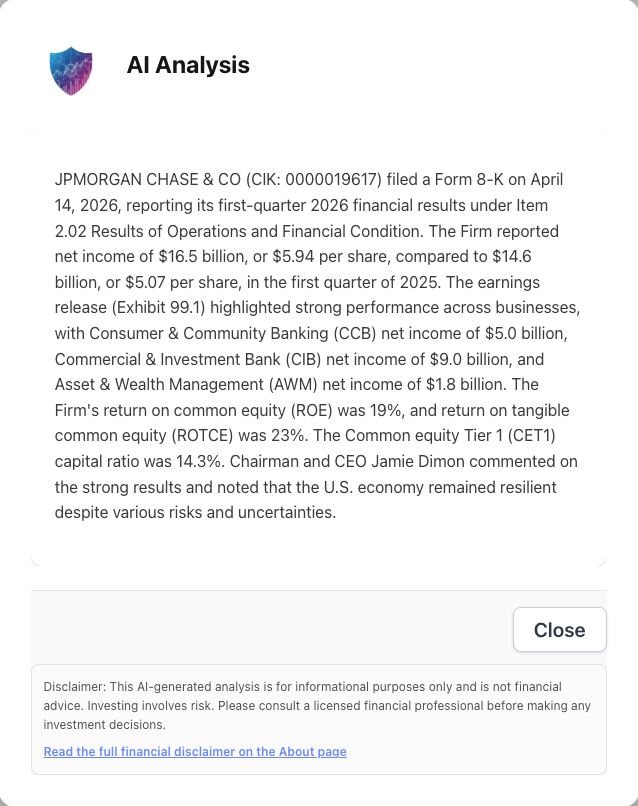
On April 14, 2026, JPMorgan Chase filed an 8-K reporting Q1 net income of $16.5 billion — $5.94 per share against an analyst estimate of $5.45. A 9% beat. Revenue hit $50.5 billion, up 10% year-over-year. Trading revenue hit a record $11.6 billion. Investment banking fees jumped 28%.
Every metric beat. The stock fell 0.82% anyway.
If you only read the press release, that makes no sense. If you read the 8-K, it’s obvious.
What an 8-K Actually Is
An 8-K is a “current report” — filed with the SEC whenever a material event occurs that shareholders need to know about. Earnings releases are the most common trigger, but 8-Ks also cover guidance changes, executive departures, debt activity, and legal proceedings.
The key word is material. When a company files an 8-K, it is legally asserting that the information inside is significant enough to affect an investor’s decision.
Most investors read the earnings table. The signal is in the paragraphs.
The Two Things the Press Release Didn’t Lead With
1. Full-year net interest income guidance was cut.
JPMorgan quietly lowered its 2026 NII outlook from $104.5 billion to approximately $103 billion. Net interest income — the spread between what a bank earns on loans and what it pays on deposits — is the core driver of bank profitability. A $1.5 billion guidance trim, buried after the record EPS headline, is not a footnote. It’s the reason the stock fell.
2. Jamie Dimon used the 8-K to flag something the earnings call headline ignored.
Here is what Dimon actually wrote in the filing:
“There is an increasingly complex set of risks — such as geopolitical tensions and wars, energy price volatility, trade uncertainty, large global fiscal deficits and elevated asset prices. While we cannot predict how these risks and uncertainties will ultimately play out, they are significant and they reinforce why we prepare the firm for a wide range of environments.”
That is not boilerplate. That is a deliberate, specific list from a CEO who has navigated multiple financial crises and chooses his words accordingly. He named five distinct risks — in writing, in a legally filed document — on the same day his firm reported record profits.
The market read it. The -0.82% reaction on a 9% EPS beat is the market’s answer.
Why the Gap Between Headline and Filing Matters
The earnings press release is written by the communications team. The 8-K is reviewed by lawyers and signed off by the CFO. They are not the same document, and they don’t always tell the same story.
Here’s what JPMorgan’s Q1 results actually showed across its three major segments:
- Consumer & Community Banking: $5.0B net income, 32% ROE
- Commercial & Investment Bank: $9.0B net income, 21% ROE — trading revenue at a record $11.6B
- Asset & Wealth Management: $1.8B net income
Strong across the board. And yet: guidance cut. Dimon warning of complex risks. Stock down.
The most experienced investors track this gap — between what the headline says and what the filing says — because it’s where price discovery actually happens.
How to Read Any Earnings 8-K in Under 5 Minutes
1. Find the guidance language. Look for phrases like “we expect,” “we anticipate,” or “our outlook.” Any change from prior guidance — especially a trim — is more important than whether EPS beat by $0.10.
2. Read the CEO statement in full. It’s usually one to three paragraphs. CEOs use this space to contextualize the results. When a CEO lists specific risks by name in a filed document, that’s not hedging — that’s disclosure.
3. Compare to last quarter’s filing. The signal isn’t just what a company says — it’s what changed. If Dimon’s Q4 statement was optimistic and Q1 flags five specific risks, that shift is the story.
The market fell 0.82% on a 9% earnings beat. It wasn’t confused. It read the 8-K.
NexusAlert Tracks Every 8-K the Moment It’s Filed
NexusAlert monitors all 8-K filings in real time and uses AI to surface the flags that matter — earnings reports, guidance changes, revenue shifts — so you’re not manually scanning EDGAR during earnings season.
The JPMorgan alert above was live within minutes of the filing. The AI analysis extracted the key figures and Dimon’s risk language automatically.
Create a free NexusAlert account to get instant 8-K alerts with AI analysis for any company on your watchlist — and never miss what the filing says versus what the headline claims.
Prefer to own it outright? NexusAlert lifetime access is available for a one-time payment of $299 — no subscription, no recurring charges, all future Pro features included. Learn more →