
Home BancShares' Chairman & CEO Just Bought 100,000 Shares — In One Trade
Home BancShares Chairman & CEO John W. Allison filed a Form 4 disclosing an open-market purchase of 100,000 shares. NexusAlert scored it a 65 Smart Money / Strong Buy. Here's what the signal actually says.
Most insider transactions on EDGAR are noise. Option exercises. Automatic 10b5-1 sales. Tax-withholding code F dispositions that are mechanically required and tell you nothing about sentiment.
And then there’s the one that matters: a Chairman and CEO, on the open market, writing a personal check, for a round-number block.
On April 20, 2026, Home BancShares (NYSE: HOMB) filed a Form 4 disclosing that John W. Allison — Director, Chairman & CEO — had purchased 100,000 shares in a single open-market transaction. That kind of filing is rare. It is also the specific pattern academic research has repeatedly flagged as predictive.
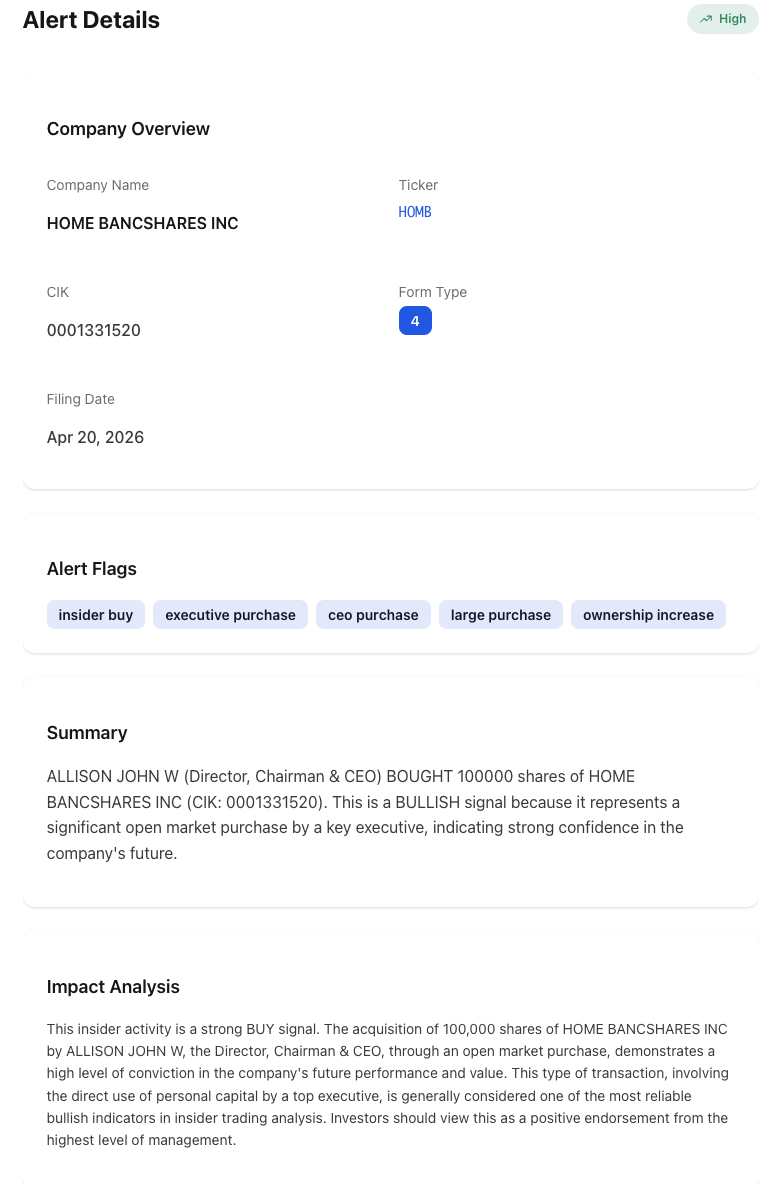
Five flags fired on one filing: insider buy, executive purchase, ceo purchase, large purchase, ownership increase. That flag stack is what separates a meaningful Form 4 from the hundreds of mechanical ones filed every week.
Why This Form 4 Is Different From Most
Form 4 is the SEC’s catch-all for changes in beneficial ownership by insiders. It contains dozens of transaction codes, and most of them are not buy signals. The only one that actually tells you an insider is betting their own money is code P — open market or private purchase.
Here’s how a typical week of Form 4 flow breaks down:
- Code S (open-market sale) — by far the most common; insiders sell for diversification, taxes, estate planning. Usually not informative.
- Code F (payment of exercise price or tax withholding) — mechanical; tells you a vesting event happened, nothing else.
- Code A (award grant) — compensation; does not reflect conviction.
- Code M (exercise of options) — often paired with same-day sale; not net-new capital commitment.
- Code P (open-market purchase) — the insider is writing a check out of their own pocket to buy shares.
Allison’s filing is code P. Direct ownership. 100,000 shares. The Chairman and CEO of the bank wrote the check.
The Signal: Size, Single-Trade, Round Number
The insider-buying literature has consistently flagged three features that separate noisy buys from predictive ones:
- Size relative to the insider’s existing holdings — a nominal top-up tells you less than a meaningful percentage increase.
- Single-trade versus programmatic — a 100,000-share block in one order is a decision, not an algorithm.
- Round numbers — round-number buys correlate with conviction buying (a target allocation) rather than opportunistic buys against a disclosed budget.
Allison’s filing has all three. One trade. Round number. And as NexusAlert’s AI impact analysis on the alert puts it, “the direct use of personal capital by a top executive” is “generally considered one of the most reliable bullish indicators in insider trading analysis.”
What the Broader Insider Pattern Looks Like on HOMB
A single Form 4 in isolation is a data point. A single Form 4 in the context of a 90-day insider flow is a pattern. NexusAlert’s Investor Trends view shows the second:
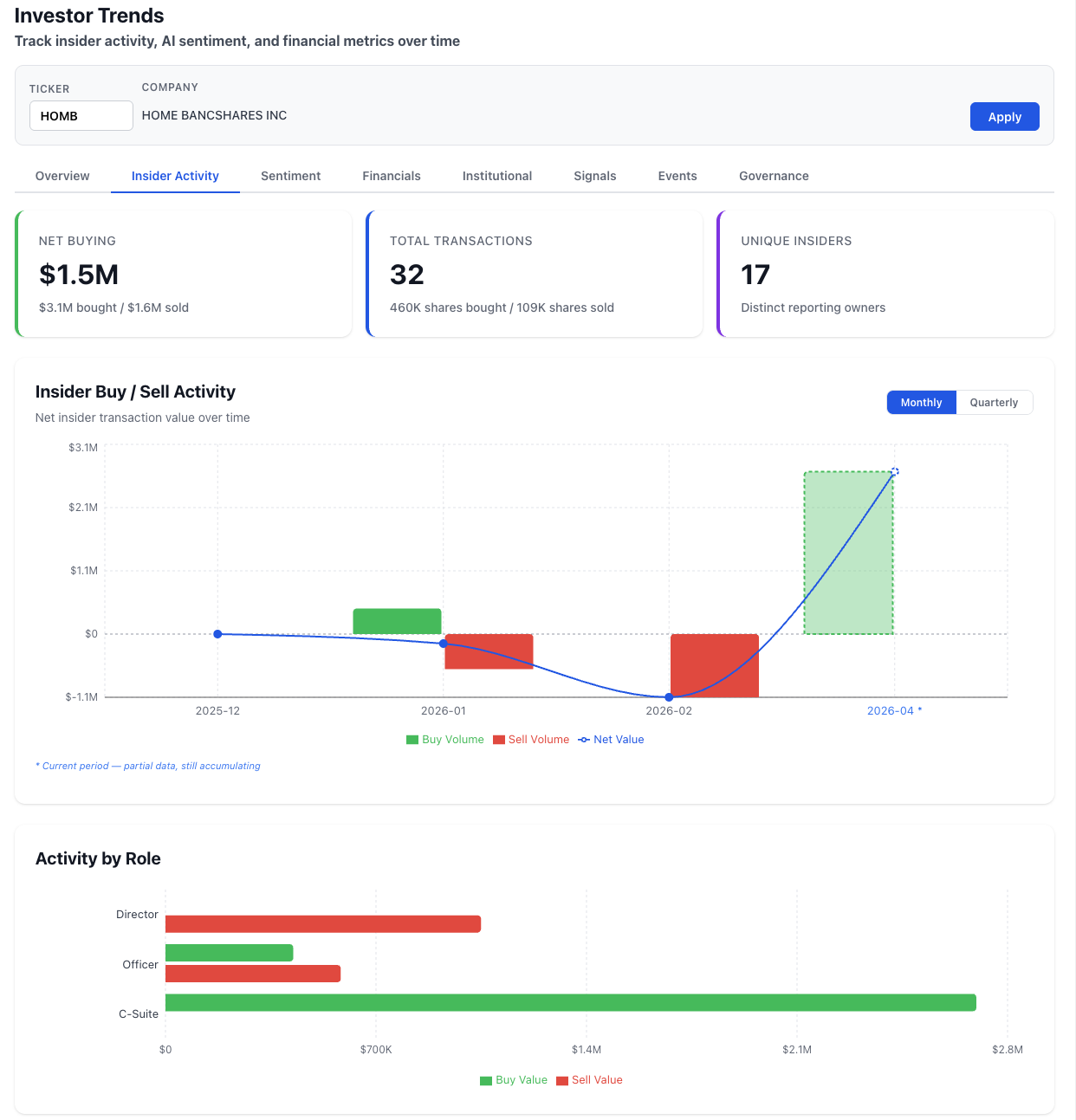
Three things stand out in the 90-day picture:
- $1.5M net buying — aggregate insider activity is net positive, with $3.1M in buys versus $1.6M in sells across 32 transactions and 17 distinct reporting owners.
- The April 2026 spike — the monthly chart shows insider buying had been flat-to-negative from December through February and then flipped sharply positive in April. That is the shape of conviction accumulating at a specific price.
- The role split is the nuance — the Activity by Role chart shows C-Suite is the concentrated buyer at roughly $2.7M, while Directors as a group are actually net sellers. That means the people running the bank day-to-day are backing it with personal capital even as some board members trim. In insider-buying analysis, C-suite buying generally outranks director activity as a signal.
Signal Scoring: 65 / Strong Buy
Raw Form 4 flow is hard to read on its own. NexusAlert’s Signals tab runs the math and condenses the insider pattern, institutional flow, sentiment, and flag density into a single composite:
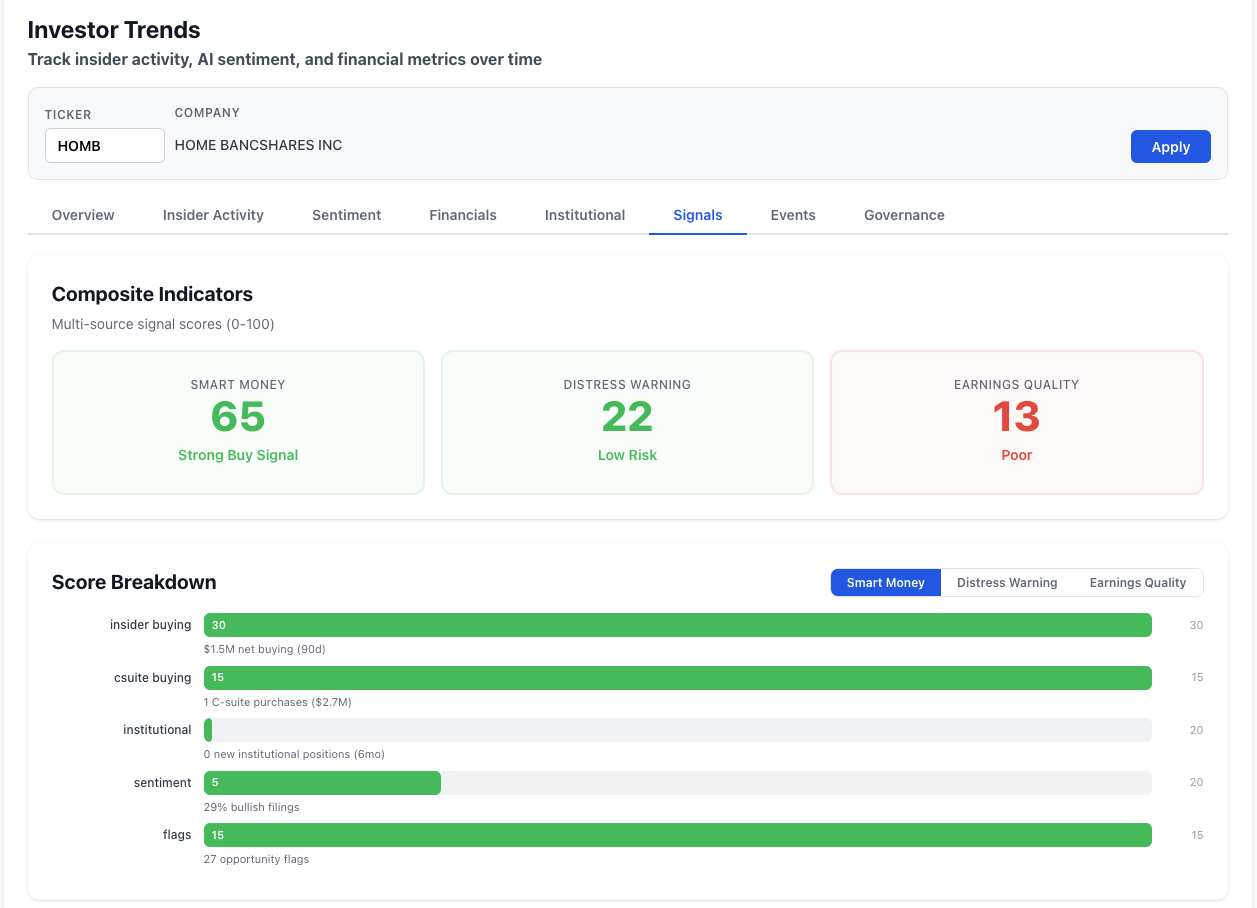
The breakdown is where this stops being a single headline and starts being a full picture. Of the 80 possible points on the Smart Money score that aren’t noise:
- Insider buying — 30 / 30 (maxed) — the $1.5M net buying over 90 days scored the category’s ceiling.
- C-suite buying — 15 / 15 (maxed) — the Allison purchase alone, combined with other executive activity, tops out the category.
- Flags — 15 / 15 (maxed) — 27 opportunity flags across recent filings.
Together those categories drive the 65 / Strong Buy headline. The composite is not declaring the stock a winner — no composite can. It is saying that on the insider-activity dimension, this is one of the strongest patterns in the database right now.
The Honest Caveats — What the Score Is Not Saying
A useful signal includes what the signal doesn’t cover. Two categories on the breakdown came in low:
- Institutional — 0 / 20 — zero new institutional 13G/13D positions opened on HOMB in the prior six months. Insiders are buying; big outside funds are not stepping in yet.
- Sentiment — 5 / 20 — only 29% of recent filings were scored bullish by the AI analyzer. The operational tone across 10-Qs, 8-Ks, and earnings-adjacent filings is mixed.
A third composite is also worth reading honestly: the Earnings Quality score is 13 / Poor, and the Distress Warning score is 22 / Low Risk. Nothing on the filing stack suggests distress — Distress Warning is explicitly low — but the quality of reported earnings is a drag worth understanding before sizing any position.
What that means in practice: the insider signal is maxed, but the rest of the story isn’t yet confirmed by the institutional or sentiment sides. Insiders often buy first. The question this composite is really asking is whether the rest follows.
What the Flag Distribution Tells You
Across all HOMB filings over the trailing window, NexusAlert’s flag distribution breaks out the top patterns:

The takeaways:
- Executive Purchase / CEO Purchase / Strategic Acquisition each fired 3 times in the window — indicating this is not a one-off event but a pattern of insider conviction paired with corporate activity.
- Routine Sale at 7 is the most frequent flag — normal for an active-ticker universe, and not by itself bearish.
- The Risk-vs-Opportunity time-series shows Opportunity flags dominating throughout, with Risk flags briefly rising in February 2026 and then fading. That February bump is the shape of a short-lived concern that resolved — exactly the kind of inflection where contrarian insider buying often lights up.
Why You Can’t Track This Manually
Every SEC reporting day produces hundreds of Form 4 filings. Most are code S, code F, and code A — noise. Filtering for code P buys at size, by named executives, at companies you care about, is a spreadsheet exercise that takes hours and still misses the same-day context that makes the signal tradeable.
NexusAlert runs the filter automatically:
- Parses transaction codes from every Form 4 on EDGAR as it hits
- Flags code
Pat insider-role weighting (Chairman / CEO / CFO rank above other officers and directors) - Cross-references against your watchlists
- Scores the buy for signal strength based on size, ownership percentage change, and prior filing pattern
- Surfaces cluster-buying patterns when multiple insiders file code
Pbuys on the same name within a rolling window - Rolls insider activity into the Investor Trends view so you see the 90-day shape, not just today’s headline
- Composes it all into the Smart Money / Distress Warning / Earnings Quality scores so the signal is readable in seconds
The HOMB 100,000-share code P purchase by the Chairman and CEO fired as a High-severity Opportunity alert in real time — with the share count, the flag stack, the 90-day context, and the composite score pre-parsed, before the retail-investor cycle picked it up.
Insider selling has many explanations. Insider buying has one: the insider thinks the stock is worth more than the price they paid.
Turn Form 4 Flow Into a Watchlist Signal
Create a free NexusAlert account to get AI-powered alerts on insider buying, cluster purchases, and Form 4 signals across every public company — with the transaction code, size, post-buy ownership percentage, and Smart Money composite score parsed and ranked for you.
Prefer to own it outright? NexusAlert lifetime access is available for a one-time payment of $299 — no subscription, no recurring charges, all future Pro features included. Learn more →