
Eli Lilly Just Killed the Second Half of Its $960M Rigel Deal — And the 8-K Says When
Rigel's April 21 8-K confirms Eli Lilly is terminating the non-CNS portion of the RIPK1 collaboration effective June 15, 2026 — the second walk-away after Lilly already dropped the CNS program in November 2025.
Pharma partnership terminations are the biotech version of a breakup note. Most of the ones filed with the SEC are anodyne — mutual decisions, preserved rights, diplomatic language. You can read ten of them without finding one that actually re-prices the smaller counterparty.
On April 21, 2026, Rigel Pharmaceuticals (NASDAQ: RIGL) filed an 8-K disclosing that Eli Lilly had elected to terminate its License and Collaboration Agreement — the one dated February 18, 2021 that gave Lilly an exclusive worldwide license to ocadusertib (R552) for non-CNS diseases, plus other RIPK1 inhibitors. Effective date: June 15, 2026.
Here’s the part the wires are missing: this is the second termination, not the first. Lilly already terminated the CNS disease program in November 2025. The April notice winds down the non-CNS remainder of a partnership once valued by industry coverage at up to $960 million in total deal value. What started as a full RIPK1 collaboration has now been unwound in two pieces, 11 months apart, by the same counterparty.
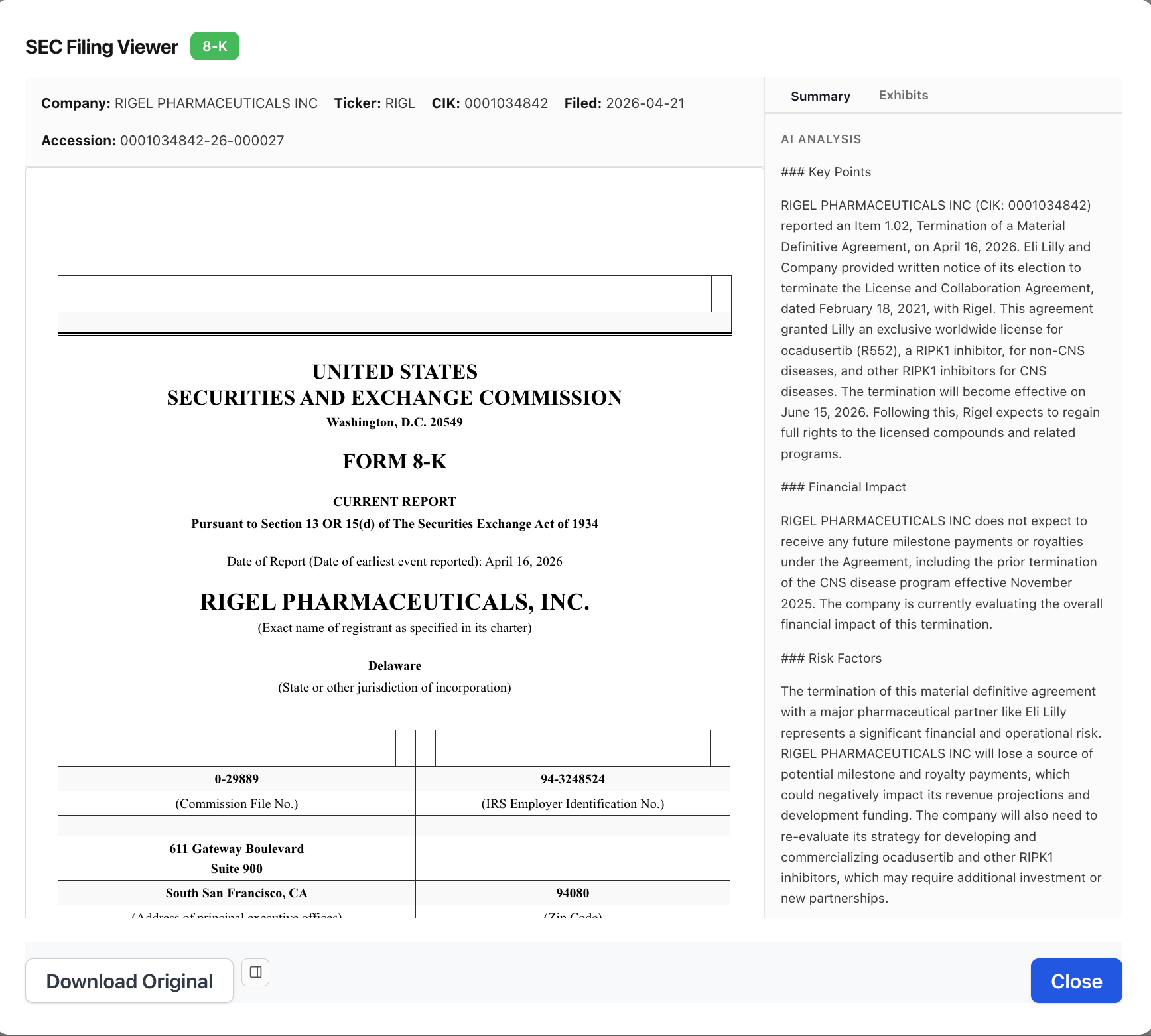
The Sentence That Moves the Model
Rigel’s 8-K contains the line that every biotech analyst tracking the name needed to read immediately. As captured in NexusAlert’s AI Analysis of the filing:
RIGEL PHARMACEUTICALS INC does not expect to receive any future milestone payments or royalties under the Agreement, including the prior termination of the CNS disease program effective November 2025.
That single sentence does two things most readers will miss on a first pass. First, it zeroes out future expected cash flows from the collaboration. Second, it confirms the November 2025 CNS termination as a related, prior event — making this an 11-month sequenced walk-away, not a one-off.
Four specifics from the filing are worth reading directly:
- Lilly elected to terminate. This was a unilateral counterparty action, not a mutual decision.
- Termination effective June 15, 2026. Not immediate — the agreement specifies a transition window.
- Rigel regains rights. Ocadusertib and the other RIPK1 inhibitors covered by the agreement revert to Rigel, who is now free to partner again, develop independently, or out-license.
- Agreement was dated February 18, 2021. A roughly five-year collaboration that survived its early milestones before Lilly concluded it no longer fit the portfolio.
Items one through three are financial and strategic. Item four frames the timeline — this was not an exploratory option that lapsed at the first go/no-go. It ran for five years before both halves came off the board.
Why Sequenced Terminations Fit the 2026 Pharma Pattern
The November 2025 CNS termination and the April 2026 non-CNS termination read as a connected sequence, not two independent events. Fierce Biotech’s earlier “Lilly pulls out of CNS portion of RIPK1 collab” coverage captured the first half. The April 16 8-K closes the second. Two signals from the same counterparty, on the same asset class, within a single fiscal window, point in one direction.
That pattern fits how large-pharma portfolio rebalancing has trended across 2025–2026:
- Lilly’s internal CNS pipeline has been reallocated toward obesity, Alzheimer’s, and autoimmune indications with larger commercial ceilings.
- RIPK1 inhibition — while mechanistically compelling for neurodegeneration — has had mixed clinical reads across the pharma industry over the last two years.
- Partners whose lead asset sits in a program the pharma’s portfolio committee has downgraded tend to receive termination notices at scheduled decision gates, often in two or three pieces rather than a single announcement.
None of that makes ocadusertib a bad molecule. It does mean the specific partner funding the clinical and commercial path forward has now walked away from both halves of the program, and Rigel has to rebuild the thesis from a different starting point.
The Tell in the 8-K’s Item 1.02 Language
Item 1.02 of Form 8-K — Termination of a Material Definitive Agreement — is a required disclosure whenever an issuer terminates or has its counterparty terminate an agreement that is material to the company. For small-cap biotech, a partnership with a top-five global pharma almost always qualifies.
What makes the Rigel filing readable is the specificity:
- Counterparty is named (Eli Lilly and Company).
- Agreement is identified (the License and Collaboration Agreement dated February 18, 2021, covering RIPK1 inhibitors).
- Effective termination date is stated (June 15, 2026).
- Assets reverting are listed (ocadusertib / R552, plus other RIPK1 inhibitors).
- Forward economic expectations are stated explicitly (no future milestone payments or royalties).
- Related prior event is referenced (the November 2025 CNS program termination).
That specificity is what makes the filing queryable. A semantic search across 8-K flow for “Item 1.02” + “license and collaboration agreement” + “termination” + any named pharma counterparty is a tractable question. Running that search across the biotech universe every day — and linking sequential terminations from the same counterparty on the same asset — is how you find this story before the sell-side model updates.
How Watchlists Catch Partnership Breakups Before the Wire
If RIGL was on a NexusAlert watchlist — or if any watchlist was filtering for Lilly counterparties — the notification is not “Rigel filed an 8-K.” It’s a structured alert:
- Form: 8-K (Item 1.02)
- Company: Rigel Pharmaceuticals (RIGL)
- Counterparty: Eli Lilly and Company (LLY)
- Event type: Material Agreement Termination
- Related prior event: CNS program termination (Nov 2025)
- Forward economic impact: No future milestone payments or royalties
- Effective date: June 15, 2026
Each of those fields is indexed from the filing text, not scraped from the press release. That means you can assemble a watchlist not just of tickers but of relationships — every biotech with an active Lilly collaboration, every small-cap with a top-five pharma partner, every company whose pipeline value leans on a single material agreement. When one of those relationships changes — or changes again — the alert fires with the prior event linked in.
What the Semantic Search Actually Does Here
A plain keyword search for “termination” across 8-K flow would return hundreds of matches per week — most of them employment-related, office-lease-related, or routine contract wind-downs that have no impact on pipeline value.
Semantic search reads context. NexusAlert’s semantic layer over SEC filings groups conceptually similar language together, so a query for “material pharmaceutical collaboration terminated” surfaces:
- License and Collaboration Agreement terminations
- Co-development agreement terminations
- Research and discovery collaboration wind-downs
- Option-exercise deadlines that expired without exercise
- Mutual consent terminations of joint development programs
That’s the query set a biotech analyst needs, and it’s the one a plain-text keyword search cannot produce cleanly. The Rigel 8-K lands inside that surface because the semantic layer understands what the language is doing, not just which words appear in it.
Why the Distress Flag Doesn’t Fire Here — But Pipeline Impact Does
Rigel’s filing triggers the Material Agreement Termination flag inside the NexusAlert taxonomy, not the Financial Distress flag. That distinction matters:
- Financial Distress is reserved for covenant events, going-concern language, delinquencies, bankruptcy filings, and comparable balance-sheet-level signals. Rigel is not in that category based on this 8-K alone.
- Material Agreement Termination is a pipeline-value event. It re-prices the company’s expected cash flows from one specific relationship without changing the company’s solvency.
For a smaller biotech where a single material agreement accounts for a meaningful share of modeled revenue, the pipeline-value signal is the one that matters on the day of the filing. The distress signal — if it comes — is typically downstream, visible in subsequent 10-Q or proxy filings that revise guidance or restructure operations around the lost partner funding.
Partnership terminations are a category of their own. They don’t read like distress. They read like a re-shaped pipeline — and when the same counterparty walks away twice in 11 months, the re-shape is a rebuild.
The Broader 2026 Partnership Termination Tape
Rigel is one data point in a broader pattern across biotech partnerships this year. Several of the top-ten global pharmas have been unwinding or rebalancing collaborations that don’t fit their current portfolio-committee priorities. That flow, aggregated over a rolling 12 months, is itself a signal:
- Which pharmas are terminating the most external partnerships
- Which therapeutic areas are losing pharma interest
- Which small-cap biotechs are regaining rights to previously out-licensed assets
- Which regained-rights assets attract new partners within six months
A semantic search across 8-K Item 1.02 flow can be tuned to answer each of those questions. That’s what makes a structured feed over SEC filings different from reading press releases — the answers compound.
Track Pharma Partnership Risk in One View
Create a free NexusAlert account to get AI-powered alerts on biotech partnership terminations, material agreement events, and pipeline-value signals across every public pharma and biotech — with the counterparty, effective date, and forward economic impact parsed from the 8-K before the sell-side adjusts the model.
Sources
Prefer to own it outright? NexusAlert lifetime access is available for a one-time payment of $299 — no subscription, no recurring charges, all future Pro features included. Learn more →