
Amazon Just Filed an 8-K to Buy Globalstar for $11.6B — and Quietly Took Apple's Satellite Business With It
On April 14, 2026, Amazon and Globalstar filed 8-Ks disclosing a $11.57B definitive merger agreement. Buried in the announcement: Amazon Leo will now power Apple's Emergency SOS. Here's what the filing actually says.
On April 14, 2026, two 8-Ks hit EDGAR within minutes of each other: one from Amazon.com, Inc. (NASDAQ: AMZN), one from Globalstar, Inc. (NASDAQ: GSAT). Same event, two filers, two sets of shareholders.
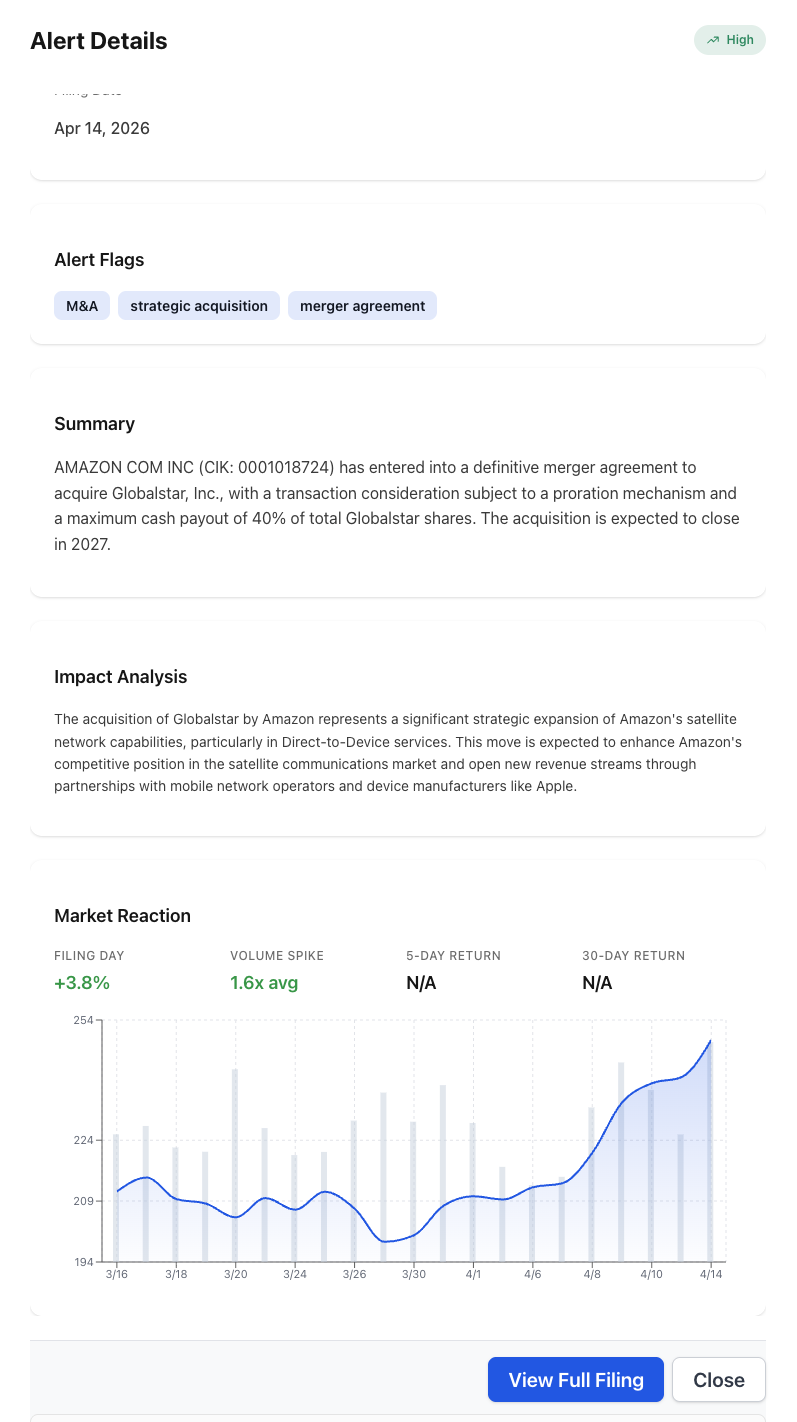
The event: Amazon is acquiring Globalstar for $11.57 billion in a definitive merger agreement. Cash or stock at the holder’s election, with a 40% cap on cash consideration. Expected close: 2027. AMZN closed the filing day up 3.8% on 1.6x average volume.
But the real story isn’t in the headline. It’s in a single paragraph most summaries skipped: Amazon Leo will now power Apple’s Emergency SOS satellite service for iPhone and Apple Watch.
What the 8-K actually discloses
Amazon filed its 8-K under Item 7.01 — Regulation FD Disclosure, not Item 1.01. That’s a choice worth noticing. Item 1.01 (Entry into a Material Definitive Agreement) is the usual home for a signed merger, and it typically carries the full merger agreement as an exhibit. Item 7.01 is the “we’re publicly confirming what we’re also saying on the wire” item — used when management wants to get the disclosure on the record simultaneously with a press release, without the full agreement attached.
In practice, for a deal of this size, the Item 1.01 filing — with the merger agreement itself as an exhibit — typically follows within days as either a new 8-K or an amendment. If you’re watching this deal, that’s the next filing worth flagging.
The core terms disclosed in the 7.01:
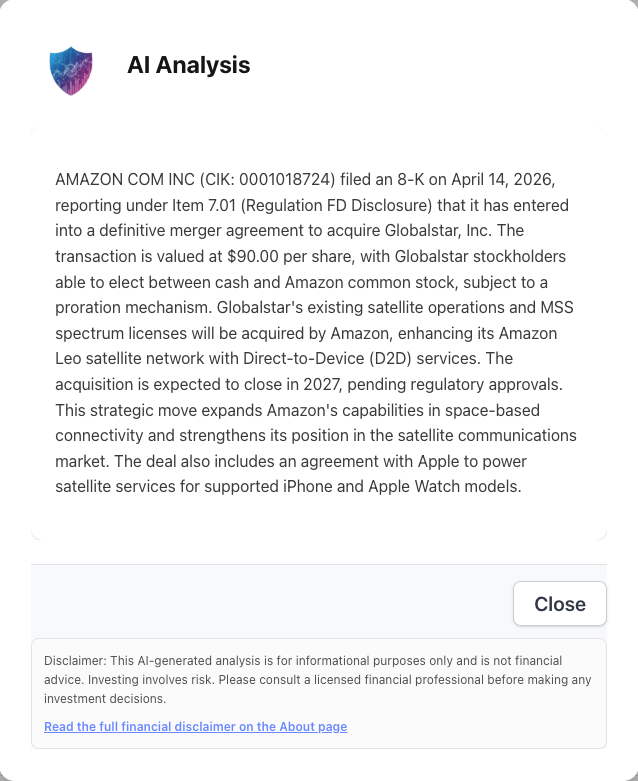
- Price: $90.00 per share in cash or 0.3210 shares of Amazon common stock — with the stock consideration value capped at $90.00 per share
- Cash cap: cash consideration limited to 40% of total Globalstar shares
- Proration mechanism: if cash elections exceed the 40% cap, each electing holder gets a pro-rata mix of cash and stock
- Consideration adjustment: total consideration subject to a downward adjustment of up to $110 million if Globalstar fails to achieve specified operational milestones (including HIBLEO-4 satellite milestones)
- Assets acquired: Globalstar’s existing satellite operations, infrastructure, and Mobile Satellite Services (MSS) spectrum licenses (globally harmonized L-band and S-band)
- Strategic pairing: an agreement with Apple to power satellite services for supported iPhone and Apple Watch models — including Emergency SOS via satellite, Messages, Find My, and Roadside Assistance
- Tax structure: intended to qualify as a tax-free reorganization
- Shareholder approval: already obtained — a majority holder group led by Thermo, owning approximately 57.6% of Globalstar common stock, approved the transaction by written consent at signing. No further Globalstar shareholder vote is required.
- Implied deal value: $11.57 billion
- Expected close: 2027, subject to antitrust, foreign investment, satellite, and telecommunications approvals
- Agreement type: definitive — i.e., not a letter of intent, not a term sheet
The cash cap is the structurally interesting piece. Amazon is willing to pay up in cash, but it wants the deal to be at least 60% stock-funded. That keeps leverage off Amazon’s balance sheet and gives Globalstar holders equity exposure to the satellite strategy they’re selling into.
The Apple paragraph is the whole thesis
Here’s the line that matters most for anyone modeling AMZN going forward: Amazon Leo — Amazon’s low-Earth-orbit satellite constellation — will power direct-to-device satellite services for supported iPhone and Apple Watch models, covering Emergency SOS via satellite, Messages, Find My, and Roadside Assistance.
Apple’s satellite service has been running on Globalstar’s MSS spectrum and network since the iPhone 14 and Apple Watch Ultra 3. By acquiring Globalstar — spectrum licenses, satellite operations, and the Apple relationship together — Amazon inherits the contract and the technical integration behind it. The MSS spectrum itself is the most durable piece of the asset base: globally harmonized L-band and S-band frequencies are scarce, regulated, and essentially impossible to replicate organically, no matter how many satellites you launch.
Amazon’s own D2D service is targeted to launch in 2028 on this spectrum.
Read that again. Amazon didn’t just buy a satellite operator. Amazon bought Apple’s satellite vendor — and locked in a services relationship with the only hardware company on the planet that can sell a billion-unit install base of direct-to-device satellite endpoints.
A few implications that fall out of the filing:
- Starlink now has a real, well-capitalized D2D competitor. Amazon Leo + Globalstar spectrum + Apple handsets is the first credible threat to SpaceX’s satellite-to-phone business.
- Amazon’s capex narrative gets cleaner. The Leo buildout has been a line item analysts have questioned. Buying a commercial satellite business with an anchor customer (Apple) converts it into a revenue story faster.
GSATholders are effectively getting paid inAMZNstock for a satellite strategy. The 60%+ stock component means Globalstar shareholders are now long Amazon’s Leo + AWS + ads + retail flywheel — not just the satellite business they owned yesterday.
Why the 8-K beats the press release
Every material acquisition announcement is accompanied by a press release. The press release is marketing. The 8-K is the legal document.
The full merger 8-K (Item 1.01) — which should follow this Item 7.01 filing — includes or attaches as exhibits the actual merger agreement, disclosure schedules, material adverse effect carve-outs, termination fees, no-shop provisions, and regulatory conditions. Everything that determines whether this deal actually closes, and on what terms, is in the agreement exhibit. Not the press release.
For a deal this size, the questions professionals will be asking the filing to answer:
- What’s the termination fee if either side walks?
- What regulatory conditions trigger a walk right? (This is a big-tech buying satellite spectrum — expect a CFIUS and FCC review.)
- What’s the outside date for closing?
- What no-shop and fiduciary out language governs Globalstar’s board between signing and close?
- Are there any MAE (Material Adverse Effect) carve-outs that would let Amazon renegotiate if Globalstar’s business deteriorates?
Each of those answers is in the filing. None of them are on CNBC.
In any M&A deal above $5B, the 8-K and merger agreement exhibit are the primary source. The press release is a distilled marketing summary. If you’re trading the deal, you’re trading the 8-K.
How NexusAlert surfaced this — on both sides of the deal
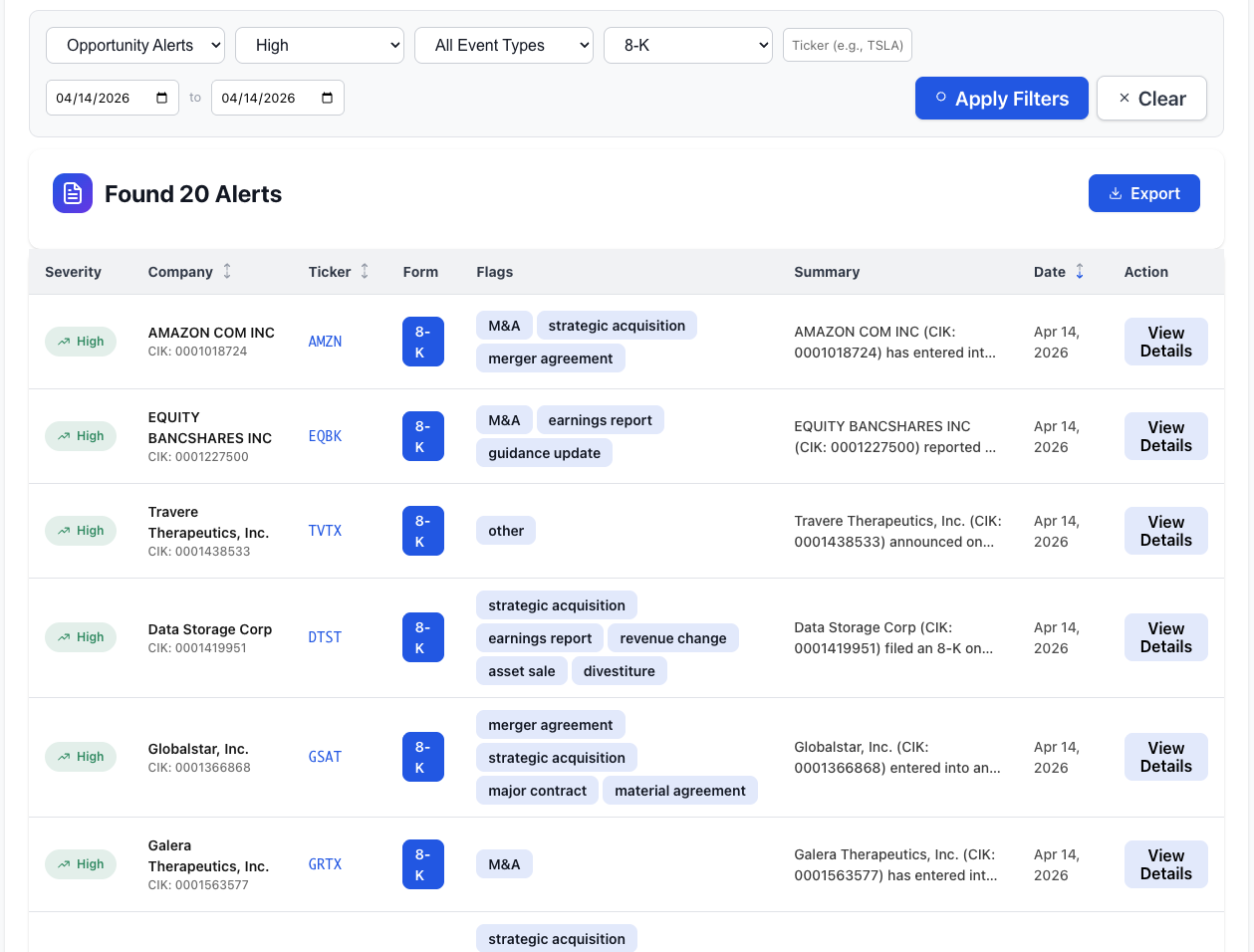
The screenshot that prompted this post shows something the press-release-driven coverage missed: both AMZN and GSAT filed 8-Ks on April 14, 2026, and NexusAlert flagged both simultaneously — tagged with M&A, strategic acquisition, and merger agreement.
For investors holding GSAT, AMZN, or an adjacent name like T, VZ, or IRDM (Iridium Communications), the cross-ticker alert is the signal. You don’t just want to know that Amazon filed an 8-K. You want to know that Amazon and its counterparty both filed, on the same day, with the same flags — because that’s the structural footprint of a real, signed deal.
NexusAlert’s alerts surface this automatically:
- Watch lists by ticker — so
AMZN,GSAT, and every satellite comp on your list flagged together when the deal hit. - AI-generated flags — M&A, strategic acquisition, and merger agreement were auto-tagged the moment the 8-K parsed.
- Impact analysis — a plain-English read of what the filing actually means for the business, generated from the filing text rather than the press release.
- Market reaction snapshot — filing-day price change, volume spike vs. average, and 5-day / 30-day return — all attached to the alert so you can see how the market absorbed the disclosure in real time.
- Semantic search — “which
AMZN8-Ks in the last five years disclosed an acquisition above $10B” is one query, not an afternoon on EDGAR. - Filing search across 8-K, 10-K, 10-Q, SC 13D/G, DEF 14A, S-1 and Forms 3/4/5 — so when the proxy and the S-4 drop for this deal, you’ll see them the moment they file.
The next filings to watch for this deal
If you care about AMZN or GSAT from here, these are the forms you want flagged when they hit EDGAR:
- Follow-on 8-K with Item 1.01: the formal merger-agreement filing with the agreement itself as an exhibit — almost certainly coming within days of the Item 7.01.
- S-4 (Registration Statement): filed by Amazon to register the stock consideration — includes the full merger-related disclosures and pro forma financials.
- Schedule 14C (Information Statement): not a proxy. Because Thermo’s majority block already approved the deal by written consent at signing, there’s no
GSATshareholder vote — but SEC rules still require Globalstar to send an information statement to remaining holders. This is the document that will contain the full deal narrative for retail holders. - SC 13D filings: any merger-arbitrage fund or activist crossing 5% of
GSATpost-announcement. - Form 4 filings: Globalstar insider activity between signing and close in 2027.
- 8-K Item 2.01: completion of the acquisition when the deal actually closes.
- Any
GSAT8-K flagging HIBLEO-4 satellite milestones: these directly affect the $110M downward consideration adjustment.
Each of those is a supported form type in NexusAlert.
Track the next $11B 8-K before the press release catches up
If your first read of this deal came from a newsletter 18 hours after it filed, you’ve already experienced the gap NexusAlert is built to close.
Create a free NexusAlert account to get real-time 8-K alerts on every ticker you follow — and AI-flagged summaries of what’s actually in the filing.
Prefer to own it outright? NexusAlert lifetime access is available for a one-time payment of $299 — no subscription, no recurring charges, all future Pro features included. Learn more →