
Tango Therapeutics Just Posted a 92% Response Rate in Pancreatic Cancer. Here Is What the Number Means.
Tango Therapeutics reported a 92% response rate in metastatic pancreatic cancer on June 8, 2026, and the stock jumped about 45%. Here is what the 8-K shows.
A small-cap biotech just reported a 92% response rate in one of the deadliest cancers in medicine, and the stock nearly doubled intraday before settling up about 45%.
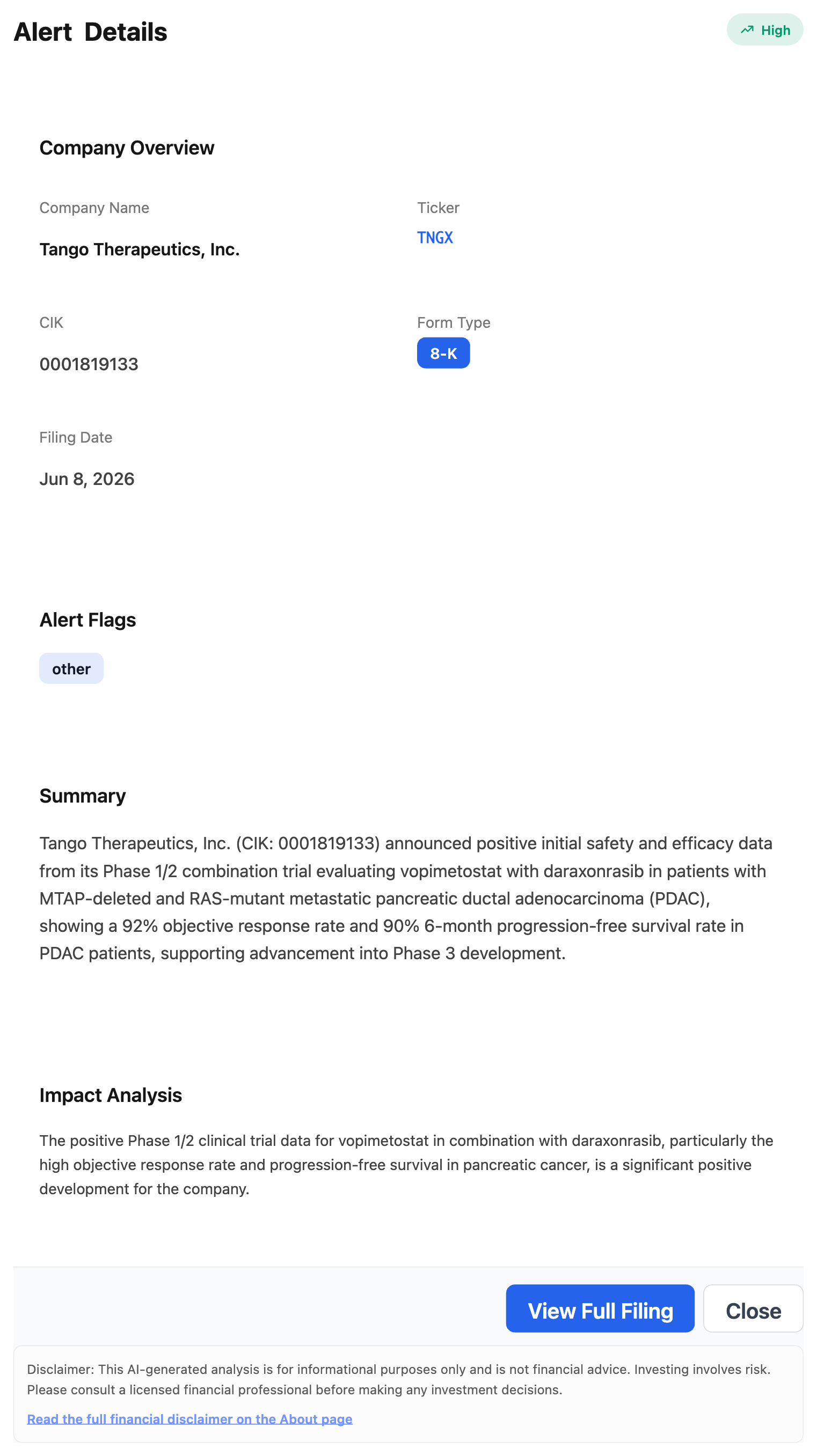
On June 8, 2026, Tango Therapeutics (NASDAQ: TNGX) filed an 8-K and announced initial Phase 1/2 data for vopimetostat combined with daraxonrasib, a RAS(ON) inhibitor from Revolution Medicines (RVMD), in patients with MTAP-deleted, RAS-mutant metastatic pancreatic ductal adenocarcinoma (PDAC). The combination posted a 92% objective response rate and a 90% six-month progression-free survival rate. The filing surfaced on TNGX the same day it hit the wire, flagged High severity with a positive opportunity signal.
What the Filing Actually Says
A headline will tell you “92% response rate” and stop there. The filing tells you the part that decides whether the number is real: how many patients, how durable, and how clean the safety data is.
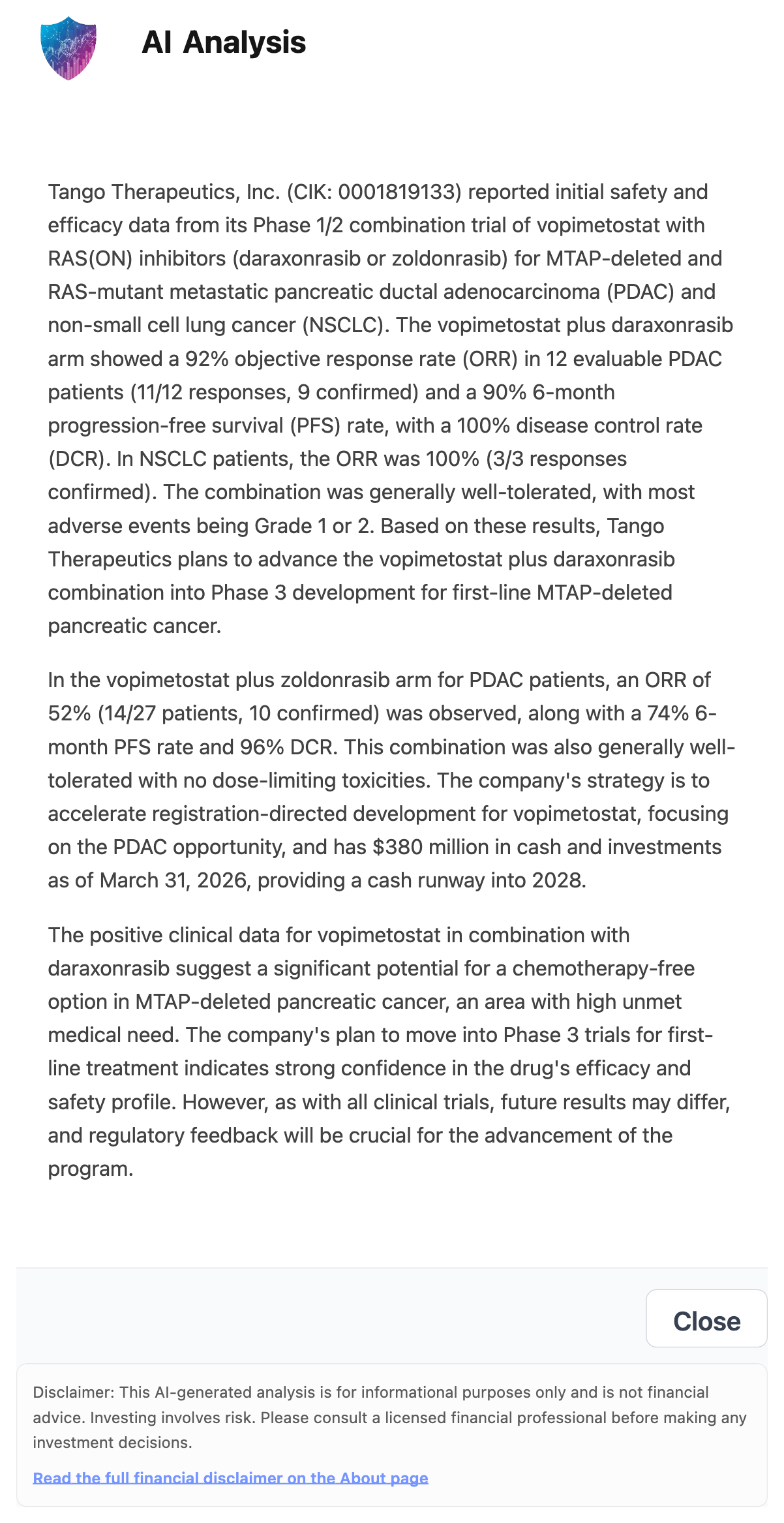
The 92% objective response rate came from 12 evaluable PDAC patients, with 11 of 12 responding and 9 responses confirmed. The disease control rate was 100%, and the six-month progression-free survival rate was 90%. In a small non-small-cell lung cancer cohort, the same combination produced a 100% response rate in 3 of 3 patients. The company described the regimen as generally well tolerated, with most adverse events Grade 1 or 2 and no dose-limiting toxicities reported.
That detail matters because pancreatic cancer is where most drugs go to fail. Metastatic PDAC has a five-year survival rate in the low single digits, and second-line and third-line options are thin. A response in nine of twelve confirmed cases, paired with a 90% six-month PFS, is the kind of signal that does not usually show up in this tumor type.
So Is a 92% Response Rate As Good As It Sounds?
Yes and no, and the nuance is the whole point.
Here is the misconception worth busting. A response rate tells you the tumor shrank. It does not tell you the patient lived longer. Objective response rate and survival are different endpoints, and regulators approve drugs on survival, not on tumor shrinkage alone. A 92% ORR in 12 patients is a small sample, and early-phase numbers in tiny cohorts often soften as the patient count grows. The honest read is that this is a strong early signal, not a finished result.
What pushes it past “interesting” is the company is not betting on one arm. A second combination, vopimetostat plus zoldonrasib, posted a 52% response rate across 27 patients, with a 74% six-month PFS and a 96% disease control rate. Two combinations both clearing the bar in a brutal cancer is a more durable data point than a single eye-catching percentage.
The Part the Headline Skips: Can They Pay For It?
A biotech with great data and an empty bank account is a different investment than a biotech with great data and runway. The filing answers that too.
Tango reported about $380 million in cash and investments as of March 31, 2026, enough runway into 2028. The company said it plans to advance the vopimetostat-plus-daraxonrasib combination into Phase 3 development for first-line MTAP-deleted PDAC and expects to finalize the Phase 3 design in the second half of 2026. Funded runway through a Phase 3 start is the difference between a data readout you can act on and one that gets diluted away before it matters.
A response rate tells you the tumor shrank. It does not tell you the patient lived longer. The patient count, the confirmation rate, and the survival data are where the real signal lives.
What to Watch
The next checkpoints are the finalized Phase 3 design later this year and longer follow-up that shows whether the six-month PFS holds as median survival data matures. A 45% one-day move prices in a lot of optimism, so the durability of these responses, not the initial percentage, is what the next readout has to defend.
That is the difference between reading a headline and reading the filing. NexusAlert reads the filing for you: real-time alerts on 8-K material events, Forms 3, 4, and 5 for insider activity, and SC 13D and SC 13G for activist and institutional moves, with AI analysis that pulls the patient counts, the confirmation rates, and the cash runway out of the document so you do not have to.
Create a free NexusAlert account to get same-day 8-K and clinical-readout alerts on any ticker you follow.
Sources
- Tango Therapeutics press release, GlobeNewswire (June 8, 2026)
- Tango Therapeutics posts 92% ORR in pancreatic trial, StockTitan
- Tango Therapeutics stock surges 45% on pancreatic cancer data, Investing.com
- Why Is Tango Therapeutics Stock Soaring Monday, Benzinga
- SEC EDGAR, Tango Therapeutics filings (CIK 0001819133)
Prefer to own it outright? NexusAlert lifetime access is available for a one-time payment of $299 — no subscription, no recurring charges, all future Pro features included. Learn more →