
Johnson & Johnson's $5.5 Billion Talc Settlement Comes With a 95% Catch
Johnson & Johnson committed $5.5 billion to resolve the ovarian talc litigation, but its July 27 8-K shows the deal hinges on 95% claimant participation.
Johnson & Johnson just agreed to pay $5.5 billion to make the talc lawsuits go away. The filing shows it is not that simple.
On July 27, 2026, Johnson & Johnson ($JNJ) filed an 8-K disclosing a proposed comprehensive resolution of the ovarian talc litigation, committing $5.5 billion. NexusAlert flagged it as a High severity Regulatory event the same morning it hit Bloomberg tier wires.
The headline reads like the end of a fifteen-year fight. Read the filing and the picture is more conditional than the word “settlement” suggests.
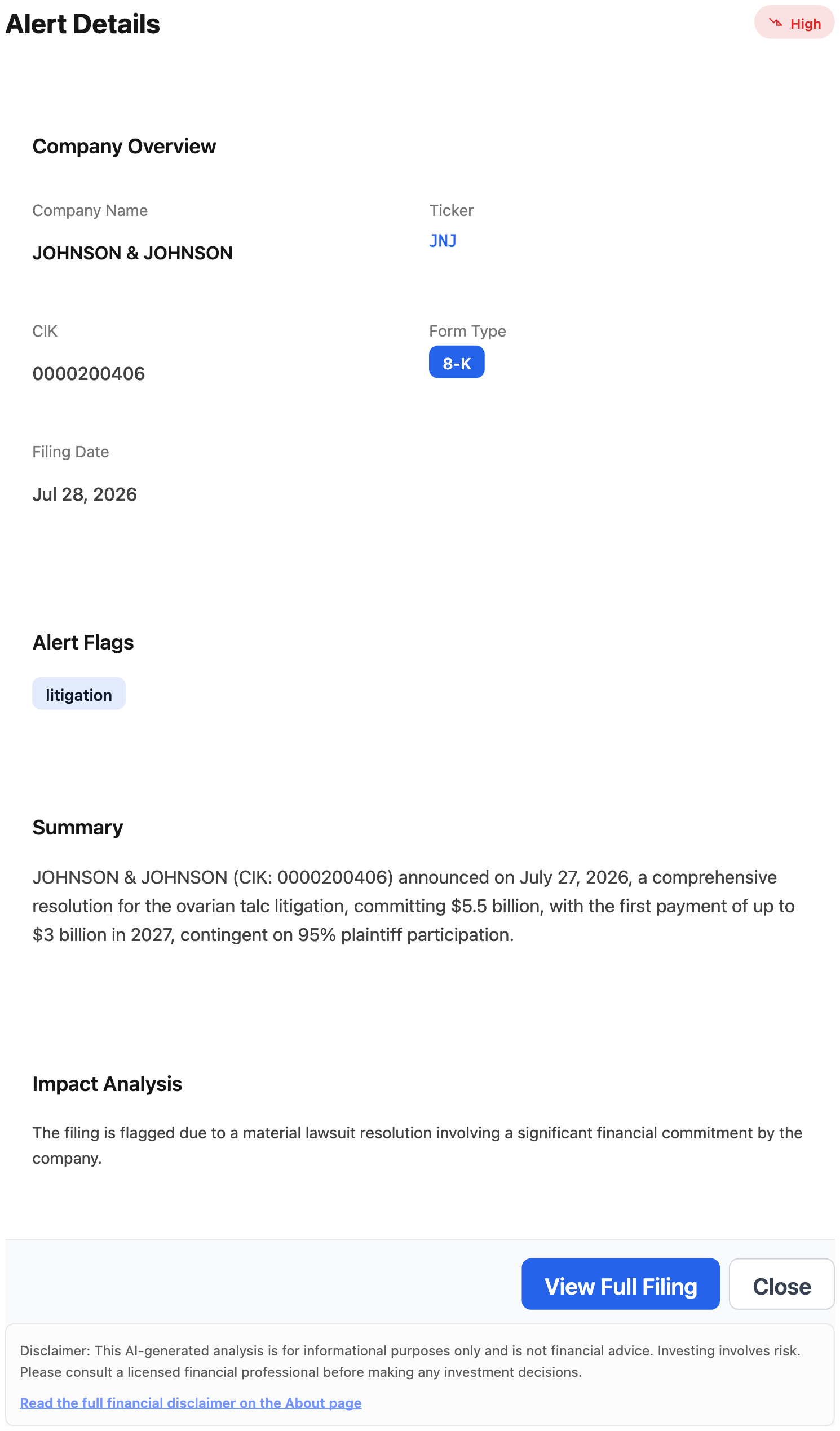
What the 8-K actually says
The proposed resolution covers roughly 69,000 cases consolidated in the federal multidistrict litigation in the District of New Jersey, plus related state court cases. Together that is about 99.75% of the remaining talc claims against the company.
The structure matters more than the number. The deal becomes final only if lead plaintiff firms representing at least 95% of the remaining claims accept it. The first payment, up to $3 billion, is scheduled for 2027, with further payments in 2028. Because the agreement assigns dollar values to qualifying ovarian cancer claims and does not cap the total, one attorney who negotiated it said J&J could ultimately pay $7 billion or more depending on how many claimants participate.
So the $5.5 billion is a floor on a conditional framework, not a check that has cleared. J&J itself continues to call the underlying claims meritless, and its litigation vice president framed the decision as buying closure rather than conceding the science.
Why the market can absorb a number this big
Here is the question worth asking: if a household name just agreed to a multi-billion-dollar liability, why did the stock not fall apart?
The answer is on the balance sheet, and it is the kind of context a one-line news alert leaves out. NexusAlert’s Company Dossier scores $JNJ in the top 6% for financial strength and the top 2% for governance, with institutional ownership flow in the top 15%. A company with that profile can write down a $5.5 billion litigation reserve and keep its dividend, its credit rating, and its capital plan intact. The settlement removes an overhang investors have priced for years. Certainty, even expensive certainty, is often what a large cap needs to re-rate.
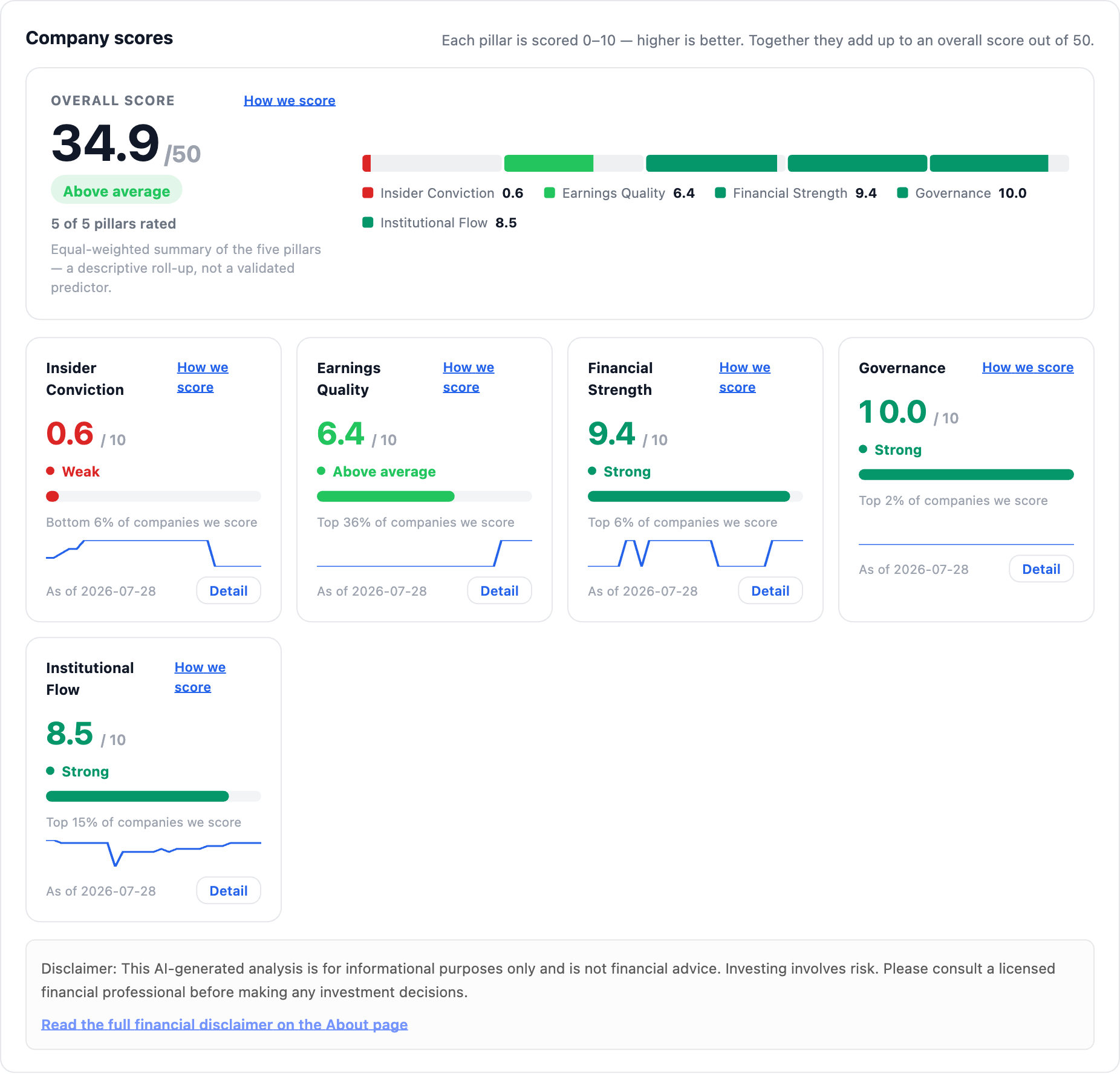
The bigger pattern
This is J&J’s third route at resolving talc. Two prior attempts to move the liability into bankruptcy through a subsidiary were rejected by the courts. A direct settlement is what remained, and it arrived shortly after a federal ruling questioned whether plaintiffs could prove that talc caused any individual claimant’s cancer. That ruling shifted the leverage, and the 8-K is where you can see the terms the press release soft-pedals: the 95% trigger, the multi-year payment schedule, the uncapped upside.
None of that is in the first news headline. All of it is in the filing.
The lesson
A settlement headline tells you a fight is ending. The 8-K tells you whether the deal actually holds and what it could cost. A $5.5 billion resolution with a 95% participation trigger is a starting point, not a finish line, and the difference between those two things is worth real money to anyone holding the stock.
Read the filing, not the headline. That is the entire reason NexusAlert exists: it reads the 8-K, Form 4, 13D, and 10-Q the moment they hit EDGAR, pulls out the exact figures and conditions, and pairs them with a Company Dossier so you see the structural picture in one view.
Create a free NexusAlert account
Sources
- Johnson & Johnson Announces a Proposed Resolution of Ovarian Talc Litigation (company release)
- Johnson & Johnson Announces $5.5 Billion Settlement of Talc Lawsuits (Insurance Journal)
- J&J to Pay $5.5 Billion to Resolve Talc-Related Cancer Claims (Bloomberg)
- Johnson & Johnson reaches proposed $5.5B talcum powder settlement (UPI)
- Johnson & Johnson Proposes $5.5B Talc Resolution (StockTitan)
Disclaimer: NexusAlert analyses are AI-generated, for informational purposes only, and are not financial advice.
Prefer to own it outright? NexusAlert lifetime access is available for a one-time payment of $299 — no subscription, no recurring charges, all future Pro features included. Learn more →