
SpaceX Just Closed the Largest IPO in History. The 8-K Shows Where the $86 Billion Goes.
SpaceX's 8-K confirms an $86 billion IPO close on June 15, 2026: 638,888,888 Class A shares at $135, a roughly $1.75 trillion debut, and proceeds aimed at AI compute.
A recognizable company, a record number, one filing
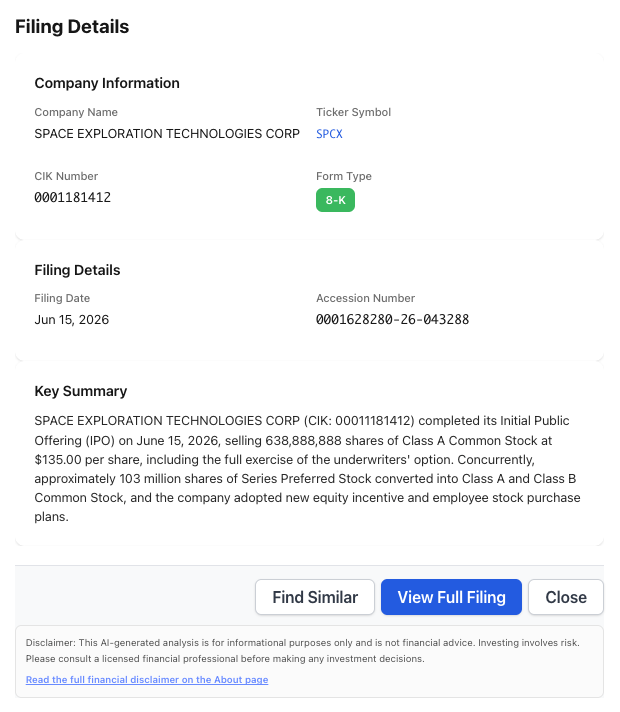
SpaceX just sold 638,888,888 shares of Class A common stock at $135.00 apiece, raising about $86 billion and closing the largest initial public offering in history. The 8-K, filed June 15, 2026, confirms the deal closed the same day, valuing Elon Musk’s rocket and satellite company at roughly $1.75 trillion on debut.
The headline writes itself: biggest IPO ever, by a wide margin. The more useful question for anyone deciding whether to buy $SPCX is what the filing actually changed about the company you would be buying.
What the 8-K actually says
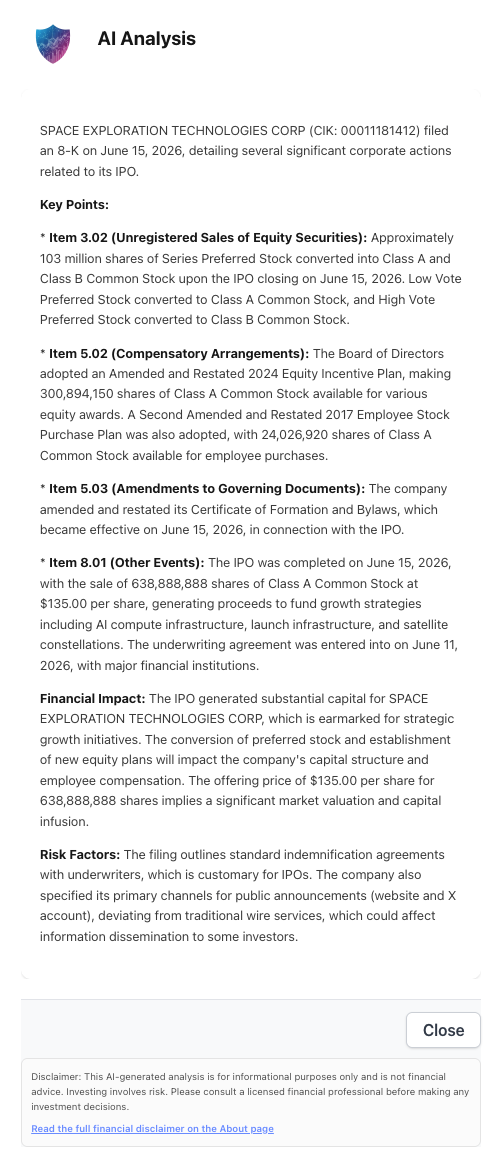
The filing bundles four corporate actions into one document. Under Item 8.01, SpaceX confirms the offering of 638,888,888 Class A shares at $135.00 closed on June 15, 2026, with the underwriting agreement signed June 11. That share count matters: the base deal was about 555.6 million shares, so the underwriters exercised the full overallotment of roughly 83.3 million shares, which is what pushed the raise from the targeted $75 billion to about $86 billion.
Under Item 3.02, roughly 103 million shares of preferred stock converted into common at the close. The structure is the tell. Low Vote Preferred became Class A common, while High Vote Preferred became Class B common. That is the dual-class machinery that keeps voting control concentrated with insiders even after a public listing.
Under Item 5.03, the company adopted an amended Certificate of Formation and Bylaws effective at close. Under Item 5.02, the board set up the equity plans that will compensate employees going forward.
The detail most investors will skim past
Here is the number worth slowing down for. The amended 2024 Equity Incentive Plan reserves 300,894,150 shares of Class A common stock for future awards, and the amended 2017 Employee Stock Purchase Plan reserves another 24,026,920 shares.
The misconception is that an IPO price tag tells you what you are buying. It does not. A reserve of roughly 301 million shares is the future dilution pipeline, and it is the kind of figure that lives in Item 5.02 rather than the press release. It does not make the stock good or bad on its own. It is simply part of the real share math that the $135 headline leaves out.
Where the money goes, and why it is not just a rocket story
The use of proceeds is the part that reframes the company. SpaceX says the capital will fund growth strategies including AI compute infrastructure, launch infrastructure, and satellite constellations. A launch company raising record capital partly to build AI compute is a signal about where management thinks the next decade of value sits, and it lines up with Starlink already driving roughly 60% of revenue.
One more disclosure is easy to miss and worth flagging. SpaceX states it will use its website and its X account as primary channels for material public announcements, rather than traditional newswires. That is a Regulation FD choice that changes how fast some investors see news, and it means following the right channels is now part of doing diligence on this stock.
The IPO price is the story everyone repeats. The share reserves, the dual-class conversion, and the disclosure channel are the story the filing actually tells. They are not in the headline.
What to watch from here
The things that will matter next are not in today’s 8-K: how $SPCX trades against a $1.75 trillion debut valuation, whether Starlink’s growth holds the revenue mix, and how quickly the reserved equity pool is put to work. But the structural facts that frame all of that, the dual-class control, the dilution pipeline, and the AI-compute use of proceeds, were sitting in the filing on day one.
The broader lesson applies to every IPO you look at. The offering size is marketing. The capital structure, the equity reserves, and the governance terms are in the filing, and they are where the durable signal lives. Read the whole filing, not the headline.
NexusAlert flagged this 8-K the same day it hit EDGAR and summarized all four items automatically. That is the point of the platform: catch the filings that move stocks the moment they post, and read the fine print so you can act on it.
Create a free NexusAlert account
Sources
Prefer to own it outright? NexusAlert lifetime access is available for a one-time payment of $299 — no subscription, no recurring charges, all future Pro features included. Learn more →