
Ryman Just Paid $1.38 Billion for the Ritz-Carlton and JW Marriott in Orlando
Ryman Hospitality agreed to buy the Grande Lakes Orlando resort for $1.38 billion. The insider buying you might spot on the filing is dividend reinvestment, not conviction. Here is how to tell the difference.
The company behind the Grand Ole Opry just bought a Ritz-Carlton
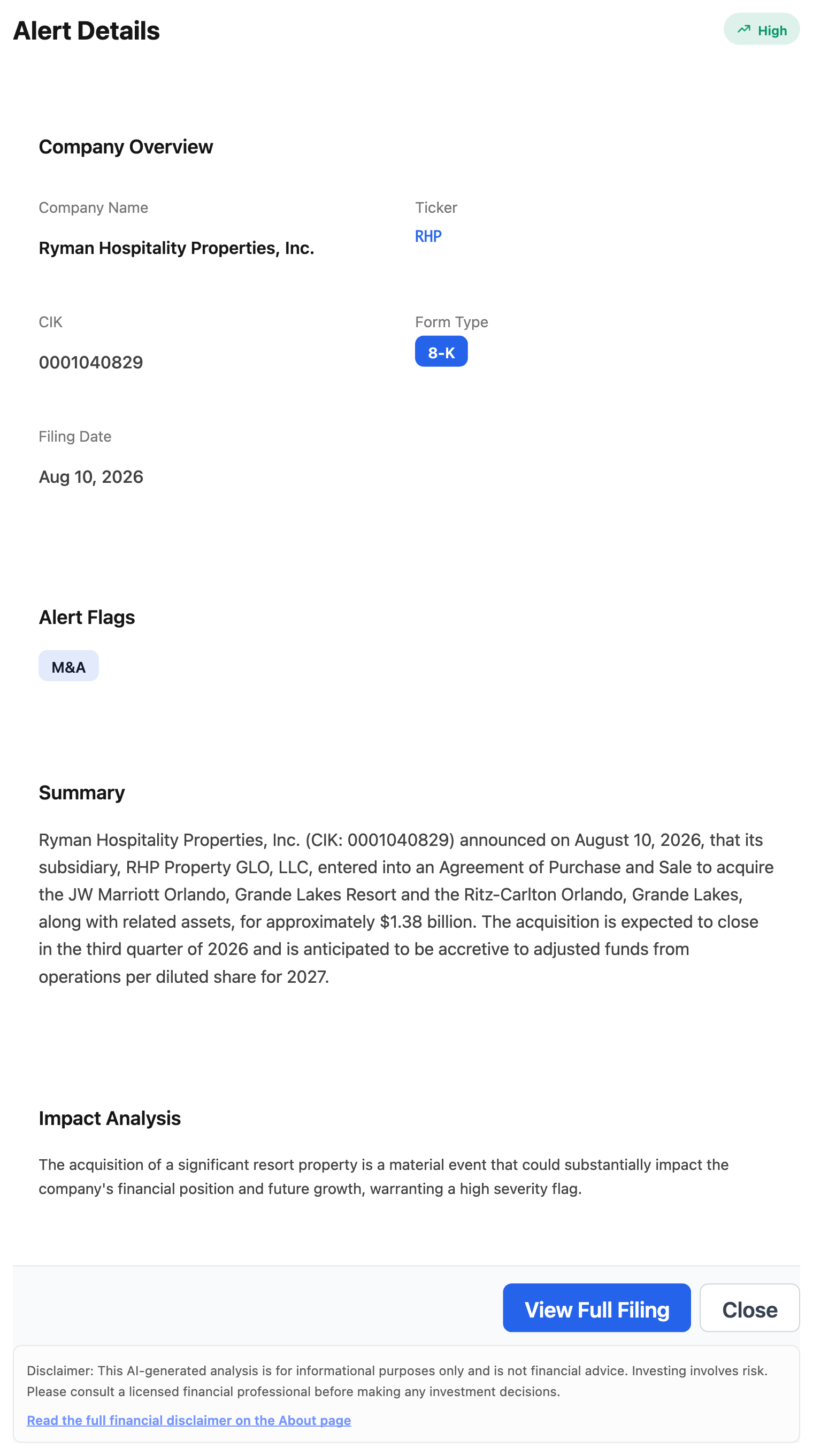
On August 10, 2026, Ryman Hospitality Properties ($RHP) filed an 8-K disclosing that its subsidiary RHP Property GLO, LLC signed an agreement to acquire the Grande Lakes Orlando resort for approximately $1.38 billion in cash. The property is a 409-acre complex holding a 1,010-room JW Marriott and a 582-room Ritz-Carlton, plus a Greg Norman designed golf course, and Ryman is buying it from Trinity Investments.
Ryman is best known for owning the Grand Ole Opry, the Ryman Auditorium, and the giant Gaylord convention resorts. This deal hands it its first Ritz-Carlton, one of the most recognizable luxury hotel names in the country, and cements its position in Orlando, the top meetings market in North America.
So here is the honest question, and it is not rhetorical. If you pulled up Ryman this morning, you might also have seen its Executive Chairman flagged as a repeat buyer of the stock. Insider buying plus a billion-dollar acquisition sounds like management doubling down. Is that what is actually happening?
Read the filings against each other and the answer is more careful than the headline.
What the filing actually says
The economics are specific. The $1.38 billion price is 12.5 times the property’s Adjusted EBITDAre for the twelve months through June 30, 2026, which works out to about $110 million of trailing property earnings. Ryman expects the deal to close in the third quarter of 2026 and to be accretive to adjusted funds from operations per diluted share in 2027.
There is a tell about price too. Trinity Investments bought Grande Lakes in December 2018 for roughly $870 million, backed by Elliott Investment Management. Selling it now for $1.38 billion is close to a $510 million gain, about 59% higher, in under eight years. That is the seller’s return, and it is a useful anchor for whether Ryman is paying up.
To fund it, Ryman did not just wave the balance sheet. The same day, it launched an offering of 5,100,000 shares of common stock and filed a fresh debt shelf. Issuing stock to help pay for an acquisition dilutes existing holders, which is why the shares slipped on the news even though the deal itself reads as a growth move.
The misconception this busts
Now back to the insider buying. On the surface, Executive Chairman Colin V. Reed looks like a steady buyer. His Form 4 filings show purchases coded as buys, roughly $800,000 at a time, several times over the past year. A green Purchase tag feels like conviction.
Read the footnote and it changes. Each of those purchases is the reinvestment of previously accrued cash dividends into Mr. Reed’s SERP account, a deferred-compensation plan, not a fresh-cash open-market bet. The August 13, 2025 filing spells it out: 8,611 shares acquired at $95.208, footnoted as dividend reinvestment. It is not money he chose to pull out of his pocket and put into the stock that morning. It is his own deferred pay rolling back into shares automatically.
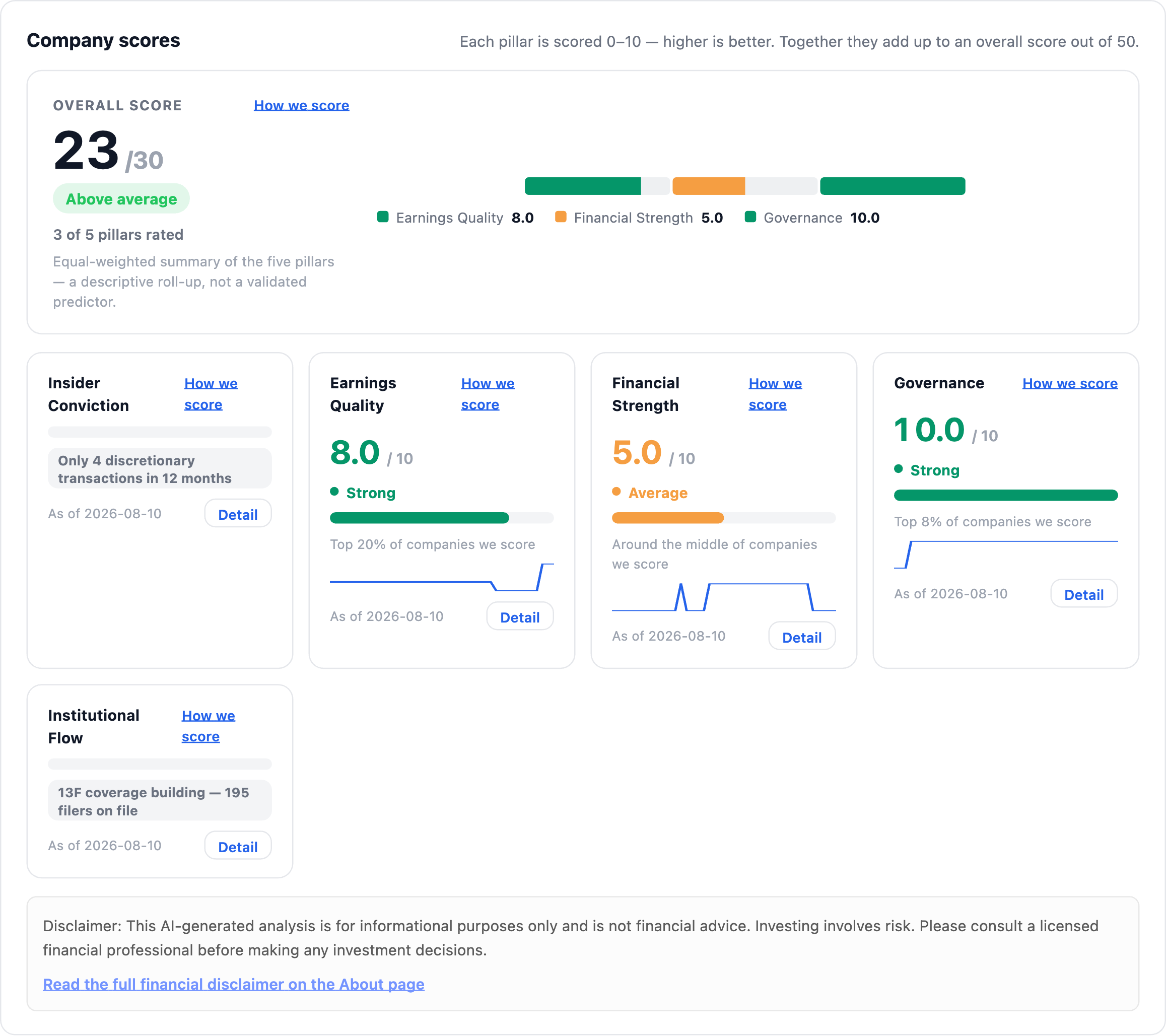
That distinction matters, and it cuts both ways. A Form 4 that says Purchase is not automatically an insider reaching for his wallet, in the same way a Form 4 that says Sale is not automatically an insider losing faith, because a lot of sales are just tax withholding at vesting. The code tells you the mechanics. The footnote tells you the meaning. NexusAlert’s own Company Dossier is blunt about it: on the Insider Conviction pillar, Ryman shows only 4 discretionary transactions in 12 months, which is why that pillar is not even scored.
One green Purchase tag is not conviction. Conviction is fresh cash, freely chosen. Everything else is plumbing.
The bigger pattern is in the scorecard, not the insider table
Strip out the noise and the real signals on Ryman are elsewhere. On the NexusAlert Company Dossier, the company carries an overall score of 23 out of 30 rated, with Governance at a perfect 10.0, the top 8% of companies scored, and Earnings Quality at 8.0, the top 20%. Financial Strength sits at an average 5.0, which is the honest read on a REIT that just committed $1.38 billion and is funding part of it with new stock and debt.
That is a cleaner backdrop for judging this deal than any single insider line. A top-decile Governance score and strong Earnings Quality say the company clearing this transaction is well run and reports believable numbers. The average Financial Strength score is the caution flag, and it lines up exactly with why the stock dipped: the equity raise. The scorecard and the price action tell the same story, and neither of them is the insider table.
What to watch
The deal still needs to close, which Ryman expects in the third quarter of 2026 subject to customary conditions. Watch the size and pricing of the 5,100,000-share offering, since that sets how much dilution existing holders actually absorb, and watch whether management reaffirms the 2027 accretion math once the financing is locked. The 12.5 times multiple is the number to hold them to.
NexusAlert fired a High severity M&A alert on Ryman the morning the 8-K posted, pulled the exact price and the named hotels out of the filing, and put the insider activity in context instead of taking the Purchase tag at face value. That is the difference between seeing a green buy and understanding what it is. Read the whole filing, not the headline, and not the tag.
Create a free NexusAlert account
Sources
- Ryman Hospitality Properties, Inc. to Acquire Grande Lakes Orlando Resort for $1.38 Billion (GlobeNewswire, August 10, 2026)
- Ryman Hospitality Properties, Inc. Announces Offering of 5,100,000 Shares of Common Stock (StockTitan, August 10, 2026)
- Trinity Investments Sells Grande Lakes Orlando Resort for $1.38 Billion (StockTitan, August 10, 2026)
- Ryman Hospitality Form 4 for Colin V. Reed, dividend reinvestment into SERP account, filed August 13, 2025 (StockTitan)
- Trinity Investments and Elliott Acquire Grande Lakes Orlando Resort (Paul Hastings, December 2018)
Prefer to own it outright? NexusAlert lifetime access is available for a one-time payment of $299 — no subscription, no recurring charges, all future Pro features included. Learn more →