
Kimberly-Clark Just Borrowed $4.9 Billion for Tylenol. A Director Put In $1 Million First.
Kimberly-Clark priced $4.9 billion of notes at 5.1% to 5.8% to fund the Kenvue deal. Director Todd Maclin bought $1.0 million of the stock in February.
$1.0 million. That is what Kimberly-Clark director Todd Maclin spent on 10,000 shares of the company behind Kleenex, Huggies and Cottonelle in early February, at about $104 a share. Eight months later, Kimberly-Clark borrowed $4.9 billion to help pay for Kenvue, the company behind Tylenol, Band-Aid and Listerine.
What happened
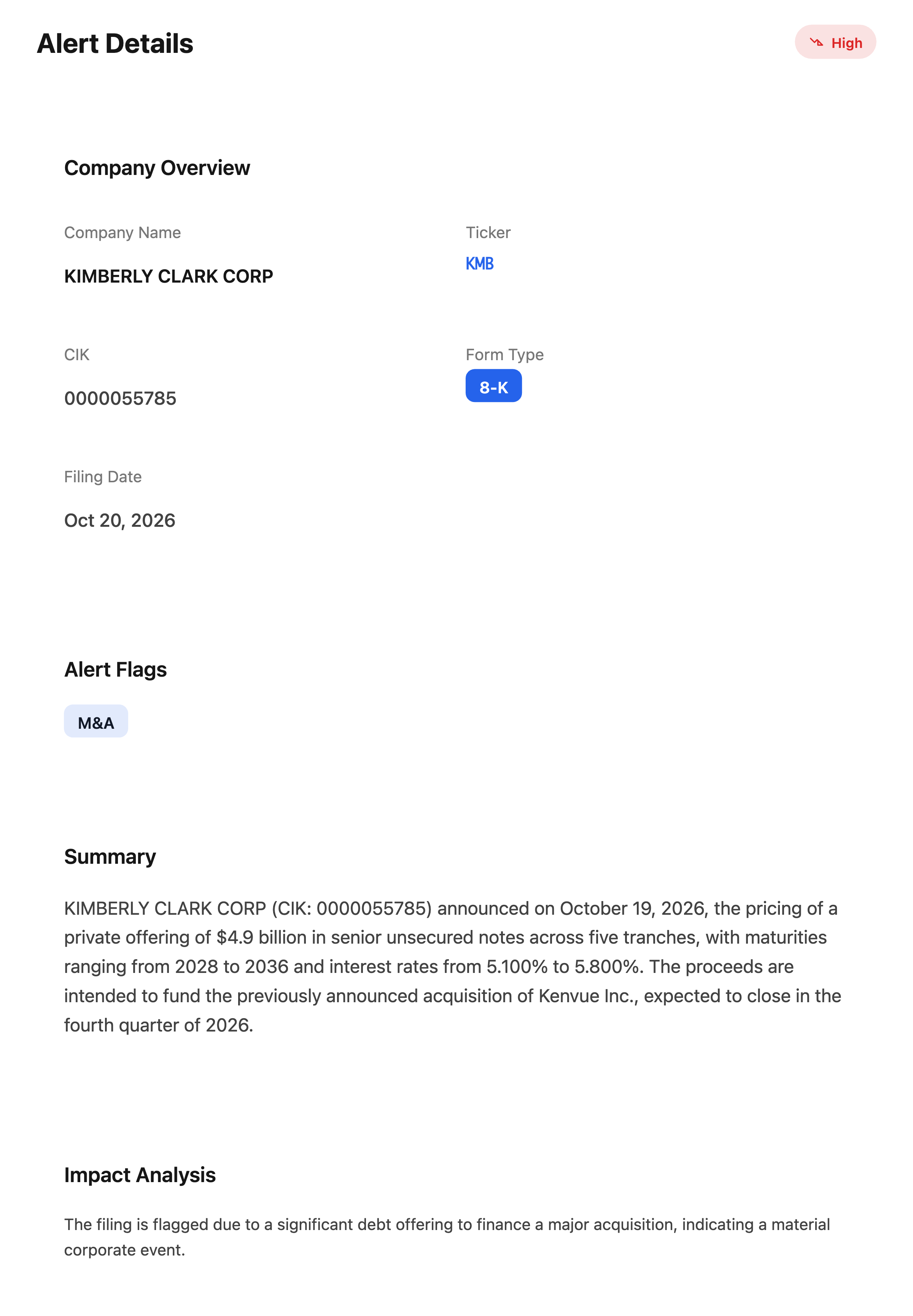
Kimberly-Clark priced a private offering of $4.9 billion in senior unsecured notes on October 19, 2026, and disclosed it in an 8-K filed October 20. The notes come in five tranches:
- $750 million at 5.100%, due 2028
- $1 billion at 5.300%, due 2029
- $1.25 billion at 5.450%, due 2031
- $750 million at 5.650%, due 2034
- $1.15 billion at 5.800%, due 2036
The offering is expected to close October 29. The proceeds, plus cash on hand and commercial paper, will fund the cash portion of the Kenvue acquisition, which the company expects to close in the fourth quarter of 2026.
NexusAlert flagged the 8-K High severity on its filing date, tagged it M&A, and read it as a risk rather than an opportunity. That is the right call for a filing that adds nearly $5 billion of debt.
The question: is $4.9 billion of new debt a red flag?
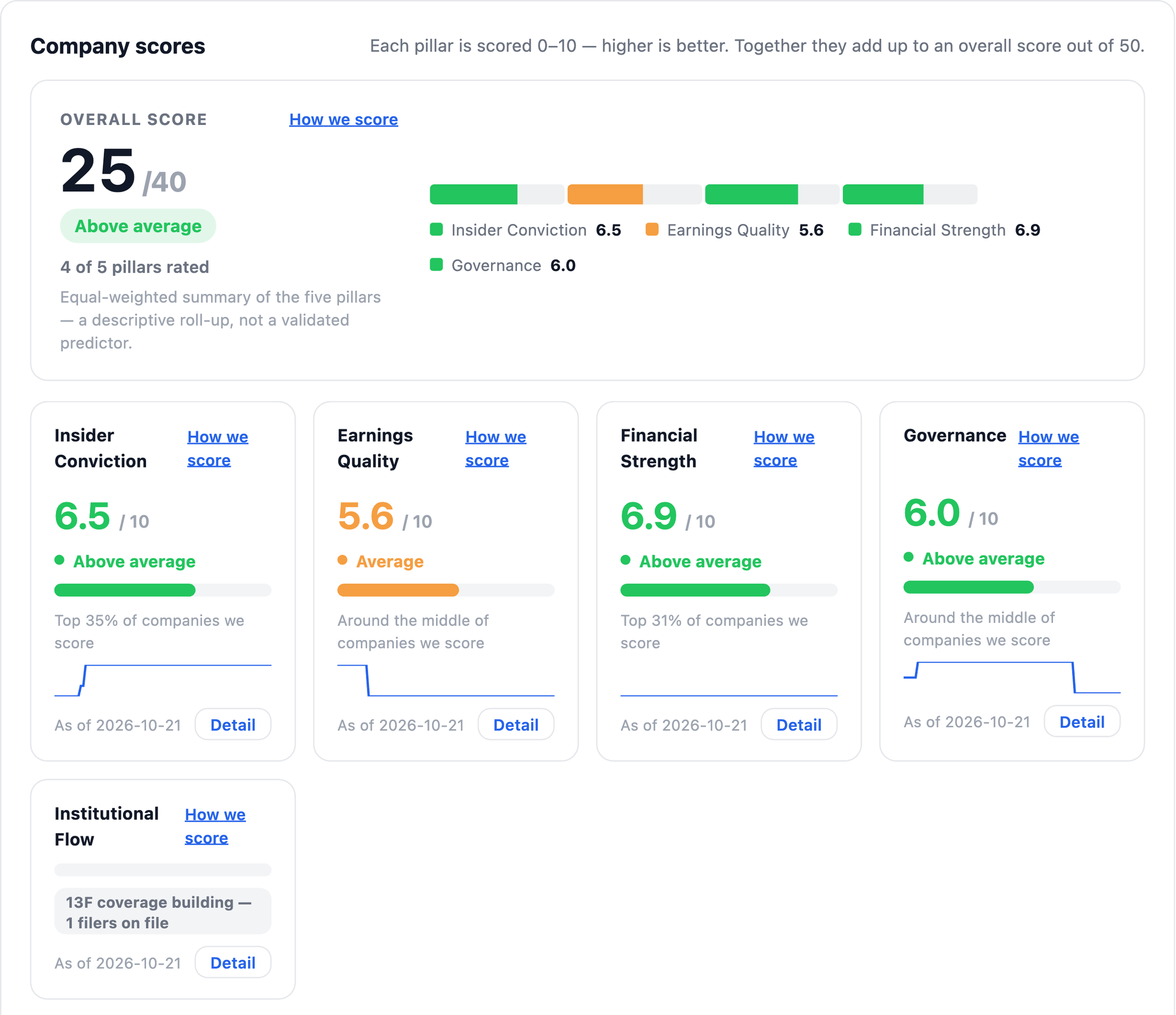
Not on its own. The coupons are real: 5.1% to 5.8% across maturities from 2028 to 2036 means a meaningful jump in interest expense, and the AI Analysis says so plainly. But the Company Dossier shows a balance sheet that can carry it. Kimberly-Clark’s Financial Strength score is 6.9 out of 10, in the top 31% of companies NexusAlert scores. Governance is 6.0, Earnings Quality is 5.6, and the overall score is 25 out of 40 across the four pillars that are rated.
Institutional Flow is not yet rated, because 13F coverage for the name is still building. That is a gap in the data, not a verdict.
The misconception: $4.9 billion is not the price of the deal
A headline that says “borrows $4.9 billion to buy Kenvue” sounds like the whole bill. It is not. When the deal was announced on November 3, 2025, it was valued at about $48.7 billion including debt. Kenvue shareholders receive $3.50 in cash plus 0.14625 Kimberly-Clark shares for each share they own, and the cash portion comes to roughly $6.8 billion.
Most of the price is paid in Kimberly-Clark stock. The bonds fund the cash piece.
There is a second detail that only the filing shows. The offering is not conditioned on the acquisition closing. But if the deal is not completed by the outside date (the later of May 31, 2027 or a date the parties agree to) or Kimberly-Clark decides not to pursue it, the company must redeem the notes at 101% of principal plus accrued interest. That clause protects lenders, and it explains why the notes could be sold before the deal closes.
The person: a director who bought after the deal was public
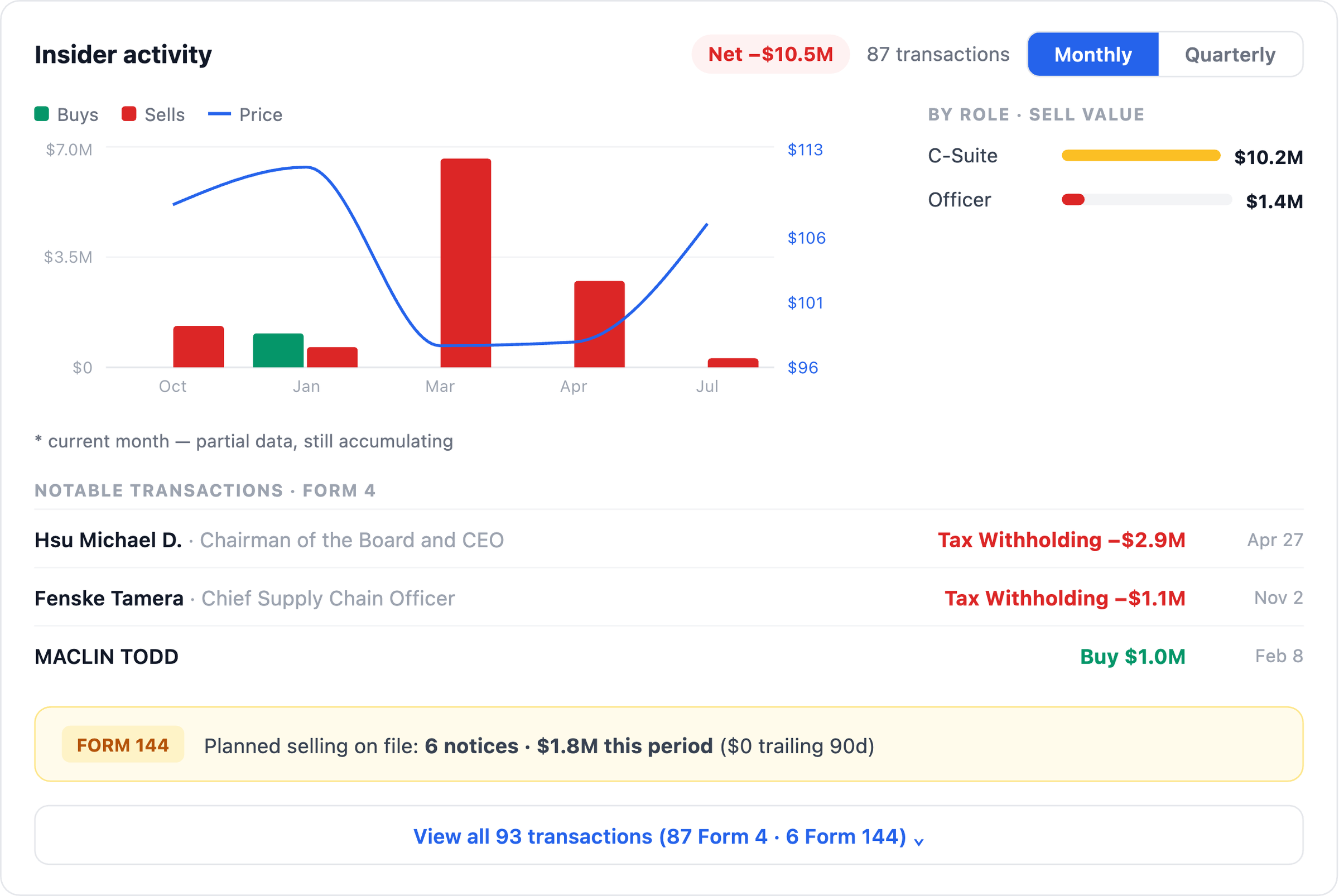
Now back to Maclin. The Dossier’s Insider activity card shows net selling of $10.5 million across 87 transactions. Read that number alone and it looks like executives heading for the exits.
Open the notable Form 4 lines and the picture changes. CEO Michael Hsu’s $2.9 million line on April 27 and Chief Supply Chain Officer Tamera Fenske’s $1.1 million line on November 2 are both tax withholding, the shares a company automatically holds back when stock vests to cover taxes. Neither is a decision to sell. The one voluntary named trade on the list is Maclin’s $1.0 million open-market buy.
Timing matters here. The Kenvue deal was announced in November. Maclin bought in February, with the deal already public. That is not a tip ahead of news. It is a director putting his own money behind the combined company after the market had digested the announcement.
None of this proves every dollar of the $10.5 million is mechanical. C-Suite sell value is $10.2 million, and the card also lists six Form 144 notices for $1.8 million of planned selling. It does mean the headline total cannot be read as conviction until you open the table.
The bigger pattern
Debt, deal terms and insider trades rarely arrive in the same news cycle. The bond headline lands this week, the deal terms were announced last November, and the director’s Form 4 was filed in February. Each piece looks different alone. Together they tell a more balanced story: lenders charged 5.1% to 5.8% for the risk, and one director paid about $104 a share for conviction.
The lesson
A bond headline tells you a company borrowed. Only the filing tells you what for, what happens if the deal fails, and who is on the hook. And only the transaction table tells you whether “insider selling” means people leaving or just taxes being paid.
Lenders price the risk. Directors price the conviction.
Read the whole filing, not the headline.
Create a free NexusAlert account to get same day alerts on 8-Ks and Form 4s like these, with the Company Dossier to show you what is behind the number.
Sources
- Kimberly-Clark Corporation announces pricing of $4.9 billion private offering of senior notes (PR Newswire via StockTitan, October 19, 2026)
- Kimberly-Clark prices $4.9B senior notes across five tranches to fund Kenvue acquisition (TradingView News)
- Kimberly-Clark to acquire Kenvue, enterprise value about $48.7 billion (Nasdaq)
- Top buys: director Maclin’s $1M bet on KMB (Nasdaq)
- Kimberly-Clark SEC filings (8-K and Form 4) (SEC EDGAR)
Prefer to own it outright? NexusAlert lifetime access is available for a one-time payment of $299 — no subscription, no recurring charges, all future Pro features included. Learn more →