
GameStop Just Bid $55.5 Billion for eBay — And the 8-K Reads Like a Cohen Manifesto
GameStop's May 3, 2026 8-K disclosed a non-binding $125-per-share cash-and-stock proposal for eBay. Here's what the filing actually says — and why the SC 13D paired with it matters more than the headline.
Ryan Cohen has done a lot of audacious things since taking over GameStop. Bidding $55.5 billion in cash and stock for eBay on a Sunday afternoon is a new high. On May 3, 2026, GameStop Corp. (NYSE: GME) filed an 8-K disclosing a non-binding proposal to acquire 100% of eBay Inc. (NASDAQ: EBAY) at $125.00 per share. Cohen would lead the combined company. His compensation would be entirely performance-based.
Bloomberg, CNBC, and Fortune ran the story within hours. But the 8-K — and the matching SC 13D filed by GameStop the same day disclosing 5.0% economic exposure to eBay — is where the actual negotiating posture lives. The wire copy gives you the price. The filings give you the leverage.
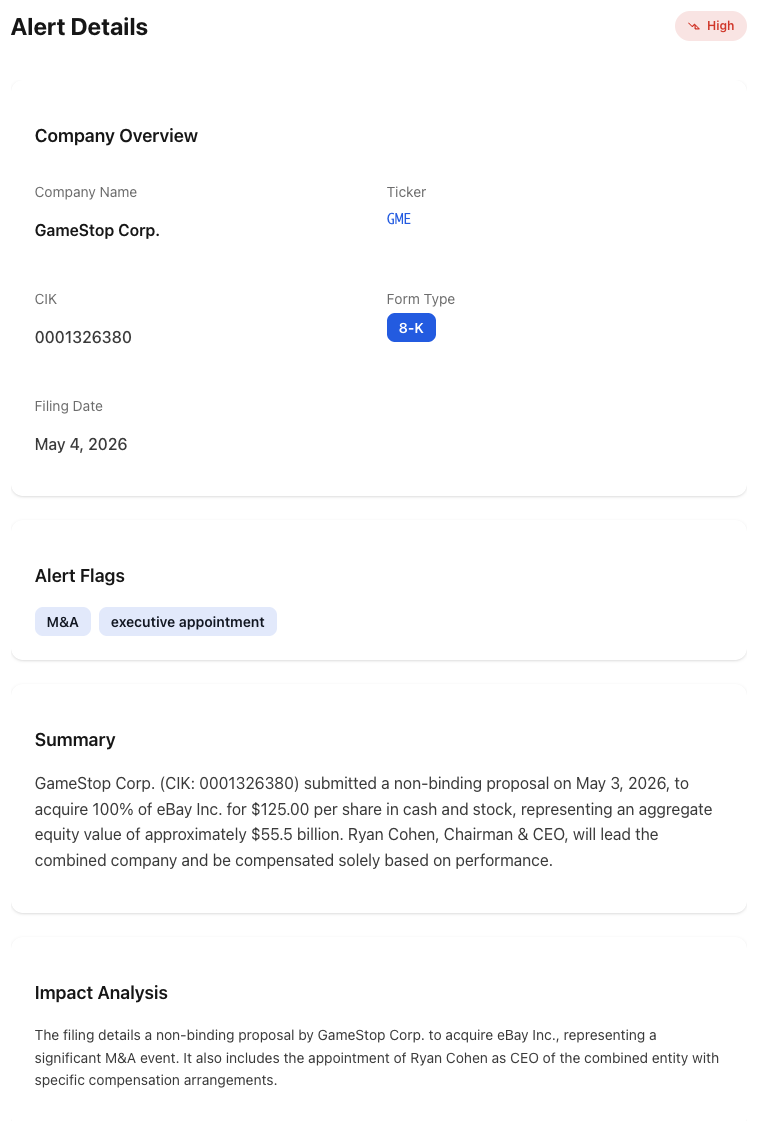
Two flags fired on one filing: M&A and executive appointment. That stack is the fingerprint of a bid that has terms and an operational thesis on the same page — not a price-only approach.
The Two-Filing Pattern That Tells You How Serious This Is
Most unsolicited bids show up in one filing — usually a public letter attached as an 8-K Item 8.01 exhibit. Cohen filed two on the same day:
- GameStop’s 8-K — discloses the proposal, the price ($125/share), the structure (cash and stock), and the post-close governance (Cohen as CEO, performance-only comp).
- eBay’s matching SC 13D — discloses GameStop’s 5.0% economic exposure to eBay, with “plans or proposals” language under Item 4 that maps directly to the 8-K proposal.
That paired sequence is the structural signature of a hostile or quasi-hostile bid that has already been turned down once privately. The SC 13D 5%-position is what gives the bidder a right to keep filing — and a public platform to escalate. The 8-K is the opening offer; the 13D is the implicit threat that this isn’t going away if the board says no.
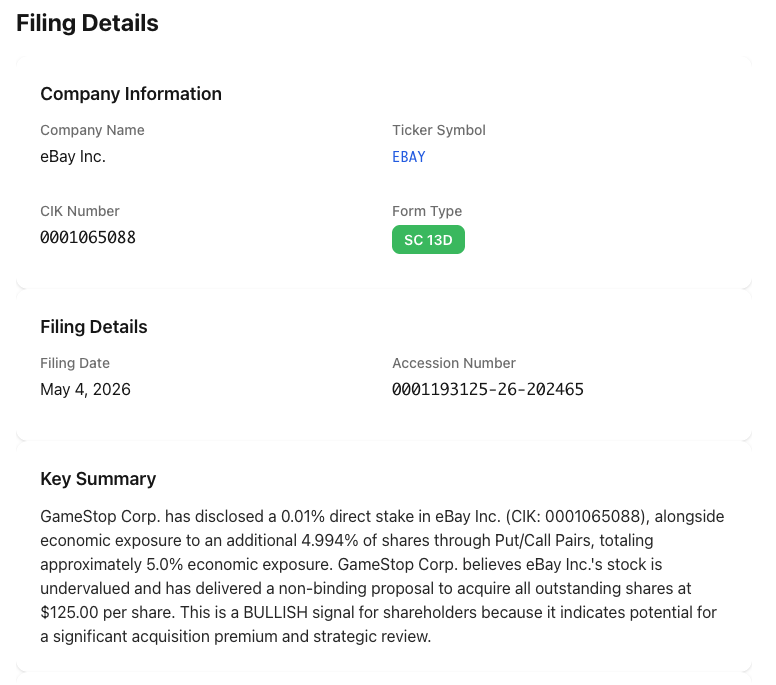
The economic-exposure breakdown in the SC 13D is the part most readers will skim past. It is the most informative paragraph in either filing. 0.01% direct + 4.994% via Put/Call Pairs = ~5.0% economic exposure. Constructing the stake mostly through options instead of an outright equity purchase keeps the cash outlay small while still producing a >5% reporting trigger that forces public disclosure. That is a deliberate filing-architecture choice, not an accident of execution.
Why $125 Per Share Is the Number That Matters
The aggregate equity value cited in coverage — ~$55.5B — is the headline. The per-share number is the negotiating anchor:
- $125.00 per share — fixed cash-and-stock consideration disclosed in the 8-K.
- eBay’s recent trading range — well below the bid, which is why the stock spiked on the announcement.
- The stock-component dilution — GameStop has already telegraphed via Cohen’s commentary that it would issue shares to fund the cash portion. That makes GME a pro-forma capital-structure trade as much as it makes EBAY an event-driven one.
The 8-K is careful to label the proposal “non-binding.” That language is the legal wrapper that lets GameStop walk if the board engages and the diligence comes up short — but it’s also the language that tells eBay’s board this is a serious, well-advised approach, not a Twitter-storm bid.
What the M&A + Executive-Appointment Flag Combo Signals
The filing carried two flags: Merger/Acquisition and executive appointment. That combination is rare on an unsolicited proposal, and it’s diagnostic.
- Merger/Acquisition alone — a strategic bid at a market premium. The acquirer’s board has approved the offer; deal terms are negotiated; the target board responds.
- Executive appointment alone — leadership change at an existing public company. Common in proxy contests, succession events, or post-merger integration.
- M&A + executive appointment together on the bidder side — the acquirer is signaling who runs the combined entity before the target’s board has agreed to anything. That’s a public claim of operational control, not just capital control.
Cohen has done this playbook before — at Chewy, at Bed Bath & Beyond, at GameStop itself. The 8-K’s executive-appointment flag is what turns this from a financial bid into a Cohen-style operating thesis.
Why eBay’s Board Has a Hard Decision
The 8-K is structured to make a “no thank you” response expensive for eBay’s directors. Three pieces of the disclosure work together:
- The premium — $125 against eBay’s recent close puts a number on the table the board has to publicly justify rejecting.
- The performance-only CEO comp — Cohen taking no base salary removes the easy “self-dealing” rebuttal that targets often use to dismiss outside bids.
- The 5% SC 13D filing — GameStop is now a reporting holder, which means every future move (more buying, a tender offer, a proxy contest) has a defined disclosure path that the public can track in real time.
That’s the structural pressure that wire-service coverage usually doesn’t capture. The filings are designed to constrain the target’s response options, not just announce a price.
Why the Vanguard 13G on eBay Is Not the Story Here
There’s a temptation to read every pre-bid 5%-threshold filing as institutional accumulation. On April 29, 2026, an SC 13G from Vanguard Portfolio Management on EBAY showed up — 5.23%, 23,459,787 shares, classified as a NEW POSITION:
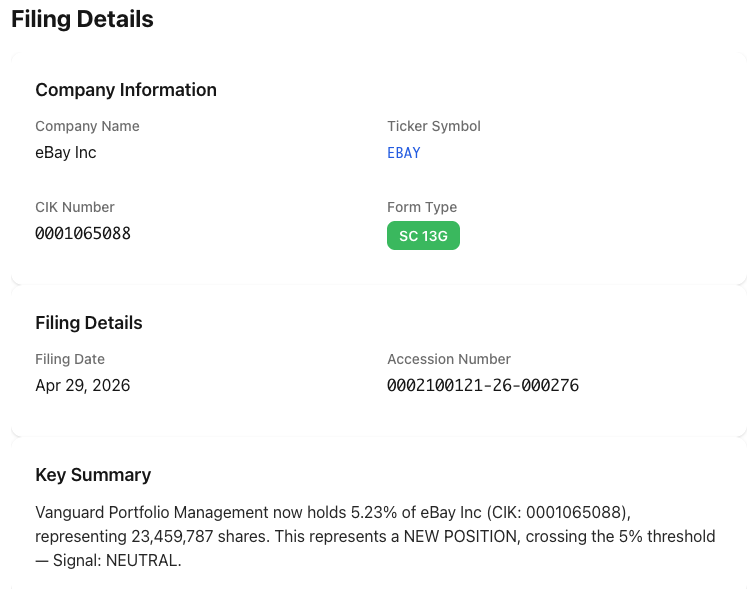
This is not directional accumulation. It is part of the Vanguard structural-restatement wave — 1,411 13G filings on 1,131 companies, where Vanguard re-stated existing economic exposure under a reorganized reporting entity. The shares were already there; the entity name on the cover page changed.
The alert handled this correctly: signal classified NEUTRAL despite the “NEW POSITION” entity-level label. That distinction is the whole point of layering AI signal classification over filing-level metadata. A 5%-threshold cross is a reporting event; whether it is directional is a separate inference, and the alert is built so the two read independently.
For a bid storyline this matters in a specific way: the GameStop / eBay narrative cannot lean on “institutions were accumulating ahead of the bid.” They weren’t, at least not via this filing. The actual institutional landscape — and the cap table the bid will have to win over — sits in the 13F panel, not the 13G wave.
The Cap Table the Bid Has To Win
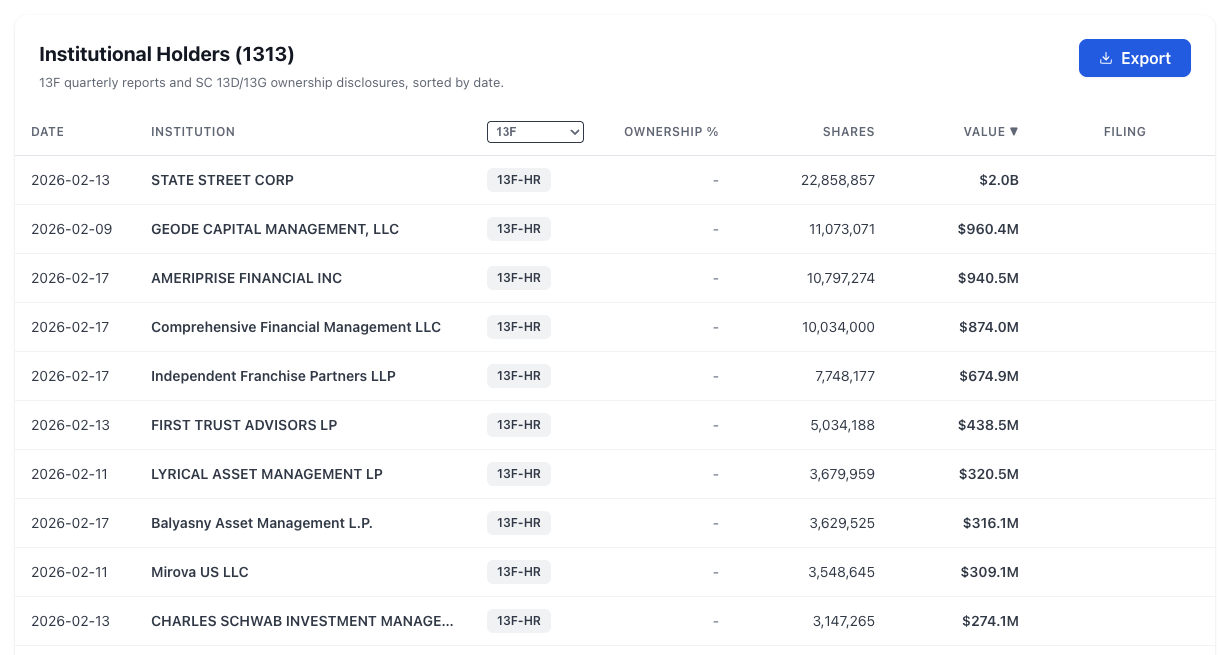
1,313 institutional holders. State Street alone holds $2.0B; the top five 13F holders together hold close to $5.4B. Any unsolicited bid at this scale is, structurally, a campaign to win those 13F holders’ votes — not just the board’s. The institutional table is where the response will be decided, and the next quarter’s 13F flow is the leading indicator of how the holders are reacting.
What This Looks Like on a Watchlist
If EBAY and GME were both on a NexusAlert watchlist heading into May 3, 2026, the notification stack would have lit up with both sides of the same event in real time:
- GME 8-K — High / Opportunity, flags: Merger/Acquisition + executive appointment, summary: non-binding proposal, $125.00/share, ~$55.5B aggregate.
- EBAY SC 13D — High / Opportunity, flags: institutional ownership, 5.0% economic exposure, Item 4 plans-or-proposals language matching the 8-K.
- Cross-link — both filings tagged as the same M&A event for one-click navigation between bidder and target perspectives.
That’s the shape of a real bilateral M&A signal. One notification gives you the bidder’s terms; the second gives you the target’s reporting-holder status; together they tell you the negotiating posture before the next press cycle.
Unsolicited bids that show up as paired 8-K and SC 13D filings on the same day aren’t trial balloons. They’re the start of a clock.
Why M&A Detection Has to Be Bilateral
Most M&A trackers are built around one side of the deal. The acquirer announces; the press release goes out; the alert fires. That model misses the more informative half of the event:
- The target-side disclosure — when the target hasn’t agreed yet, the SC 13D from the bidder is often the only filed evidence that the approach is real.
- The board-response 8-K — targets usually respond to unsolicited bids with their own 8-K Item 8.01 disclosure within days. Tracking only the bidder side means missing the response.
- The proxy-contest escalation — if the target rejects, the bidder typically files DEF 14A material to launch a contested election. That filing flow is its own signal track.
NexusAlert ties bidder and target together at the alert level. When GME files an 8-K naming EBAY as the target, the alert is cross-listed against EBAY watchlists. When EBAY files its response 8-K or its own DEF 14A, both tickers’ subscribers see the next move automatically.
How to Track Mega-Cap M&A Without Reading Every 8-K
There are 6,000+ 8-K filings hitting EDGAR every week. A tiny fraction contain unsolicited bids; an even smaller fraction pair 8-Ks with SC 13D filings on the same day. Filtering for that specific pattern manually is impractical.
NexusAlert’s M&A flag stack runs the filter automatically:
- Parses every 8-K Item 1.01 / 8.01 disclosure for proposal language, per-share consideration, and aggregate deal value
- Cross-references SC 13D and SC 13G filings on the same day for paired bidder-target signals
- Flags performance-only or contingent CEO comp language as a Cohen-style operating-bid signature
- Surfaces the matching target-side disclosure within minutes of the bidder filing
- Rolls into the Investor Trends view so subscribers see the multi-day arc, not just the announcement-day spike
The GameStop / eBay 8-K and SC 13D pair fired as a High-severity Opportunity alert in real time — with the price, the flag stack, and the bilateral linkage parsed before the headline cycle started.
Catch the Next $55B Bid the Day It Files
Create a free NexusAlert account to get AI-powered alerts on M&A 8-Ks, paired SC 13D filings, and unsolicited-bid signals across every public company — with deal terms, flag stacks, and bidder-target cross-links parsed for you in real time.
Sources
Prefer to own it outright? NexusAlert lifetime access is available for a one-time payment of $299 — no subscription, no recurring charges, all future Pro features included. Learn more →