
Alphabet Prices $84.75B Equity Raise — Berkshire Takes $10B Private Placement for AI Buildout
Alphabet upsized its equity raise to $84.75B — $18B in stock, $16.75B in convertibles, a $40B ATM, and $10B direct to Berkshire. Analysis by NexusAlert.
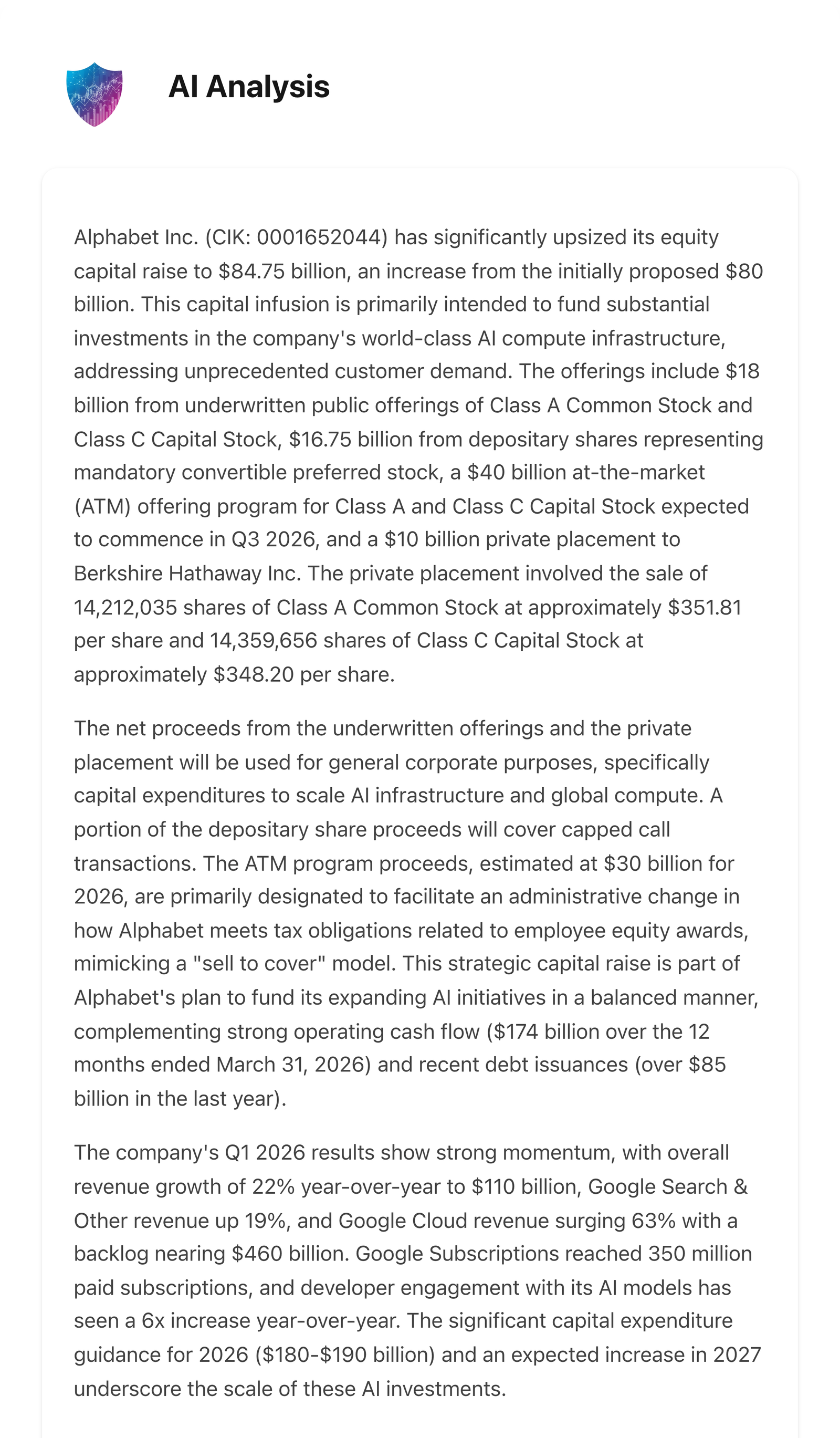
The company that famously never needed anyone’s money just asked the market for nearly $85 billion. On June 2, 2026, Alphabet Inc. (NASDAQ: GOOGL) priced an upsized equity capital raise totaling $84.75 billion in expected gross proceeds — up from the $80 billion proposed just one day earlier — and Berkshire Hathaway (NYSE: BRK.B) is taking $10 billion of it in a direct private placement. The 8-K and free writing prospectuses hit EDGAR with the full structure: $18 billion in underwritten common stock offerings, $16.75 billion in mandatory convertible preferred depositary shares, a $40 billion at-the-market program, and Buffett’s $10 billion direct allocation.
It is one of the largest equity raises in market history, and it exists for exactly one reason: AI infrastructure has become so expensive that even Alphabet’s cash machine — $174 billion in operating cash flow over the twelve months ended March 31, 2026 — can’t fund the buildout alone.
What NexusAlert Surfaced on Filing Day
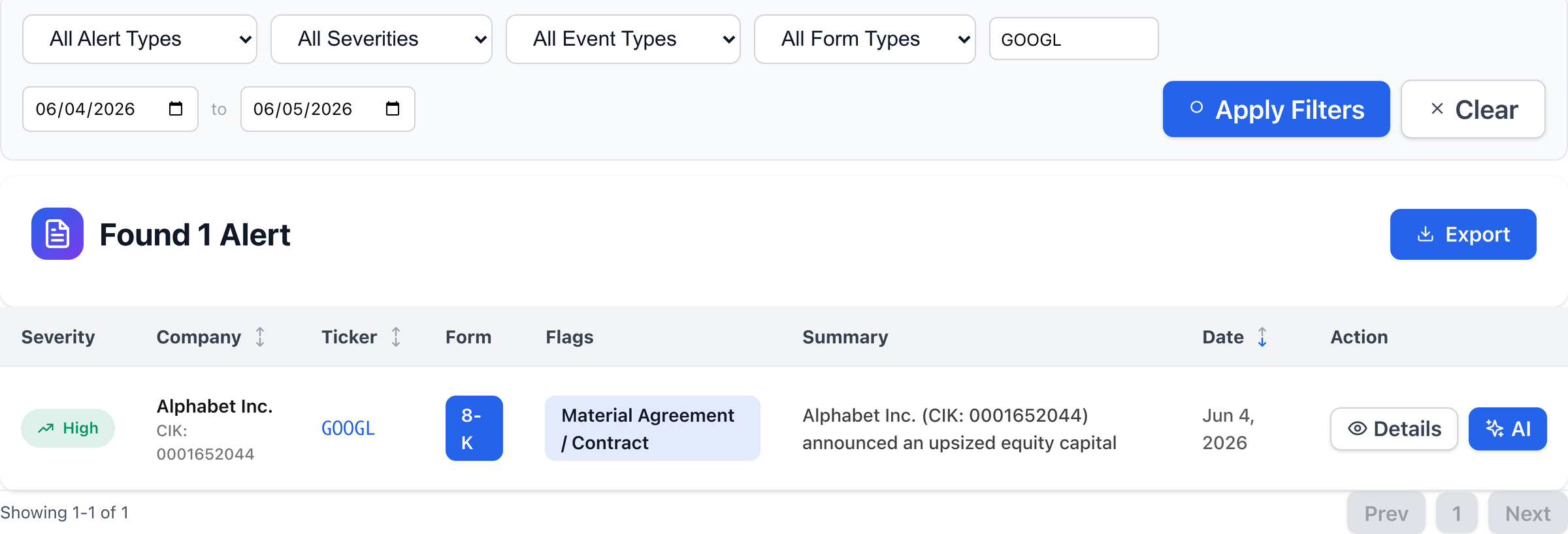
The Alphabet 8-K landed in the alerts feed as a High-severity row with the Material Agreement / Contract flag. While most headlines were still carrying the original “$80 billion proposed” figure from the June 1 announcement, the alert’s AI summary pulled the upsized $84.75 billion total straight out of the pricing filing.
The AI Analysis goes several layers deeper than the wire coverage. It itemizes every tranche of the raise, then ties it to the operating context — the Q1 numbers, the capex guidance, and the share-level detail of Berkshire’s allocation.
The Filing Facts
The raise breaks into four pieces:
- $18 billion in common stock — concurrent underwritten public offerings of Class A shares (priced at $355.1982) and Class C shares (priced at $351.8018), upsized from $15 billion.
- $16.75 billion in depositary shares representing interests in mandatory convertible preferred stock, upsized from $15 billion.
- $40 billion at-the-market (ATM) program for Class A and Class C stock, expected to commence in Q3 2026.
- $10 billion private placement to Berkshire Hathaway — 14,212,035 Class A shares at roughly $351.81 and 14,359,656 Class C shares at roughly $348.20.
The common stock offerings closed June 4; the depositary share offerings closed June 5. Proceeds fund general corporate purposes — specifically capital expenditures to scale AI infrastructure and global compute.
Why It Matters
Alphabet guided 2026 capital expenditures to $180–190 billion, roughly double the $91.4 billion it spent in 2025. Against that number, even a company that generated $174 billion in trailing operating cash flow has a funding gap. Selling equity — something Alphabet has never done at this scale — is the tell that the AI capex cycle has crossed from “funded by cash flow” to “funded by the capital markets.”
The Berkshire allocation is the signal inside the signal. Berkshire had already built an Alphabet position worth more than $16 billion since Q3 2025. Taking $10 billion directly in a private placement — at prices within a dollar of the public offering — is one of the most direct endorsements of the AI infrastructure trade that Omaha has ever given.
And the business justifies the bet, at least on current numbers: Q1 2026 revenue grew 22% year-over-year to $109.9 billion, Google Cloud grew 63% to $20.0 billion with a backlog of more than $460 billion, and EPS came in at $5.11, up 82%.
What the Tape and the Trends Say
The market’s reaction to the raise was muted — GOOGL closed at $367.60 on June 4, down 0.45%, digesting roughly 51 million new shares of supply. That’s arguably the most bullish read available: an $84.75 billion equity issuance that barely moved the stock.
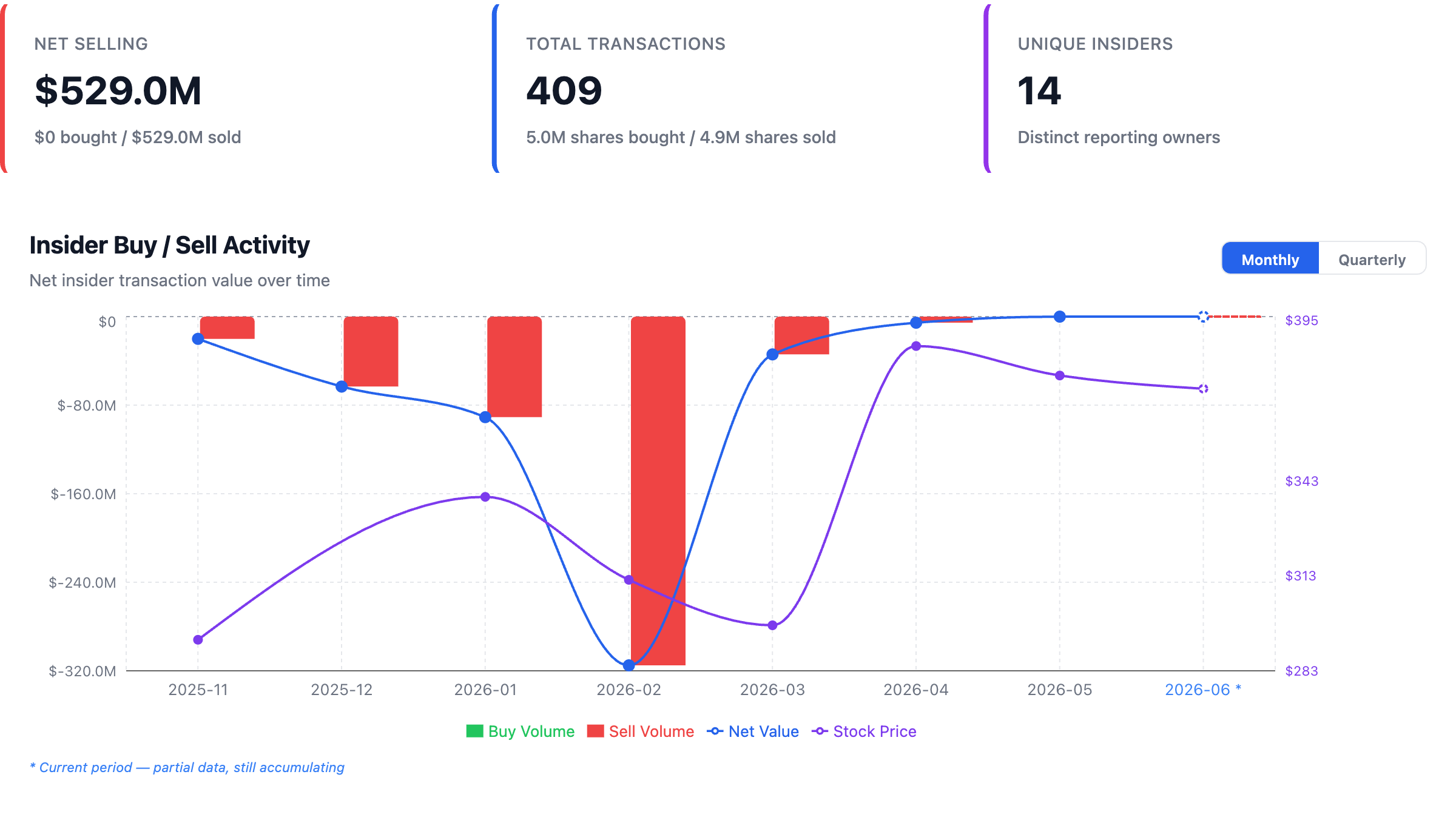
NexusAlert’s Investor Trends view adds the insider context for the same ticker: $529 million in net insider selling across 409 transactions over the trailing twelve months, with zero open-market buying — standard executive equity-award liquidation at a mega-cap, but worth watching now that employees’ “sell to cover” mechanics are being formalized through the new ATM program.
The Bigger Picture
Alphabet just established the template for funding the AI arms race: don’t drain the balance sheet, rent the equity market. A $40 billion standing ATM program means Alphabet can now sell stock continuously, quarter after quarter, as capex bills come due. If Microsoft, Meta, or Amazon follow with similar structures, the supply of mega-cap tech equity is about to grow in a way the index math has never had to absorb.
The headline number everyone reported was $80 billion. The filing said $84.75 billion. That 6% gap — nearly $5 billion — is exactly the kind of detail that lives in the pricing documents, not the press coverage.
Watchlists on GOOGL catch every follow-on filing in this sequence — the ATM launch in Q3, the quarterly issuance disclosures, and any amendment to the Berkshire stake on the next 13F cycle.
Create a free NexusAlert account to get high-severity filing alerts with AI analysis the moment they hit EDGAR.
Sources
- Alphabet 8-K — pricing of upsized offerings (SEC EDGAR)
- Alphabet press release — Proposed $80 Billion Equity Capital Raise (June 1, 2026)
- CNBC — Alphabet to raise $80 billion from stock sales to fund AI build-out
- CNBC — Berkshire Hathaway invests extra $10 billion in Alphabet
- Bloomberg — Alphabet Upsizes Equity Offering to $85 Billion for AI Spending
- Yahoo Finance — Alphabet upsizes equity raise to $84.75B
- Benzinga — Alphabet Stock Edges Lower Following Upsized AI Capital Raise
- Alphabet Q1 2026 earnings release (PDF)
- CNBC — Alphabet (GOOGL) Q1 2026 earnings
Prefer to own it outright? NexusAlert lifetime access is available for a one-time payment of $299 — no subscription, no recurring charges, all future Pro features included. Learn more →