
An Activist Declared War on Novavax's Board in an SEC Filing — the Stock Jumped 5.5%
Shah Capital filed an amended 13D on April 8 demanding a board overhaul and naming 96% shareholder dilution. The SEC filing data showed the warning signs weeks earlier.
On April 8, 2026, Shah Capital filed an amended Schedule 13D with the SEC.
Attached was an open letter accusing Novavax’s board of “value destruction,” demanding they fire 30% of senior management, cut the board from 8 to 5 members, retire a $225M convertible bond, and find a new strategic investor willing to take a 20% stake to “reshape Novavax entirely.”
Shah Capital holds 9.11% of $NVAX — 14,845,097 shares — making them the company’s second-largest shareholder.
By the end of trading that day, $NVAX was up 5.5%.
That’s the headline. But there’s a bigger story underneath it — one that was hiding in plain sight on EDGAR for weeks before the letter was written.
What the 13D Said
Shah Capital’s open letter was specific. Here’s what they put on the record:
- Novavax shares have declined 27% since 2023
- Outstanding shares have been diluted by 96% over the same period — if you owned 1% of the company in 2023, that stake has been cut nearly in half through dilution alone
- The $225M convertible bond is an overhang that needs to be retired now
- The board needs to shrink from 8 to 5 members
- Senior management headcount needs to drop 30%
- The company should authorize a buyback of 10–20 million shares
- They intend to vote against every current board nominee and against executive compensation at the 2026 annual meeting
This isn’t a strongly-worded letter. It’s a documented legal filing, on the public record, with specific metrics and specific demands. The market read it and moved.
But the NexusAlert Investor Trends data for $NVAX tells a story that started well before April 8.
The Signal That Was Already There
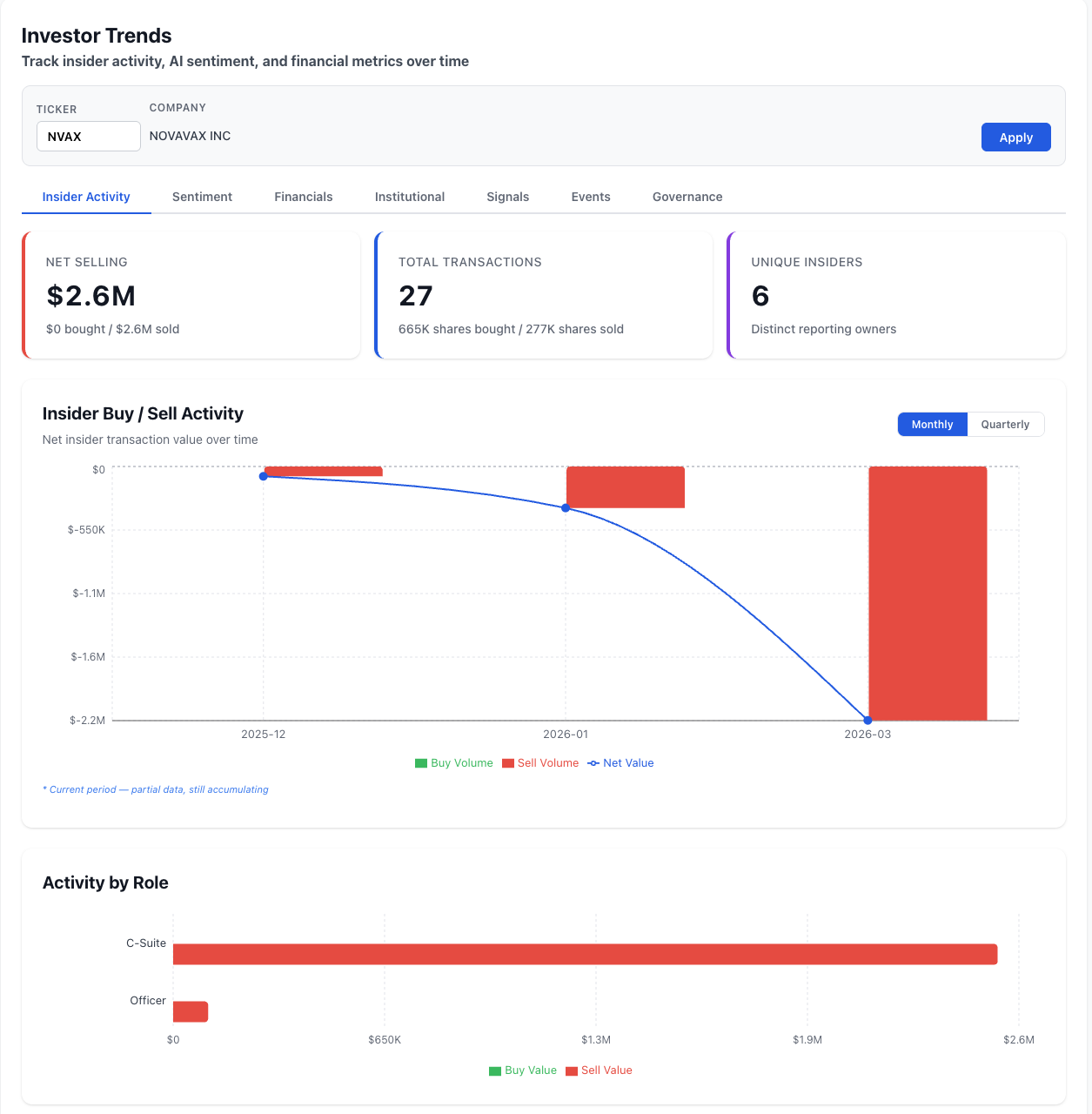
In the 90 days before Shah Capital filed, Novavax insiders sold $2.6 million in stock. They bought exactly $0.
This wasn’t one executive trimming a position. It was a pattern — six distinct insiders across 27 total transactions, all selling:
- John C. Jacobs, President and CEO — sold 69,288 shares ($658K) on March 5, 38,450 shares ($390K) on March 3, and 39,132 shares ($359K) in January
- James Patrick Kelly, EVP and CFO — sold 28,366 shares ($288K) on March 3 and 20,850 shares ($198K) on March 5
- Elaine O’Hara, EVP and Chief Strategy Officer — sold 22,429 shares ($213K) on March 5
- Mark J. Casey, Chief Legal Officer — sold 11,378 shares ($108K) on March 5
The CEO. The CFO. The Chief Strategy Officer. The Chief Legal Officer. All selling. Nobody buying. In the same weeks that Shah Capital was building its case about management failing shareholders.
Each of those sales hit EDGAR as a Form 4 filing — publicly available, the same day it was filed. The cluster selling pattern was visible. The question is whether anyone was watching.
What the Sentiment and Signals Data Shows
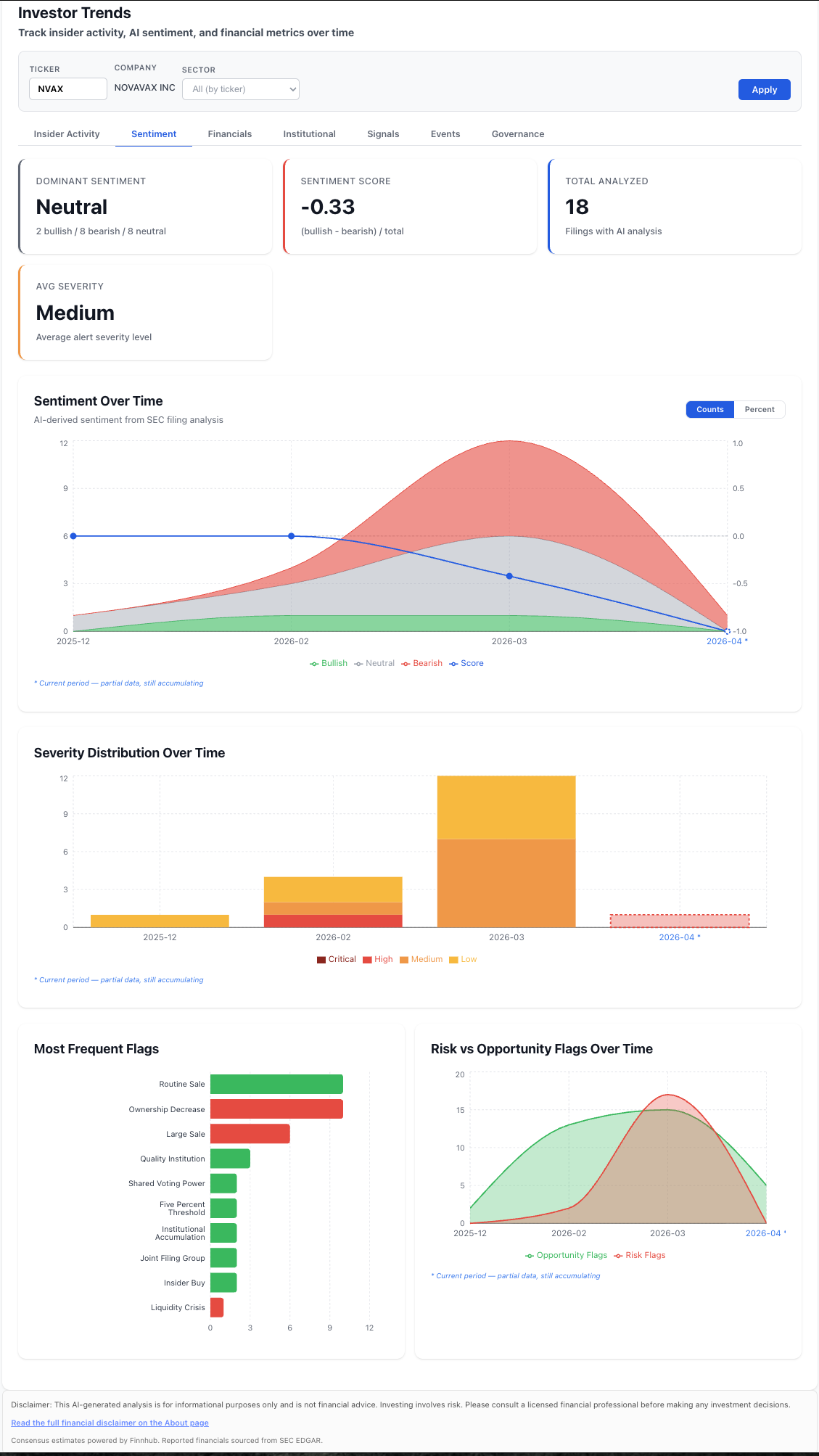
NexusAlert’s AI analyzed 18 $NVAX SEC filings over the past several months. The numbers:
Sentiment score: -0.33. Out of 18 filings analyzed, 8 were bearish, 8 were neutral, and only 2 were bullish. Bearish filings peaked through March 2026 — the same period as the insider selling spike.
Smart Money score: 32/100 (Below Average). The Smart Money composite pulls from insider buying, C-suite purchases, new institutional positions, filing sentiment, and opportunity flags. With $-2.6M net insider activity in 90 days and only 12% bullish filings, the score reflects what the raw data shows: the people closest to this company were not putting money in.
Distress Warning score: 35 (Low Risk). Here’s the nuance — despite all of the above, Novavax is not a company in acute distress. The Distress Warning score comes in at Low Risk. One distress flag, 5 unique sellers in 90 days, but no financial emergency.
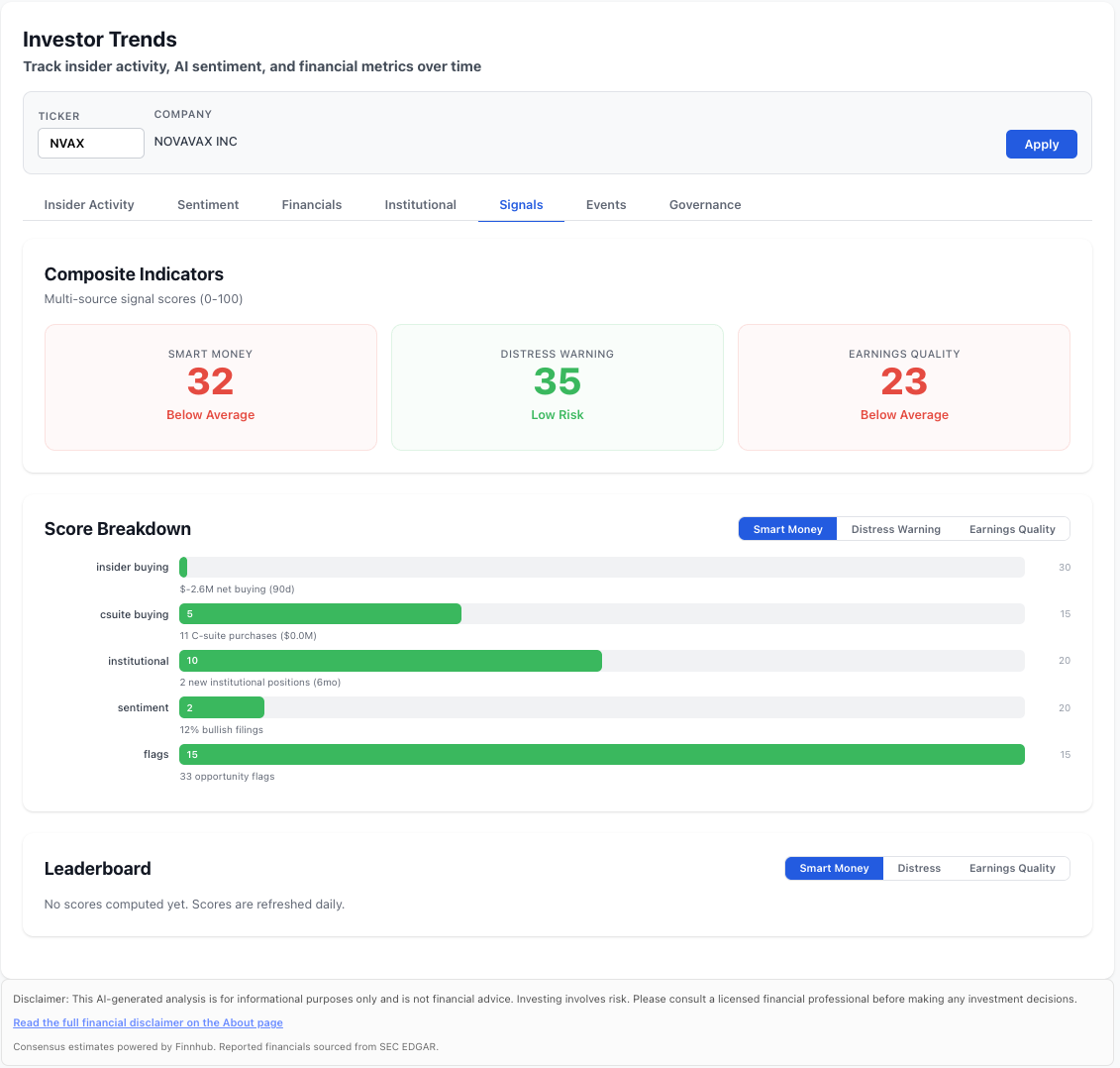
This is actually the most interesting part of the picture. The insiders are selling, the activist is angry, the sentiment is bearish — but the company isn’t going bankrupt. That’s the profile where activist pressure tends to work: there’s a real business underneath dysfunction that can be fixed.
Three Signals, One Story
Put it all together and you have three data streams that were visible simultaneously on NexusAlert — before, during, and after the 13D:
- Form 4 filings — cluster selling from the CEO, CFO, CSO, and CLO through February and March, totaling $2.6M with zero buys
- AI sentiment — bearish filings peaking through March, sentiment score at -0.33
- The 13D itself — the activist filing on April 8 that named what the data was already showing
None of this required reading hundreds of pages of filings. The signals were in the data.
A Note on What Happened After
The full picture: the 30-day return on $NVAX after the filing is -3.6%. April’s broader market volatility has weighed on the stock since the initial jump. Activist campaigns rarely resolve in a week — Shah Capital is playing a longer game.
The point isn’t that catching the 13D guaranteed a profitable trade. The point is that you’d have had the full picture — activist filing, insider selling pattern, sentiment shift, composite signals — all in one place, in real time. What you do with that is your call.
The Mechanics: Why This Starts with SEC Filings
Form 4 is filed by company insiders whenever they buy or sell shares — required within 2 business days of the transaction. It’s the earliest public record of what executives think about their own stock.
Schedule 13D is filed when any investor crosses 5% ownership with intent to influence the company. The SEC tightened the filing window to 5 business days in 2023. When a passive 13G filer converts to an active 13D, someone with significant skin in the game has decided to push for change.
Both documents are public. Both hit EDGAR the day they’re filed. The edge belongs to whoever reads them first — or has a system that does it for them.
Insiders file. Institutions disclose. We alert. You decide.
Create a free NexusAlert account to get AI-powered alerts on SEC filings, semantic search across all major form types, and per-ticker Investor Trends combining insider activity, AI sentiment, and financial metrics over time.
This post is informational and is not investment advice. Data is sourced from public SEC EDGAR filings, including Novavax’s SC 13D/A (Accession: 0001398344-26-006235) filed April 8, 2026, and NexusAlert’s Investor Trends analysis. Figures should be verified against EDGAR before any investment decision.