
BlackRock Now Owns 15.5% of VSE Corporation — Here's What the 13G/A Actually Says
BlackRock filed an amended Schedule 13G disclosing a 15.5% stake in VSE Corporation as of March 31, 2026. The headline is attention-getting. The details point to passive index accumulation, not an activist move.
On April 7, 2026, BlackRock, Inc. filed an amended Schedule 13G (a 13G/A) with the SEC reporting beneficial ownership of VSE Corporation (NASDAQ: $VSEC) as of March 31, 2026. The headline number is the kind that gets attention: 15.5% of a mid-cap aerospace and defense aftermarket company, held by the world’s largest asset manager.
The details matter more than the headline. Read closely, the filing points to routine, index-driven accumulation — not an activist position.
The filing, in plain terms
The key figures from the 13G/A:
- Shares beneficially owned: 4,344,626 (15.5% of class)
- Sole voting power: 4,296,607 shares
- Sole dispositive power: 4,344,626 shares
- Stated purpose: Acquired and held in the ordinary course of business, not for the purpose of changing or influencing control of VSE Corporation.
- Notable sub-position: BlackRock’s iShares Core S&P Small-Cap ETF ($IJR) individually holds more than 5% of VSE’s outstanding common stock.
Everything that follows is how to read those facts.
Why this is a 13G, not a 13D
Under Sections 13(d) and 13(g) of the Exchange Act, any investor crossing 5% beneficial ownership of a registered voting class has to report the position. The filer chooses between two forms.
Schedule 13D is for investors who intend to influence or change control of the issuer. It requires detailed disclosure about purpose, plans, and funding.
Schedule 13G is the shorter form for passive investors and qualified institutional holders. It’s only permitted when the shares are held without the purpose or effect of influencing control.
BlackRock is filing on 13G, and the filing explicitly states the shares are held in the ordinary course of business and not for the purpose of influencing control. That’s a legal representation, not marketing language. If BlackRock’s intent changes, it’s obligated to convert to a 13D within the applicable deadline.
The form itself is telling you this is not an activist position.
The iShares detail is the key
The most important line in the filing is easy to miss: the iShares Core S&P Small-Cap ETF — $IJR, one of the largest small-cap index ETFs in the world — individually owns more than 5% of VSE Corporation.
VSE is a component of the S&P SmallCap 600 index. $IJR tracks that index mechanically. When VSE’s index weight rises — because the company’s market cap grows, other constituents shrink, or the index committee rebalances — $IJR’s holdings rise in lockstep. There is no portfolio manager deciding to “take a stake” in VSE. There’s an index methodology.
BlackRock’s aggregate 15.5% rolls up many funds — active sleeves, model portfolios, separately managed accounts, and, critically, passive index products. The fact that $IJR alone accounts for more than 5% means a substantial portion of the headline number is mechanical index ownership.
The accurate framing isn’t BlackRock took a stake in VSE. It’s this: BlackRock’s family of funds, led by its S&P SmallCap 600 index ETF, now collectively holds 15.5% of VSE — and BlackRock’s stewardship team has filed the disclosure the law requires.
How to read any 13G/A above 10%
Here’s a five-step checklist that works on this filing and the next one:
- Confirm the stated purpose. A 13G disclaiming control intent is legally distinct from a 13D. If intent changes, the filer must convert.
- Read the sub-fund disclosure. If a single index or passive fund individually exceeds 5% of the issuer, the aggregate position is substantially index-driven. The VSE filing is a textbook example.
- Compare voting and dispositive power. The ~48,000-share gap in this filing (between 4,296,607 and 4,344,626) reflects vehicles where BlackRock has trading discretion but not voting authority. That’s routine structural plumbing, not a signal.
- Diff against the prior filing. A 13G/A is an amendment. Pulling the earlier 13G shows whether the position is accumulating, trimming, or simply crossing a threshold because shares outstanding changed.
- Cross-reference insider Form 4 activity. Useful context, not dispositive.
Run that checklist on the BlackRock / VSE filing and you get a consistent read: a passive, ordinary-course position, with a meaningful share held via an index ETF, and the required legal disclaimer on record.
What the filing doesn’t tell you
A 13G/A doesn’t disclose whether BlackRock’s discretionary sleeves are over- or underweight VSE relative to a benchmark. It doesn’t tell you whether the aggregate grew because of active buying or passive inflows into $IJR. And it says nothing about BlackRock’s view of VSE’s fundamentals, strategy, or management.
If you want a view on VSE itself, the 13G/A isn’t the document to read. VSE’s most recent 10-K risk factors, 10-Q MD&A, and any recent 8-K contract disclosures are.
The skill is telling routine from meaningful
Most retail coverage of institutional ownership filings stops at the headline number. “BlackRock Takes 15.5% Stake” is a cleaner story than “BlackRock Files Routine Passive Disclosure Largely Driven by Index ETF Mechanics.” The first version gets the click. The second version is accurate.
The skill worth building is telling them apart. Some 13G/A filings really do signal something new — an active manager accumulating ahead of a thesis, a filer crossing the 10% threshold with discretionary capital, a shift from passive to active status that triggers a conversion. Others are the sound of an index methodology doing its job. The checklist above is how you tell.
NexusAlert is built for exactly this read. A single ticker search on $VSEC, filtered to Schedule 13G, makes the point — BlackRock is not the only major holder on file.
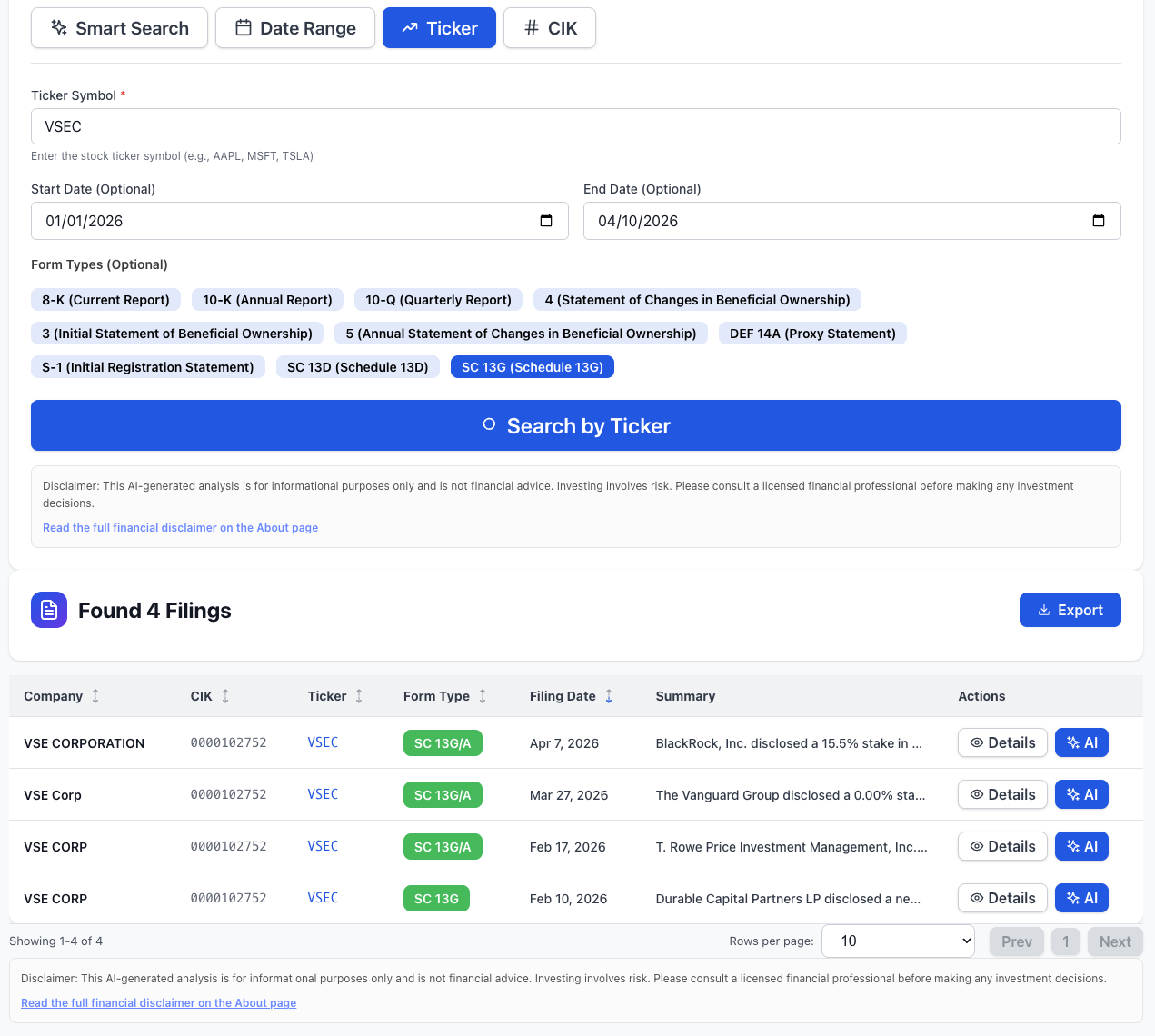
Four filings, four different institutional holders, one ticker search. BlackRock’s 15.5% is the headline number, but Vanguard, T. Rowe Price, and Durable Capital Partners all show up on the same page — and Durable Capital’s Feb 10 filing is an initial 13G from a concentrated active manager, which is a very different signal than BlackRock’s index-driven amendment. That contrast is the point. One view, four reads.
Beyond ticker search, NexusAlert also offers semantic search across SC 13G and SC 13D filings — so you can pull every BlackRock 13G/A above 10% in the last 90 days in a single query. Watchlists on Forms 3, 4, 5, 10-K, 10-Q, 8-K, SC 13G, SC 13D, DEF 14A, and S-1 notify you the moment a filing lands on a ticker you care about. AI analysis flags the filings that represent a meaningful change in ownership or intent — and, just as importantly, helps you recognize the ones that don’t.
The goal isn’t to make every 13G/A look dramatic. The goal is the opposite: to give you the detail you need to tell routine index-driven disclosures apart from the filings that genuinely change the story.
Insiders file. Institutions disclose. We alert. You decide.
Create a free NexusAlert account to get AI-powered alerts on SEC filings, semantic search across all major form types, and per-ticker Investor Trends combining insider activity, sentiment, and financial metrics over time.
This post is informational and is not investment advice. Figures are drawn from BlackRock’s Schedule 13G/A for VSE Corporation as of March 31, 2026 and should be verified against EDGAR before any investment decision.