
Bradley Radoff Just Took 8.1% of Genesco and Nominated Four Directors — That's How Proxy Fights Start
An activist group led by Bradley L. Radoff and Jumana Capital disclosed an 8.1% Genesco stake and nominated four directors on April 27, 2026. Here's what the SC 13D/A reveals about the imminent proxy fight.
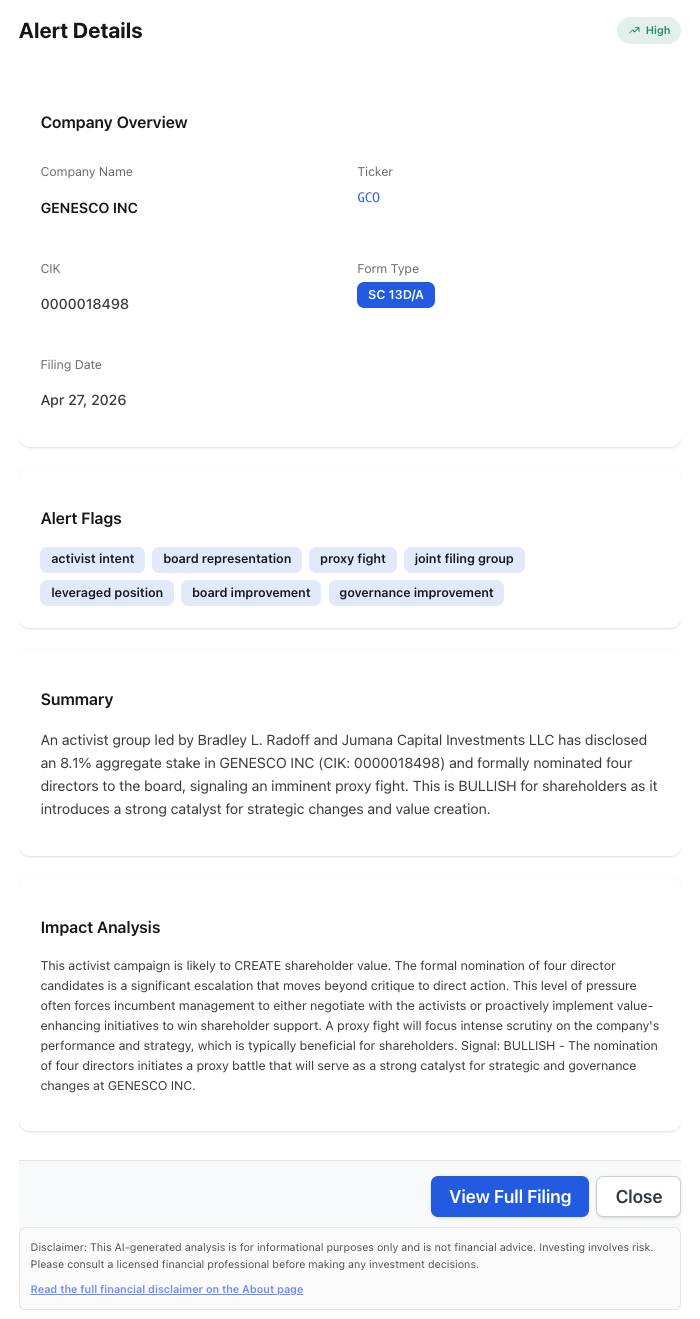
A retail holding company with a $300 million market cap and a famously sleepy board just woke up. On April 27, 2026, Bradley L. Radoff and Jumana Capital Investments LLC filed an SC 13D/A on Genesco Inc. (NYSE: GCO) disclosing an 8.1% aggregate stake and the formal nomination of four directors to the company’s board. That sequence — accumulate, disclose, nominate — is the textbook setup to a proxy fight.
The filing landed on EDGAR the same week Genesco’s stock had been drifting on weak Journeys-segment commentary. The market did not yet know an activist had been building. By the time mainstream coverage on TradingView, IndexBox, and StockStory caught up, the slate was already named.
The 12-Day Accumulation Arc
This 8.1% disclosure isn’t where the story starts — it’s where it escalates. The Genesco filing trail has three discrete events in just 12 days:
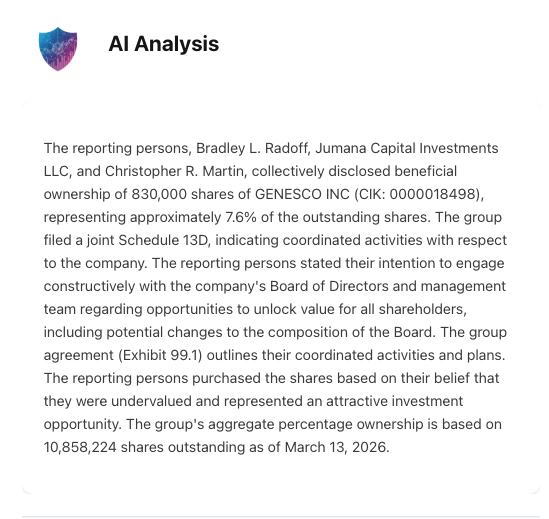
- April 15, 2026 — SC 13D (initial). Radoff, Jumana Capital Investments LLC, and Christopher R. Martin disclosed a joint 7.6% stake (830,000 shares) with constructive-engagement language about board composition. That is the activist on-ramp.
- April 22, 2026 — SC 13G/A (Pzena Investment Management). A separate filer — value manager Pzena Investment Management — disclosed a passive 10% stake (1,080,582 shares) as of March 31, with no shared voting and explicit Item 10 language disclaiming control intent.
- April 27, 2026 — SC 13D/A (Radoff group). The activist group amended up to 8.1% and attached the four-director nomination notice as an exhibit.
The Radoff filing alone would be worth tracking. What makes the Genesco situation unusually clean is the separate filer who showed up five days later — and the very different reason they were already in the name. Pzena Investment Management is one of the longest-running deep-value shops in the industry; their 13G/A is not part of the activist coalition, and the SEC paperwork is explicit about that. But it still reshapes the math the company’s incumbent board is now staring at.
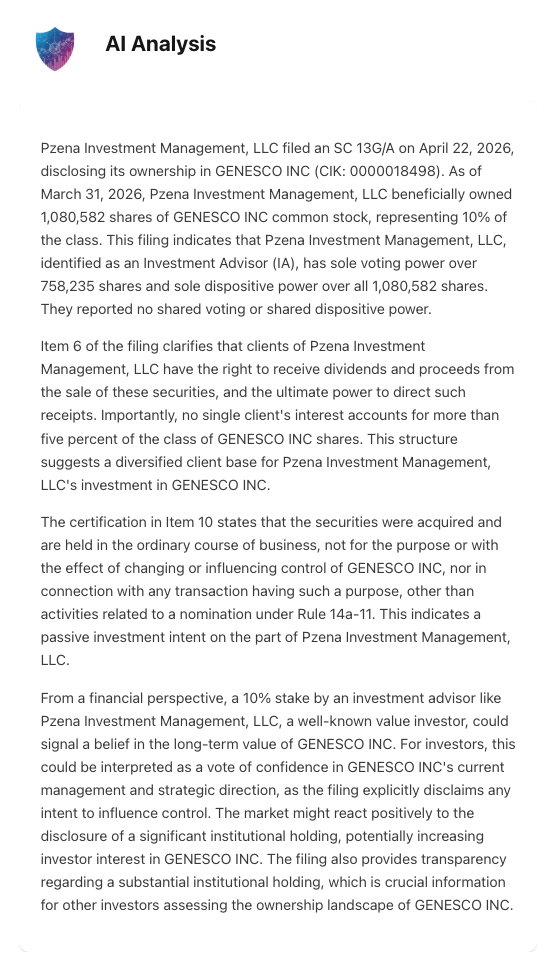
Stack those three filings together and the cap table looks very different from what most GCO watchers had on their screens a month ago. Roughly 18.1% of the float is now sitting in two named filers — one a known value investor, one a known activist running a public board campaign. Pzena’s passive 13G/A doesn’t make Pzena an ally of the slate, but a 10% value holder is exactly the constituency a credible activist needs to pull toward “yes” before the meeting.
The Number That Tells You This Is Real
Eight-point-one percent is not a passive position. The 13D form itself signals that — SC 13D is reserved for filers who intend to influence control. The amendment increases the stake meaningfully and adds the second piece of the activist playbook: board representation.
A 13D filing has six items that tell you whether an activist is bluffing or building. On this one, four of them speak loudly:
- Item 4 (Purpose of Transaction) — explicitly references discussions with management, governance changes, and the director nominations. That is the magic legal language that tells the SEC and every other shareholder that the filer plans to push.
- Item 5 (Interest in Securities) — itemizes the 8.1% across the joint filing group, anchored by Radoff personally and Jumana Capital Investments LLC.
- Item 6 (Contracts, Arrangements) — discloses the joint filing agreement and any voting arrangements among the group. That is how activists coordinate without each filer separately tripping their own 5% threshold.
- Item 7 (Material Exhibits) — typically attaches the nomination notice itself, which is the document that turns a soapbox into a ballot.
A 13D with new director nominees attached as an exhibit is not “shareholder feedback.” It is a notice that the company has roughly 60–90 days to settle, fight, or watch the slate go to a vote.
Who Is Bradley Radoff
Radoff is not a first-time activist. His past campaigns at companies like Chico’s FAS, BJ’s Wholesale, and Yelp follow a recognizable pattern: identify a mid-cap retailer with operating leverage no one is using, build an 5–10% stake, push for board change, and exit on a re-rating. Jumana Capital Investments has historically partnered with him on the largest of those campaigns.
Genesco is squarely in that lane. The company owns Journeys, Schuh, and Johnston & Murphy — three brands with very different growth profiles and cost structures stapled together. Activists tend to read that and see a sum-of-the-parts opportunity that the public conglomerate discount is masking.
What “Four Director Nominations” Actually Means
A four-seat slate at a company Genesco’s size is not symbolic. The Genesco board is a relatively small body, and four directors plausibly represent the difference between a minority voice and a working coalition able to drive committee assignments, CEO succession discussions, and capital allocation review.
Three structural details from the filing matter for handicapping the outcome:
- The advance-notice deadline — Genesco’s bylaws set the window in which shareholders can nominate directors. The April 24 nomination date in the SC 13D/A means Radoff’s group filed inside the window and the slate is on the ballot unless the company successfully challenges the notice.
- The aggregate vote share — 8.1% is enough to make a slate credible but not enough to win on its own. The contest is decided by the next 25–30% of the cap table — passive index holders who lean on ISS and Glass Lewis, plus a handful of active managers with their own views.
- The “joint filing group” tag — the filing explicitly groups Radoff and Jumana into a single reporting person under Section 13(d). That structure is what allows the group to coordinate proxy mechanics without each filer separately re-papering their disclosure.
What the Institutional Curve Already Says
The activist arc isn’t just visible on EDGAR — it’s visible on the cap-table curve. NexusAlert’s Investor Trends view for GCO puts hard numbers on what the filings imply:
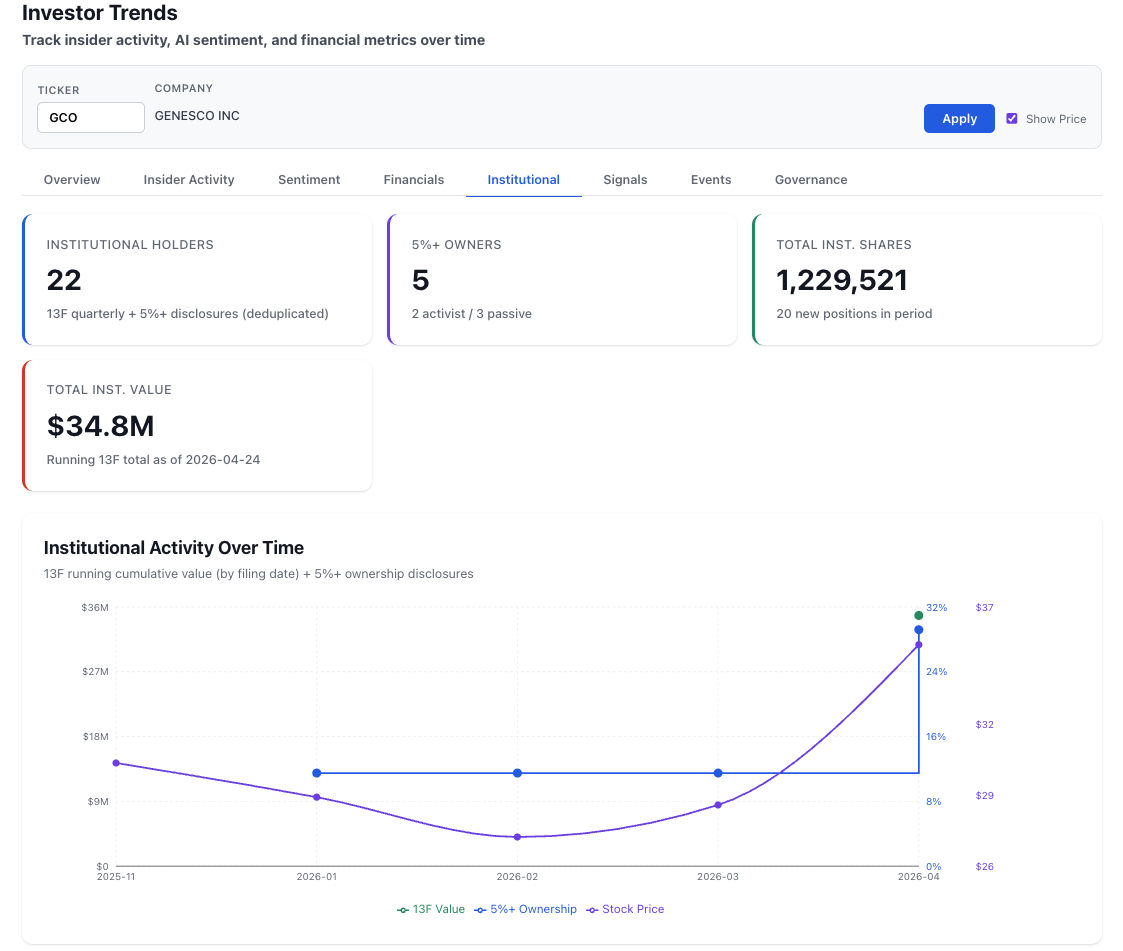
- 22 institutional holders (13F quarterly + 5%+ disclosures, deduplicated), holding 1,229,521 shares worth $34.8M as of April 24, 2026. That’s 20 new positions opened during the period — institutional accumulation, not distribution.
- 5 holders sit above the 5% threshold, broken 2 activist / 3 passive. That ratio matters. A board fight where two activists already hold 5%+ blocks and three passive holders sit on top of them is a campaign with a working coalition path, not a soapbox.
- Aggregate 5%+ ownership stepped from 16% to 24% in April 2026. The blue step-function on the chart is what Pzena’s 10% disclosure plus the Radoff group’s 50-basis-point top-up look like in cumulative cap-table form. The stair-step is the campaign, not the noise.
- The stock went from a sub-$27 trough in February to $37 in April as the institutional curve climbed. The catalyst is already pricing in; the question is how much of the next leg the proxy contest delivers.
When 5%+ ownership at a small-cap retailer steps up eight points in one month, the 13F flow is no longer the leading indicator — the cap table itself is the catalyst.
That kind of structured, time-series view across 13F filings, SC 13G/D disclosures, and price is exactly what reading the filings after they’re aggregated gives you. A single 13D/A is a data point. Twenty new positions in a quarter, with the 5%+ tier widening, is a regime change.
The Catalyst Calendar Is Now Set
When a 13D drops with director nominees, the next 90 days follow a predictable sequence:
- Universal proxy card — under SEC Rule 14a-19, both sides will use the universal card, which lets shareholders mix-and-match nominees from each slate. That changes campaign math: the board cannot rely on a binary “vote our card” pitch.
- ISS and Glass Lewis recommendations — usually published 2–3 weeks before the meeting. These move the index vote.
- Settlement window — most public-company activist campaigns settle before the meeting, with the company adding 1–3 of the activist’s nominees in exchange for the slate being withdrawn. Watch for an 8-K announcing a “Cooperation Agreement” or “Director Appointment.”
- Annual meeting — typically June or July for a company on Genesco’s calendar, but the filings will set the date.
Each of those events is a discrete, datable filing — exactly the kind of structured catalyst flow a special-situations desk runs alerts on.
Why a Friday Notice, Monday Filing Hits Different
The 13D/A landed on a Monday, but the underlying nomination notice is dated April 24 — a Friday. Activists often time the board notification to the end of the week so the company has the weekend to react privately before the public 13D amendment. The 10-day filing rule under Section 13(d) means the public disclosure follows shortly after.
That cadence — private notice Friday, public filing Monday — is one of the patterns that makes 13D flow tradeable. The public market sees the slate nomination only after the company has already had its first private conversation with the activist’s lawyers.
How NexusAlert Read This Filing
NexusAlert classified the SC 13D/A as a High-severity alert with the flag combination activist intent, board representation, proxy fight, joint filing group, leveraged position, board improvement, and governance improvement. Each of those flags maps to a specific data point in the filing:
activist intent— the Item 4 language naming director nominations and strategic alternatives.board representationandproxy fight— the four named director nominees and the bylaw-window timing.joint filing group— the Radoff / Jumana / Martin coordination structure.leveraged position— the 8.1% aggregate stake at a small-cap market cap is concentrated enough that even modest price moves onGCOare material to the filers’ fund-level returns.board improvementandgovernance improvement— Item 4 language about value creation and strategic alternatives.
The platform’s own Impact Analysis on this filing reads: “This activist campaign is likely to CREATE shareholder value. The formal nomination of four director candidates is a significant escalation that moves beyond critique to direct action.” That is the kind of multi-flag combination special-situations desks pay for, and it surfaced the same day the filing hit EDGAR.
How to Watch the Rest of This Campaign
For investors holding or shorting GCO, three filings will define the tape between now and the annual meeting:
- Genesco’s preliminary proxy (PRE 14A) — sets the meeting date and the company’s official slate.
- Radoff’s definitive proxy (DEFC14A) — the activist’s case to shareholders. Look for the IRR math, the comp tables, and the named alternatives.
- Any 8-K mentioning a Cooperation Agreement — the settlement signal.
NexusAlert tracks every form in that sequence — SC 13D amendments, PRE 14A, DEFC14A, DEFA14A, 8-K Cooperation Agreements, and the eventual DEF 14A vote results — across every public company. The platform’s Investor Trends view aggregates the same flow into a single cap-table curve so the institutional accumulation arc is visible alongside the individual filings. The Genesco campaign is one of dozens of active board fights running in parallel right now; the platform surfaces the ones with the cleanest catalyst structure as they file.
Start Tracking Activist Filings
Create a free NexusAlert account to get real-time alerts on SC 13D filings, board-change disclosures, and proxy-fight escalations across every public company.
Sources
Prefer to own it outright? NexusAlert lifetime access is available for a one-time payment of $299 — no subscription, no recurring charges, all future Pro features included. Learn more →