
Ken Griffin Just Disclosed a 4.0% Stake in Sidus Space — And Most of the Headlines Got the Number Wrong
On April 28, Citadel and Ken Griffin filed a chain of SC 13Gs in Sidus Space (SIDU). The accurate read: Griffin's individual stake is 4.0%, not 7.4%, the institutional landscape has been rotating not accumulating, and the disclosure landed one week after a $58.5M registered direct offering.
A multi-strategy hedge fund running roughly $65 billion in assets just disclosed a stake in a small-cap satellite company. On April 28, 2026, Kenneth Griffin and a chain of Citadel-controlled entities filed Schedule 13Gs in Sidus Space (NASDAQ: SIDU). The accurate, deduplicated read of the filing chain: Griffin individually holds 4.0% of SIDU, representing 3,210,428 shares — calculated against 80,756,044 shares outstanding as of April 28, 2026.
If you read the press wire instead of the form chain, you got “7.4%.” That number is an attribution-chain double-count, not a separate position. Here’s why the distinction matters, what the actual institutional history of SIDU looks like once you stop summing the same shares twice, and the share-count detail at the bottom of the 13G that reframes the entire disclosure.
The Filing Chain, Read Correctly
Schedule 13G is the short-form ownership disclosure investors file when they cross 5% on a passive basis. Multi-entity asset managers like Citadel are required to file the same shares through every layer of their attribution chain — the named principal, the advisor entity, the GP, and any sub-funds with overlapping investment authority. Each filing carries a percentage, but the underlying shares are the same.
Pulling the SIDU filings into one table:
- Kenneth Griffin (individual) — 4.0% / 3,210,428 shares
- Citadel Advisors LLC — 3.8% / 3,071,391 shares
- Citadel Advisors Holdings LP — 3.8% / 3,071,391 shares
- Citadel GP LLC — 3.8% / 3,071,391 shares
- Citadel Securities LLC — 0.2% / 139,037 shares
- Citadel Securities Group LP — 0.2% / 139,037 shares
- Citadel Securities GP LLC — 0.2% / 139,037 shares
Three observations:
- The Citadel Advisors leg (3.8% / 3,071,391 sh) is the same shares. Citadel Advisors LLC, its holding LP, and the GP LLC all report identical numbers because the advisor entity manages the position — the holding LP and the GP report it through the attribution chain, not as a separate stake.
- The Citadel Securities leg (0.2% / 139,037 sh) is also the same shares. Same logic — three entities, one sub-position.
- Sum the two unique legs and you get 3,210,428 shares — exactly Griffin’s individually disclosed total. Griffin’s 4.0% is the rolled-up position. The chain entities are decomposing it, not adding to it.
So the unique Citadel/Griffin economic interest in SIDU is 4.0%, full stop. The “7.4%” figure that appeared in some headlines aggregated two of the chain entries without recognizing they share economic exposure with Griffin’s own filing.
What the Institutional History Actually Shows
There is a separate, larger story in the SIDU institutional data — and it’s the one that gets lost when the post-filing reaction frames this as a one-way smart-money accumulation.
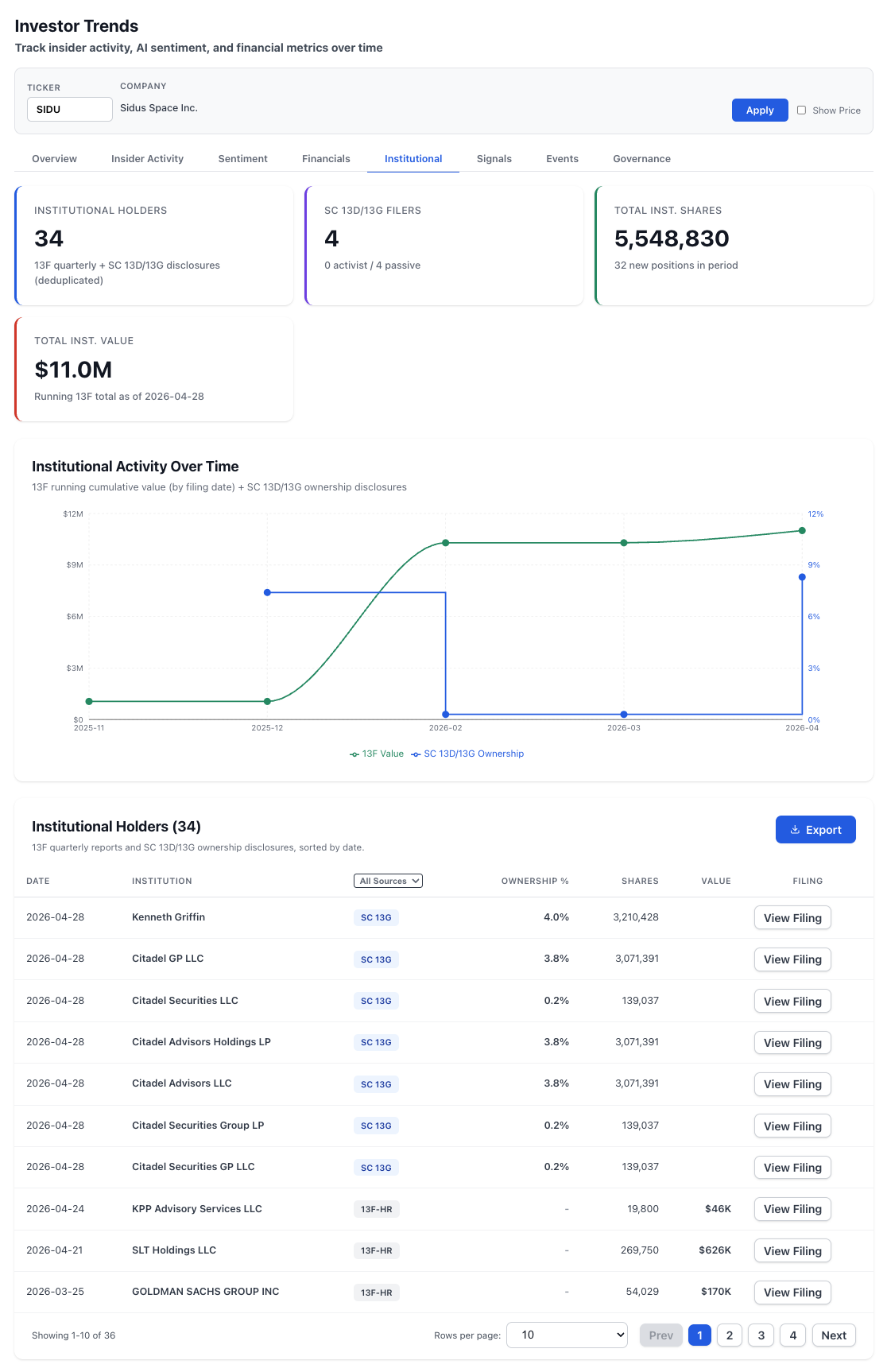
The institutional ownership chart for SIDU shows three distinct phases inside the past six months:
- Late December 2025 → February 2026 — A separate 13G filer was on file at roughly 6–7%. The position appeared abruptly and persisted for about two months.
- Late February → mid-April 2026 — The 13G ownership line drops to 0%. The prior holder either sold below the 5% threshold or filed a termination amendment.
- Late April 2026 — Griffin/Citadel files at 4.0%, restoring 13G ownership and pushing the line back up to roughly 8% on a non-deduplicated chain-aggregate basis.
The takeaway: this is a rotation, not an accumulation. Sidus Space had institutional smart money once already this cycle, and it left. The Griffin disclosure is the second 13G in six months, not the first ever — and a careful read should weigh both phases, not just the most recent one. The holders table directly below the chart is also where the chain-attribution story is unambiguous: every Citadel sub-entity reports the same shares as the entity above it in the chain, and Griffin’s row at the top is the rolled-up total.
The Share-Count Detail That Reframes the Whole Disclosure
The denominator on the 13G is the part most coverage skips entirely. The filing computes ownership against 80,756,044 shares outstanding, which the form itself decomposes into:
- 67,302,344 shares outstanding as of April 17, 2026
- 11,228,700 shares issued in a registered direct offering on April 21, 2026
- 2,225,000 shares issued on warrant exercises
In other words, exactly seven days before Citadel and Griffin’s holdings date, SIDU completed a $58.5M registered direct offering that priced 13,453,700 shares (including pre-funded warrants) at $4.35 per share. Citadel’s 4.0% stake totals 3,210,428 shares. The math is not subtle: the offering was structurally large enough to source a multi-million-share position to a participating allocator without any open-market footprint.
The 13G doesn’t disclose how the shares were acquired, but the timing argues strongly that this is at least partly an offering allocation rather than a stealth open-market accumulation. That’s a different signal — it tells you Citadel was on the deal sheet, not that they were pounding the bid in the market for two weeks.
Why a 4.0% Smart-Money Stake Still Matters
The 7.4% headline is wrong, but the underlying signal is not nothing. A 4.0% stake by a billionaire-run multi-strategy fund — disclosed under the principal’s own name — is still meaningful for three structural reasons:
- Filer credibility. Citadel deploys capital across discretionary fundamental, macro, quant, and equity-event strategies. A named-principal disclosure at the 5%+ threshold has cleared a research process most retail investors cannot replicate.
- Offering participation as endorsement. If the position was sourced through the April 21 deal — which the timing strongly implies — Citadel committed capital at $4.35 per share to a registered direct offering. That is a different kind of vote than a passive secondary-market purchase: the firm priced the deal, took allocation, and accepted the resulting filing obligation.
- Disclosure timing. The 13G filed on the same day as a parallel Citadel/Griffin 13G in Surf Air Mobility (
SRFM) at 7.1%. Two same-day disclosures in adjacent aerospace small-caps from the same filer group is a thematic signal that doesn’t depend on the SIDU number being 7.4% versus 4.0%.
The thesis isn’t that the position is huge — it’s that the position exists, is discretionary, and was disclosed under the principal’s name.
A Note on the “Stock Surged 34%” Coverage
Some early coverage of the 13G framed it as a same-day pop of 34%. SIDU’s actual price action on April 28, 2026, was a $3.07–$3.30 intraday range — under 8% peak-to-trough — with shares ending the session well below the April 21 offering price of $4.35. The dramatic surge that does show up in older SIDU coverage was tied to a different event: the Missile Defense Agency SHIELD program selection earlier in the year, which produced a multi-day move of close to triple digits.
The lesson is the one your filing-data discipline already taught you: never let an aggregator’s headline narrative about price action substitute for the chart itself.
What NEW POSITION Means on a 13G
Each of the SIDU 13G filings has the NEW POSITION checkbox marked. That is the SEC’s specific flag indicating:
- The filer did not previously hold a 5%+ stake
- The accumulation crossed the threshold during the reporting period
- The 10-day disclosure clock was triggered by that crossing
NEW POSITION is the most informative subset of 13G flow. Position increases on existing 13G filers are usually rebalancing. New positions at the 5%+ threshold are by definition deliberate — the filer chose to acquire a regulated stake.
It is also the right context for reading the institutional history. The previous SIDU 13G holder is gone. The current 13G holder is new. Those are two separate events that the period-by-period data correctly distinguishes — and that any reader should hold in mind before extrapolating from the most recent number alone.
How to Catch These Without the Wire’s Mistakes
The mainstream coverage cycle on a small-cap 13G runs roughly:
- Hour 0 — EDGAR filing. The 13G is timestamped and queryable. Each chain entity files its own form.
- Hour 1–2 — SEC-filing mirror sites. Aggregators publish templated summaries that often do not deduplicate the chain.
- Hour 3–6 — Specialty aggregators. Insider-tracking and 13F-tracking newsletters surface the position, sometimes with the wrong sum.
- Hour 6–24 — Mainstream financial press. The first-mover error in the aggregator coverage gets amplified.
- Day 2+ — General financial press. By now, the misreported figure is on every screener.
The investors who priced SIDU correctly on April 28 were the ones who pulled all four chain filings off EDGAR, deduplicated the shares, and read the institutional history including the prior 13G filer’s exit. That work is mechanical when you have structured filing data — and impossible when you don’t.
Institutional ownership data only describes the period it covers. A 13G filer’s exit doesn’t show up retroactively in a “current holders” snapshot — you have to look at the time series. The story on SIDU is that smart money has been in and out, not that it has been steadily accumulating.
How NexusAlert Handles Filing Chains
NexusAlert reads each chain filing, recognizes the attribution structure, and presents the deduplicated economic interest alongside the raw filer entries. The SIDU alert flagged Griffin’s 4.0% as the unique position, with the Citadel chain entries listed as the structural decomposition rather than additive stakes. The Investor Trends view for SIDU shows the time series — meaning the prior 13G filer’s two-month hold and subsequent exit is visible alongside the current Griffin position, not buried in a current-snapshot table.
What the SIDU 13G Looked Like in the Alert Feed
- Alert type — Opportunity (institutional accumulation, new position)
- Flags — institutional accumulation; new position; hedge fund; joint filing group; shared voting power; active manager
- Severity — High
- Detected — Same day as EDGAR filing
- Deduplicated stake — 4.0% / 3,210,428 shares (Griffin individual, with Citadel chain attribution)
That is the platform’s edge. Manual EDGAR review of SC 13G flow is impossible at scale — there are too many filings, most of them mechanical Vanguard or BlackRock threshold crossings. Filtering down to discretionary smart-money positions and presenting the chain correctly is exactly what the AI flag layer is built for.
Start Tracking 13G Flow
Create a free NexusAlert account to get real-time alerts on every SC 13G and SC 13D filing across every public company — with chain-aware deduplication and the institutional history that current-snapshot screeners leave out.
Sources
- StockTitan — Citadel/Griffin SC 13G in Sidus Space (chain filings, share counts, denominator)
- PR Newswire — Sidus Space pricing of $58.5M registered direct offering at $4.35/share, expected April 21 close
- Private Jet Card Comparisons — Griffin/Citadel parallel 7.1% Surf Air Mobility 13G, same day
- secform4.com — historical 13D/13G filings on SIDU (institutional rotation context)
Prefer to own it outright? NexusAlert lifetime access is available for a one-time payment of $299 — no subscription, no recurring charges, all future Pro features included. Learn more →