
Anthropic's Amended S-1 Adds Q3: $33.2 Billion in Revenue and $895.4 Billion in Compute Commitments
Anthropic's S-1/A adds Q3: $33.2 billion nine-month revenue, a $104 billion loss, $895.4 billion committed spend. Includes NexusAlert's full AI analysis.
Anthropic just added a third quarter to its IPO filing. The number to read is not the $104 billion loss.
On November 2, 2026, Anthropic filed an amended S-1 that brings its financials through September 30: $33.2 billion of revenue for the nine months, a $104.0 billion net loss, and about $895.4 billion of committed compute and infrastructure spend. The first S-1, which we covered on October 26, stopped at the first half of the year. This one fills in the third quarter.
NexusAlert picked up the S-1/A the day it posted and tagged it. The AI Key Summary again rates the overall picture neutral: rapid revenue growth and strong compute efficiency on one side, and heavy compute commitments, dilution from convertible notes, and a dual-class control structure on the other. The full AI analysis, which goes further, is reproduced in this post below, along with what we could and could not confirm.
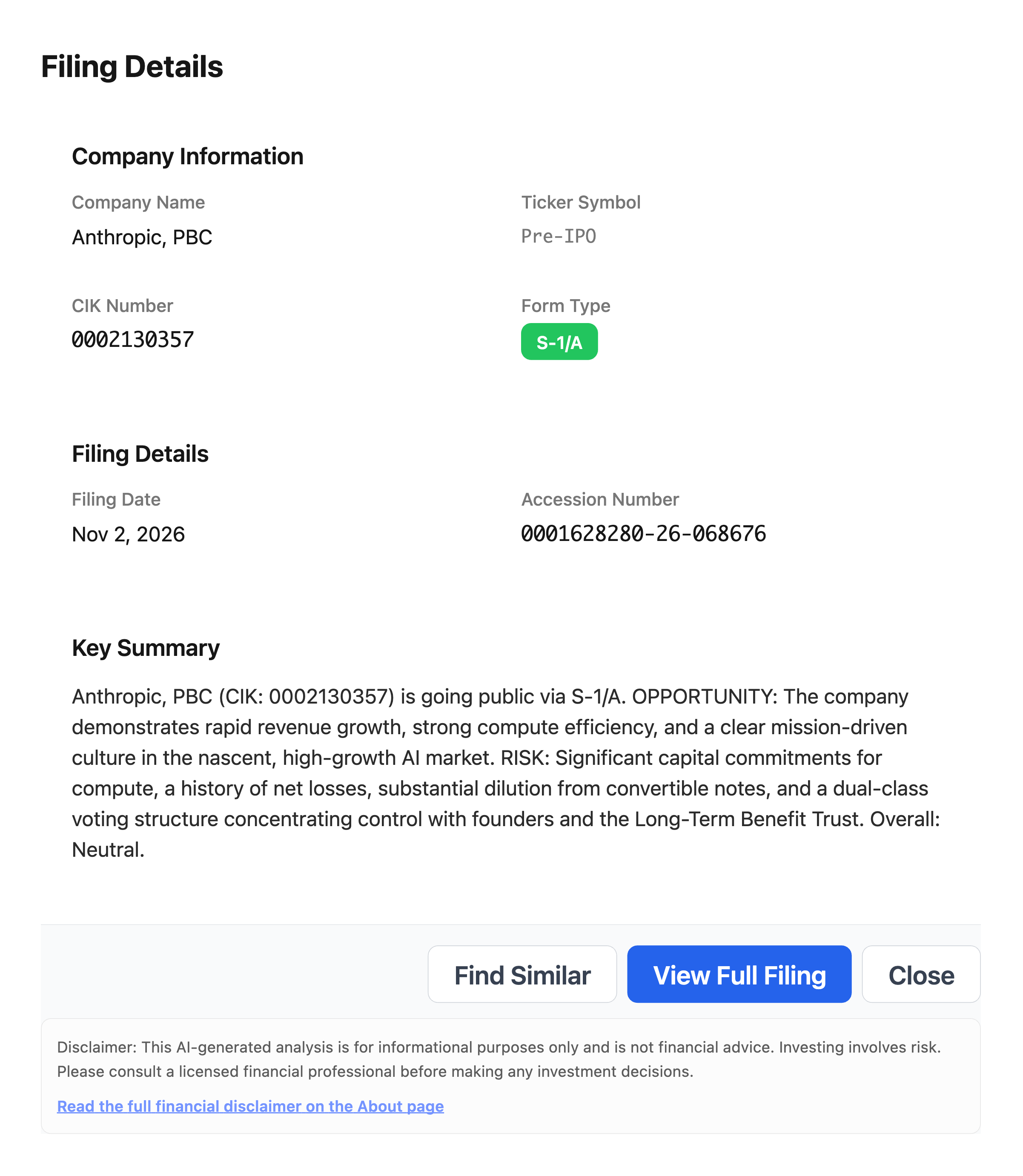
What the amendment adds
The S-1/A is an amended registration statement, filed on EDGAR on November 2 under the same file number as the original. Per CNBC’s report on the filing, the amendment’s main change is new financials: the first prospectus included results only through the first half, and this one adds the third quarter and the nine-month totals.
Those totals are large. Nine-month revenue was $33.24 billion, up roughly 1,200% from the same period last year, according to CNBC. Net loss for the nine months was $104 billion, compared with $25.1 billion a year earlier. PANews, reporting on the filing the same day, puts third-quarter revenue at $16.9 billion and the third-quarter net loss at $23.3 billion, against $12.1 billion in the third quarter of 2025.
Those figures fit together with the first S-1. The first-half numbers were $16.3 billion of revenue and an $80.7 billion net loss, so the third quarter is the difference: $33.2 billion minus $16.3 billion is $16.9 billion of revenue, and $104.0 billion minus $80.7 billion is a $23.3 billion loss. Third-quarter revenue is also about 46% above the second quarter’s $11.6 billion, which matches CNBC’s October 15 report that the quarter had come in near $16.8 billion.
The loss is still mostly not about operations
A $23.3 billion quarterly loss on $16.9 billion of revenue looks like a company burning through money. The AI analysis reads it differently. It says the nine-month loss was largely due to changes in the fair value of convertible notes and derivative liabilities, the same non-cash mark that drove the first-half loss. It also says the operating margin improved to a loss of 3% for the three months ended September 30, from a loss of 224% a year earlier.
Take that margin at face value and the arithmetic is simple. A 3% operating loss on $16.9 billion of revenue is roughly half a billion dollars, a small fraction of the $23.3 billion net loss. The gap is non-operating. The 3% and 224% figures come from the AI analysis, and we could not open the S-1/A’s financial statements to confirm them, so treat them as the analysis’s reading until you check the filing’s own tables.
The analysis keeps one caution. It says the company expects continued heavy investment to weigh on future profitability, and that the path to sustained GAAP profitability remains uncertain given the capital-intensive nature of AI development and significant non-cash charges.
The $895.4 billion line
The commitment number is the one that changed most. The AI analysis says Anthropic has commitments of approximately $895.4 billion as of September 30, extending to 2045. CNBC independently reports the same figure, describing aggregate committed spend of about $895.4 billion, “substantially all of which is related to compute and infrastructure.”
For scale, that is about 27 times the nine months of revenue the company has booked so far. It is also a different number from the one in our first AI analysis, which cited over $417 billion and which we flagged at the time as unconfirmed. We cannot say the two figures measure the same thing on the same date, so we do not treat the difference as a change. We treat $895.4 billion as the figure to use now, because a second outlet confirms it.
The commitments are the other half of the revenue story. Revenue is primarily consumption-based, and compute purchase commitments include minimum purchase terms that apply whether or not the capacity is used. Revenue can go up or down with customer demand. A commitment that runs to 2045 stays put.
Revenue is what a company has done. Commitments are what it has promised.
What did not change
Several figures carry over from the first filing. The AI analysis again cites more than 11,900 customers generating $100,000 or more of trailing twelve month revenue as of September 30, and net revenue retention of approximately 900%.
The control structure is the same. The Class F common stock, held by the Founder LLC, will command 50.1% of total voting power, and the Class T common stock, held by the Long-Term Benefit Trust, will elect a majority of the board. The analysis says this effectively eliminates the ability of Class A stockholders to influence important decisions. Public holders would own the economics and not the steering wheel.
The analysis names nine underwriters: Goldman Sachs, Morgan Stanley, J.P. Morgan, Citigroup, Deutsche Bank, Barclays, Wells Fargo, UBS, and Jefferies.
One figure to check before you repeat it
The analysis says customer concentration is a risk, with the top five customers accounting for approximately 25% of revenue for the nine months ended September 30. We could not confirm that cut in the sections of the filing we could read. When the first S-1 came out, AI Weekly headlined that about 25% of first-half revenue came from two customers. Those are different periods and different groupings, so the two numbers are not in conflict, but neither is a settled figure until you read the customer concentration note in the final prospectus.
What the amendment still does not tell you
The analysis states that the IPO valuation is not provided in the extract it read, which prevents a direct assessment of whether the offering is reasonably priced. So any valuation you see quoted today is a press estimate. The S-1/A, like the S-1, can tell you what you would be buying. It cannot tell you what the shares are worth.
The use of proceeds is unchanged in spirit: general corporate purposes, including working capital, operating expenses, capital expenditures for compute and infrastructure, and hiring, plus tax withholding for RSU settlements. The analysis calls this generally growth-oriented, but notes that the scale of the capital expenditures is immense, and that the commitment to public benefit initiatives, including significant equity contributions, may divert resources from maximizing short-term shareholder value.
The complete NexusAlert AI analysis
Every filing in NexusAlert gets an AI analysis written the day it posts. Below is the full text for the Anthropic S-1/A, as the app produced it. It is AI-generated and informational only, not financial advice.
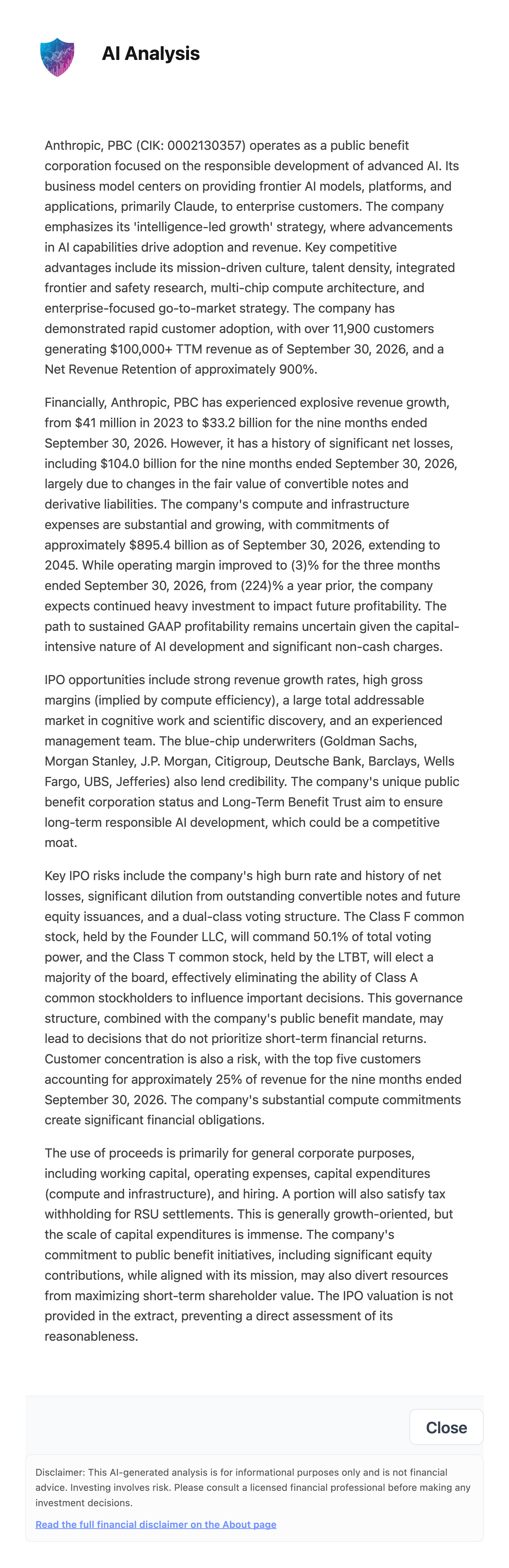
Anthropic, PBC (CIK: 0002130357) operates as a public benefit corporation focused on the responsible development of advanced AI. Its business model centers on providing frontier AI models, platforms, and applications, primarily Claude, to enterprise customers. The company emphasizes its ‘intelligence-led growth’ strategy, where advancements in AI capabilities drive adoption and revenue. Key competitive advantages include its mission-driven culture, talent density, integrated frontier and safety research, multi-chip compute architecture, and enterprise-focused go-to-market strategy. The company has demonstrated rapid customer adoption, with over 11,900 customers generating $100,000+ TTM revenue as of September 30, 2026, and a Net Revenue Retention of approximately 900%.
Financially, Anthropic, PBC has experienced explosive revenue growth, from $41 million in 2023 to $33.2 billion for the nine months ended September 30, 2026. However, it has a history of significant net losses, including $104.0 billion for the nine months ended September 30, 2026, largely due to changes in the fair value of convertible notes and derivative liabilities. The company’s compute and infrastructure expenses are substantial and growing, with commitments of approximately $895.4 billion as of September 30, 2026, extending to 2045. While operating margin improved to (3)% for the three months ended September 30, 2026, from (224)% a year prior, the company expects continued heavy investment to impact future profitability. The path to sustained GAAP profitability remains uncertain given the capital-intensive nature of AI development and significant non-cash charges.
IPO opportunities include strong revenue growth rates, high gross margins (implied by compute efficiency), a large total addressable market in cognitive work and scientific discovery, and an experienced management team. The blue-chip underwriters (Goldman Sachs, Morgan Stanley, J.P. Morgan, Citigroup, Deutsche Bank, Barclays, Wells Fargo, UBS, Jefferies) also lend credibility. The company’s unique public benefit corporation status and Long-Term Benefit Trust aim to ensure long-term responsible AI development, which could be a competitive moat.
Key IPO risks include the company’s high burn rate and history of net losses, significant dilution from outstanding convertible notes and future equity issuances, and a dual-class voting structure. The Class F common stock, held by the Founder LLC, will command 50.1% of total voting power, and the Class T common stock, held by the LTBT, will elect a majority of the board, effectively eliminating the ability of Class A common stockholders to influence important decisions. This governance structure, combined with the company’s public benefit mandate, may lead to decisions that do not prioritize short-term financial returns. Customer concentration is also a risk, with the top five customers accounting for approximately 25% of revenue for the nine months ended September 30, 2026. The company’s substantial compute commitments create significant financial obligations.
The use of proceeds is primarily for general corporate purposes, including working capital, operating expenses, capital expenditures (compute and infrastructure), and hiring. A portion will also satisfy tax withholding for RSU settlements. This is generally growth-oriented, but the scale of capital expenditures is immense. The company’s commitment to public benefit initiatives, including significant equity contributions, while aligned with its mission, may also divert resources from maximizing short-term shareholder value. The IPO valuation is not provided in the extract, preventing a direct assessment of its reasonableness.
How we checked the analysis
We checked the headline numbers against outside reporting, and we want to be plain about what is and is not confirmed. The S-1/A itself is on EDGAR under accession number 0001628280-26-068676, filed November 2, and we confirmed its form type, date, and file contents there. We could not load the S-1/A’s main document text in our review, so the line items below come from reporting on the filing and from the AI analysis, not from our own read of the financial statements.
Confirmed by outside reporting: nine-month revenue of $33.2 billion, the $104 billion nine-month net loss, the $895.4 billion commitment figure, third-quarter revenue of $16.9 billion, and the $23.3 billion third-quarter net loss. These also reconcile arithmetically with the first-half figures in the original S-1.
Not independently confirmed: the third-quarter operating margin of a 3% loss against a 224% loss a year earlier, the top five customers at about 25% of revenue, the 11,900 customer count as of September 30, and the nine-underwriter list. These come from the AI analysis and should be checked against the final prospectus. The analysis calls the filing neutral in its Key Summary and describes it as an investment with considerable risk elsewhere, which is consistent: neutral says the opportunity and the risk roughly balance, and the range of outcomes is wide.
The lesson
A $104 billion loss is a headline. A $23.3 billion quarterly loss against a roughly half billion dollar operating loss, plus $895.4 billion of commitments running to 2045, is a filing.
The bear case is a company that has promised nearly 27 times its nine-month revenue to compute providers, answers to a handful of customers, and leaves public holders without a vote that matters. The bull case is third-quarter revenue of $16.9 billion, a near break-even operating margin, and a business that grew roughly 13 times in a year. Neither case fits in a headline, which is why a headline is usually wrong. Read the whole filing, not the headline.
That is why NexusAlert exists: to read the S-1, the S-1/A, the 8-K, or the Form 4 the moment it posts and put the exact figures, the flags, and the risks in front of you, so you can check the line items before the hot takes go out.
Create a free NexusAlert account
Sources
- SEC EDGAR, Anthropic, PBC Form S-1/A filing index, filed November 2, 2026, accession 0001628280-26-068676
- Anthropic releases amended IPO prospectus with third-quarter financials (CNBC report, as reproduced by Jingletree)
- Anthropic Q3 Revenue $16.9 Billion, Net Loss $23.3 Billion (PANews)
- Anthropic’s third-quarter revenue is said to hit $16.8 billion ahead of IPO (CNBC, October 15, 2026)
- SEC EDGAR, Anthropic, PBC Form S-1 filed October 26, 2026
- Anthropic IPO filing reveals $80 billion net loss, spending spree (NBC News)
- Anthropic S-1 Shows $16.3B H1 Revenue, 25% From Two Customers, and $80.7B Non-Cash Loss Ahead of November IPO (AI Weekly)
Prefer to own it outright? NexusAlert lifetime access is available for a one-time payment of $299 — no subscription, no recurring charges, all future Pro features included. Learn more →